
A bilateral investment treaty in Bangladesh gives qualifying foreign investors rights that sit above domestic law: fair and equitable treatment, compensation for expropriation, free transfer of returns and, crucially, the right to take the State to international arbitration. Knowing which treaty covers you, and what it actually says, should shape how you invest.

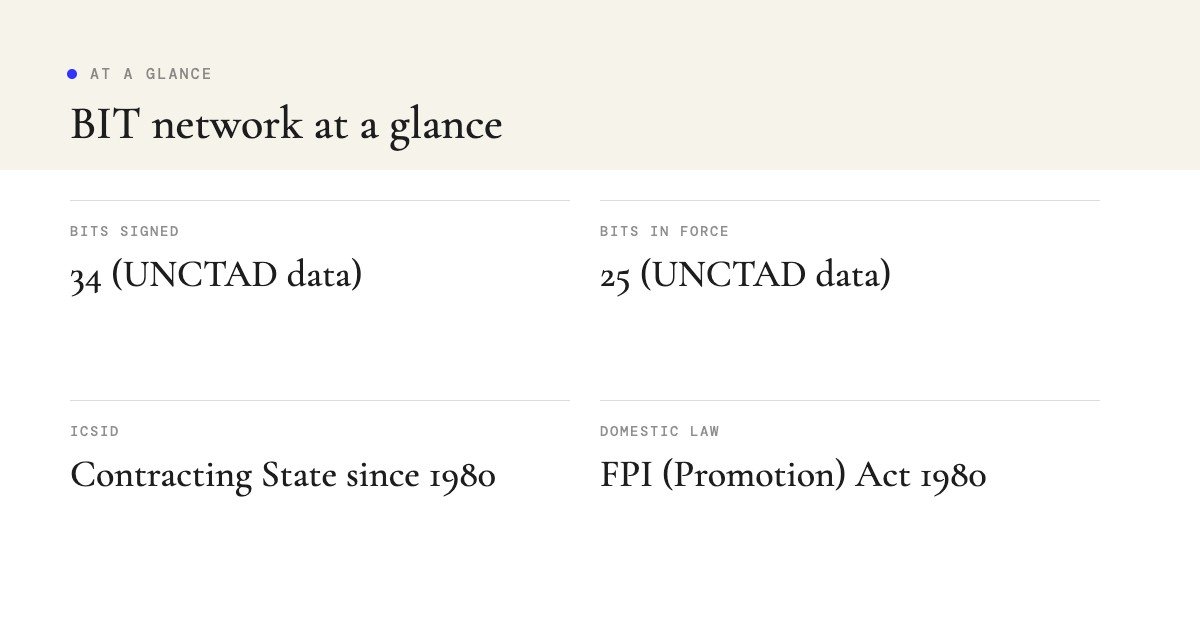
- UNCTAD lists 34 bilateral investment treaties signed by Bangladesh, of which 25 are in force, with partners including the UK, US, Germany, Japan, China, India, Singapore and the Netherlands.
- Typical protections are fair and equitable treatment, full protection and security, non-discrimination, compensation for expropriation and free transfer of funds.
- Most treaties allow investors to bring claims against Bangladesh before ICSID or an UNCITRAL tribunal after a cooling-off period.
- Treaty protection depends on nationality and structure; restructuring after a dispute is foreseeable rarely works.
- Domestic protection under the Foreign Private Investment (Promotion and Protection) Act 1980 runs alongside treaty rights.
Under the Invest Bangladesh Act 2026, effective 23 August 2026, the Bangladesh Investment Development Authority (BIDA), the Bangladesh Economic Zones Authority (BEZA) and the PPP Authority were merged into a single body, Invest Bangladesh. References below to BIDA, BEZA or the PPP Authority should be read as references to Invest Bangladesh. BEPZA continues as a separate authority.
What a bilateral investment treaty in Bangladesh does
A bilateral investment treaty (BIT) is an agreement between two States under which each promises to treat investors from the other State according to agreed standards. If the host State breaks those promises, the investor can usually claim compensation directly against the State before an international tribunal, without needing its own government to take up the case.
For a foreign investor, a bilateral investment treaty in Bangladesh works as an insurance policy written in international law. It does not replace the contract, the licence or domestic law. It adds a second layer of protection that applies when government action, such as cancelling a licence, refusing payment through State bodies or changing rules in an arbitrary way, destroys the value of an investment.
Treaty rights and contract rights
Contract claims and claims under a bilateral investment treaty in Bangladesh are different. A power purchase agreement with a State utility may give you contract claims under its own arbitration clause. A BIT gives you claims for breach of the State's international obligations. The same facts can support both, but the tribunals, the applicable law and the remedies differ, and some treaties force you to choose a single route.
The treaty network: who is covered
Bangladesh signed its first BIT, with the United Kingdom, in 1980. According to the UNCTAD Investment Policy Hub, Bangladesh has signed 34 BITs, of which 25 are in force, seven are signed but not in force, and two older treaties (with Thailand and Turkey) have been replaced. Figures change as treaties are signed or terminated, so check the treaty text and status before relying on it.
| Partner | Signed | In force | Notes |
|---|---|---|---|
| United Kingdom | 1980 | 1980 | Oldest treaty in the network |
| Germany | 1981 | 1986 | Common route for European investors |
| United States | 1986 | 1989 | Includes national and most-favoured-nation treatment |
| Italy | 1990 | 1994 | Treaty relied on in the Saipem claim |
| Netherlands | 1994 | 1996 | Often used for holding structures |
| China | 1996 | 1997 | Relevant to infrastructure and energy investment |
| Japan | 1998 | 1999 | Covers a major source of development investment |
| Singapore | 2004 | 2004 | Regional hub for holding companies |
| India | 2009 | 2011 | Clarified by joint interpretative notes in 2017 |
| United Arab Emirates | 2011 | 2013 | Relevant to Gulf investors |
| Turkey | 2012 | 2019 | Replaced the 1987 treaty |
Other treaties in force include those with Austria, Belgium-Luxembourg, Denmark, France, Indonesia, Iran, Korea, Malaysia, the Philippines, Poland, Romania, Switzerland, Thailand and Uzbekistan. Treaties signed but not yet in force include those with Bahrain, Belarus, Cambodia, Kuwait, Pakistan and Viet Nam.
Recent developments
On 9 September 2026, Hong Kong and Bangladesh signed an Investment Promotion and Protection Agreement covering fair and equitable treatment, compensation for expropriation, free transfers and dispute settlement by mediation and arbitration. It enters into force only after both sides complete their internal procedures, so it does not yet protect investors.
Core protections in a bilateral investment treaty in Bangladesh
Wording varies from one bilateral investment treaty in Bangladesh to another, and small drafting differences decide cases. The protections below appear in most treaties, but you must read the specific treaty that applies to your investment.
Fair and equitable treatment
Fair and equitable treatment (FET) is the standard most often invoked in investment arbitration worldwide. Tribunals have read it to protect against arbitrary or discriminatory conduct, denial of justice, lack of due process and, in some formulations, the frustration of legitimate expectations created by specific government assurances. Some newer treaties narrow FET to a defined list of breaches.
Full protection and security
This obligates the State to exercise due diligence to protect investments, traditionally against physical harm such as violence, riots or destruction of property. Some tribunals have extended it to legal security, but that wider reading depends on the treaty wording.
National treatment and most-favoured-nation treatment
Many treaties require Bangladesh to treat covered investors no less favourably than its own nationals (national treatment) or investors from any third State (most-favoured-nation treatment), in like circumstances. Some treaties limit these standards to investments already made, rather than the right to invest, and many carve out tax measures and regional economic arrangements.
Expropriation
Almost every BIT prohibits expropriation unless it is for a public purpose, non-discriminatory, carried out under due process and accompanied by compensation. Expropriation can be direct, such as nationalisation, or indirect, where measures deprive the investor of the use or value of the investment without formal transfer of title.
Free transfer of funds
Treaties usually guarantee the right to transfer capital, profits, dividends, loan repayments and sale proceeds in freely convertible currency, often subject to balance-of-payments safeguards and compliance with reporting rules. In practice, transfers still pass through Bangladesh Bank's foreign exchange framework, so documentation matters.
Umbrella clauses
Some treaties include a clause requiring the State to observe obligations it has entered into regarding investments. Where present, an umbrella clause may allow certain contract breaches by the State to be pursued as treaty breaches. Whether a given treaty has one, and how far it reaches, must be checked case by case.
Do not rely on a summary of "standard" protections. The difference between "fair and equitable treatment" and "fair and equitable treatment in accordance with customary international law", or between a broad and a narrow definition of investment, can decide whether you have a claim at all.
Who qualifies as an investor and an investment
A treaty claim fails at the first hurdle if the claimant is not a protected investor or the asset is not a protected investment. Each bilateral investment treaty in Bangladesh defines both terms, and the definitions differ.
Investor
Individuals usually qualify by nationality. Companies usually qualify by incorporation in the treaty partner, sometimes with an added requirement of a seat or substantial business activity there. Dual nationals and companies controlled by Bangladeshi nationals raise particular issues.
Investment
Most treaties use a broad asset-based definition covering shares, loans, movable and immovable property, contractual rights, concessions and intellectual property. Many require that the investment be made in accordance with the laws of Bangladesh. An investment made without required BIDA, Bangladesh Bank or sector approvals may therefore lose treaty protection.
Denial of benefits
Some treaties allow the State to deny benefits to a company that is owned or controlled by third-country nationals and has no substantial business activity in the treaty partner. Mailbox companies are vulnerable.
Structuring investments for treaty protection
Because the protection of a bilateral investment treaty in Bangladesh depends on nationality, investors often hold Bangladeshi operations through a company in a State with a strong treaty. Singapore, the Netherlands and the UK are common choices for regional holding structures, though tax, corporate and commercial factors matter just as much.
Timing is critical. Tribunals generally accept restructuring done for legitimate planning before a dispute arises. They regularly reject claims where the restructuring took place once a specific dispute was foreseeable, treating it as an abuse of process. Plan your position under a bilateral investment treaty in Bangladesh at the time of investment, not when a problem appears.
Investment structure also interacts with domestic approvals. Changes of shareholding may need BIDA notification, Bangladesh Bank reporting for foreign currency flows and RJSC filings. Our foreign direct investment practice handles these alongside treaty planning.
Domestic protection alongside treaties
Rights under a bilateral investment treaty in Bangladesh operate alongside domestic law. The Foreign Private Investment (Promotion and Protection) Act 1980 gives foreign private investment protection against expropriation and nationalisation without adequate compensation, and guarantees the repatriation of capital and returns, subject to the law. Investors in economic zones and export processing zones also rely on the Bangladesh Economic Zones Act 2010 and the zone authorities' rules.
Domestic protection can be enforced in Bangladeshi courts, including through writ petitions in the High Court Division against unlawful public action. A bilateral investment treaty in Bangladesh adds an international forum that is independent of the domestic courts, which is why investors in high-value or politically sensitive sectors value it.
How a treaty claim against Bangladesh works
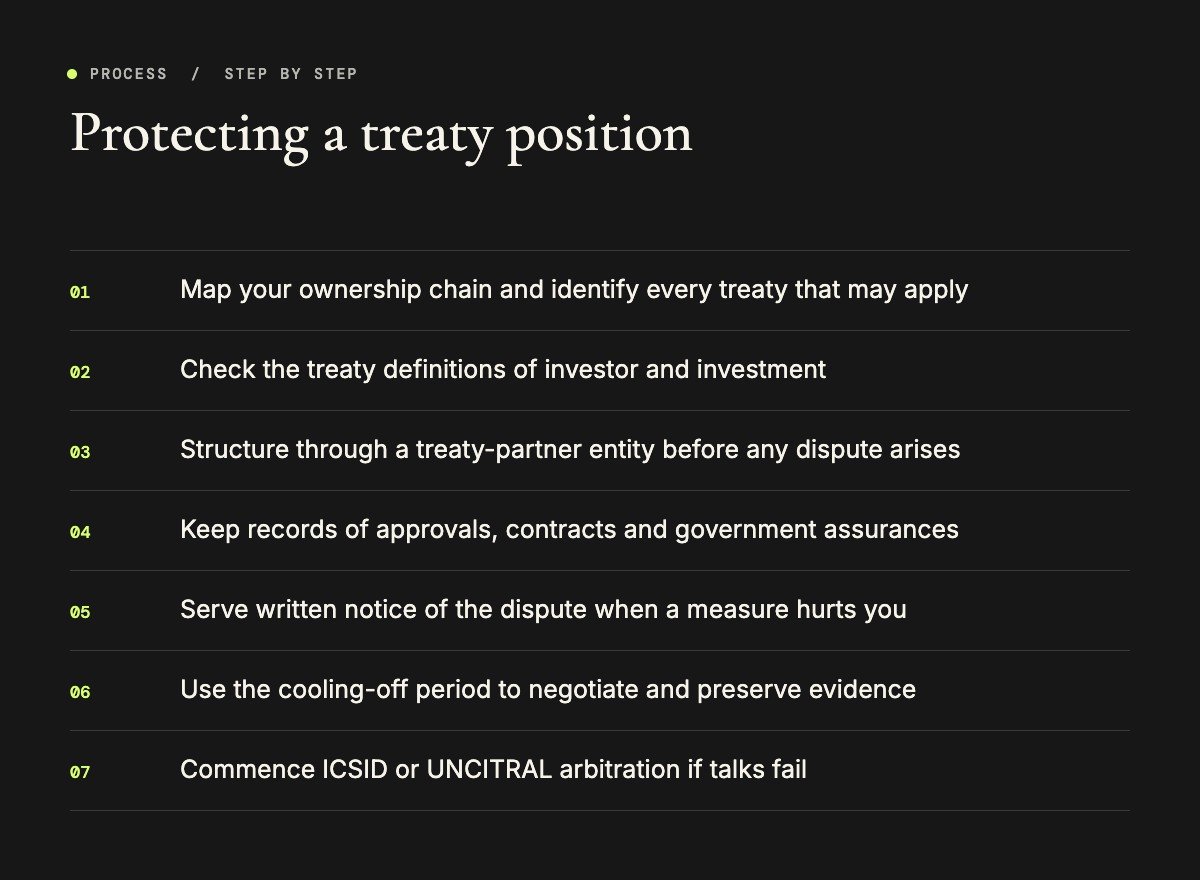
Almost every bilateral investment treaty in Bangladesh sets out a staged dispute process. The details differ, but the sequence below is typical.
- Identify the measure. Pinpoint the government act or omission complained of and the treaty standards it breaches.
- Serve notice. Send formal written notice of the dispute to the Government of Bangladesh, as the treaty requires.
- Observe cooling-off. Negotiate in good faith for the treaty period, often three to six months, before starting arbitration.
- Check preconditions. Some treaties require recourse to local courts for a period or contain a fork-in-the-road clause that makes a domestic court choice final.
- Choose the forum. File with ICSID or start ad hoc arbitration under the UNCITRAL Rules, depending on what the treaty offers.
- Constitute the tribunal. Each side normally appoints one arbitrator and the presiding arbitrator is agreed or appointed by an appointing authority.
- Enforce the award. ICSID awards are binding under the ICSID Convention; non-ICSID awards are enforced under the New York Convention.
ICSID and Bangladesh
Bangladesh is a Contracting State to the ICSID Convention, which it ratified in 1980. ICSID awards are not subject to review by national courts; the only post-award remedy is annulment by an ICSID ad hoc committee on narrow grounds. Every Contracting State must recognise an ICSID award as binding and enforce its pecuniary obligations as if it were a final judgment of its own courts.
Lessons from past cases
Bangladesh's best-known treaty case is Saipem v Bangladesh (ICSID Case No. ARB/05/7), brought under the Italy BIT. The tribunal held that Bangladeshi court decisions revoking the authority of an ICC tribunal, and treating the resulting ICC award as a nullity, amounted to an expropriation of the investor's rights under the award. The case is cited worldwide on how national court interference with arbitration can breach investment treaties.
Other well-known disputes involving Bangladesh, including the Niko cases at ICSID, arose from contracts with State entities rather than BITs, which shows how contract and treaty routes sit side by side in the energy sector.
Practical steps for investors before a dispute
Most treaty cases are won or lost on documents created long before the dispute. Investors relying on a bilateral investment treaty in Bangladesh should build the record from day one.
- Keep approvals. Retain BIDA registrations, sector licences, Bangladesh Bank permissions and board resolutions showing the investment was lawfully made.
- Record assurances. Specific written assurances from ministries or regulators are far stronger evidence of legitimate expectations than general policy statements.
- Track capital. Keep evidence of every inward remittance, encashment certificate and capital contribution.
- Engage early. Raise concerns in writing with the responsible authority; a measured paper trail helps both settlement and any later claim.
- Avoid waivers. Be careful with settlement agreements or court filings that might waive treaty rights or trigger a fork-in-the-road clause.
Sector focus: energy, infrastructure and PPP projects
Treaty protection matters most where investors deal directly with the State. In Bangladesh that means power generation, LNG and gas, ports, telecoms and public-private partnership projects, where the counterparty is often a State utility or authority and the project depends on licences, tariffs and payment by public bodies.
The repeal of the Quick Enhancement of Electricity and Energy Supply (Special Provisions) Act 2010 by ordinance in late November 2024, with existing contracts remaining valid subject to government review, is a reminder that the legal framework around State contracts can shift. When contracts are reviewed, renegotiated or terminated, investors should assess both their contractual remedies and whether a bilateral investment treaty in Bangladesh adds protection, for example against arbitrary or discriminatory treatment.
Project documents should be drafted with treaties in mind: stabilisation and change-in-law clauses, a neutral arbitration seat, express consent to ICSID jurisdiction where possible, and clear rules on the effect of any treaty claim on contract remedies.
Choosing your route: contract, court or treaty
When a State measure harms an investment, investors usually have several options, and they are not mutually exclusive. The right sequence depends on the treaty, the contract and the commercial relationship.
| Route | Best suited to | Main limitation |
|---|---|---|
| Negotiation with the ministry or authority | Preserving an operating business and licences | No binding outcome without a signed settlement |
| Writ petition in the High Court Division | Unlawful or arbitrary public action needing quick relief | Domestic forum; may trigger a fork-in-the-road clause |
| Contract arbitration | Payment and performance disputes with a State entity | Limited to contract rights and the contracting entity |
| Treaty arbitration | Measures by the State that breach international standards | Slow, costly and dependent on investor nationality |
A bilateral investment treaty in Bangladesh is therefore one tool among several. Mapping all routes at the outset helps avoid steps, such as a domestic filing, that might close the treaty route later.
Limits and risks of treaty claims
Arbitration under a bilateral investment treaty in Bangladesh is powerful but slow and expensive. Cases commonly run for several years, and costs for counsel, experts and the tribunal are substantial. Tribunals may award costs against an unsuccessful claimant.
A claim against the host State can also affect an ongoing business relationship, licences and future approvals. Many investors use the treaty as leverage in negotiation and commence arbitration only when the investment is already lost or talks have broken down. Collecting on an award against a State may require enforcement proceedings in several countries, and assets used for sovereign purposes are generally immune from execution.
Frequently asked questions about a bilateral investment treaty in Bangladesh
How many investment treaties does Bangladesh have?
The UNCTAD Investment Policy Hub lists 34 BITs signed by Bangladesh, 25 of them in force. A new agreement with Hong Kong was signed in September 2026 but is not yet in force.
Can a Bangladeshi company owned by foreigners bring a treaty claim?
Usually the foreign parent brings the claim, as the protected investor, for harm to its shares and the local company's assets. The ICSID Convention also allows a locally incorporated company under foreign control to be treated as foreign if the parties agree.
Do I have to go to Bangladeshi courts first?
It depends on the wording of the bilateral investment treaty in Bangladesh that applies. Some require a period of local litigation or negotiation, others allow arbitration after a cooling-off period, and some contain a fork-in-the-road clause.
Can I restructure to get treaty protection after a problem starts?
Tribunals generally refuse jurisdiction where restructuring took place once a specific dispute was foreseeable. Plan structure at the time of investment.
Is an ICSID award enforceable in Bangladesh?
As an ICSID Contracting State, Bangladesh must recognise ICSID awards as binding and enforce their pecuniary obligations. Domestic enforcement procedure for ICSID awards has had little testing, so take advice on the route.
How we can help
We advise foreign investors on coverage under each bilateral investment treaty in Bangladesh when they structure investments, assess claims when government measures cause loss, and work with international counsel on notices, negotiations, ICSID and UNCITRAL proceedings and enforcement. Learn more about our investment treaty arbitration practice.
Worried about government action affecting your investment?
We review your structure, identify the treaties that may protect you and set out the options before deadlines and waivers bite.
Book a consultationTreaty arbitration practicePrimary sources: the ICSID Convention and case records; the UNCITRAL Arbitration Rules; investment registration with BIDA; treaty texts and status as listed by the UNCTAD Investment Policy Hub; the Foreign Private Investment (Promotion and Protection) Act 1980 on the Laws of Bangladesh portal.
This article is general information about Bangladeshi and international investment law as of 2026 and is not legal advice. Treaty texts differ and their status changes; confirm the applicable treaty and current position with a qualified lawyer before acting.

0 Comments