
Mediation in Bangladesh is no longer an optional courtesy. Civil suits, loan recovery cases, family disputes and, since 2025 and 2026, many pre-case and commercial claims now pass through a mediation stage. Used well, it can end a dispute in weeks instead of years; used badly, it is just another delay.
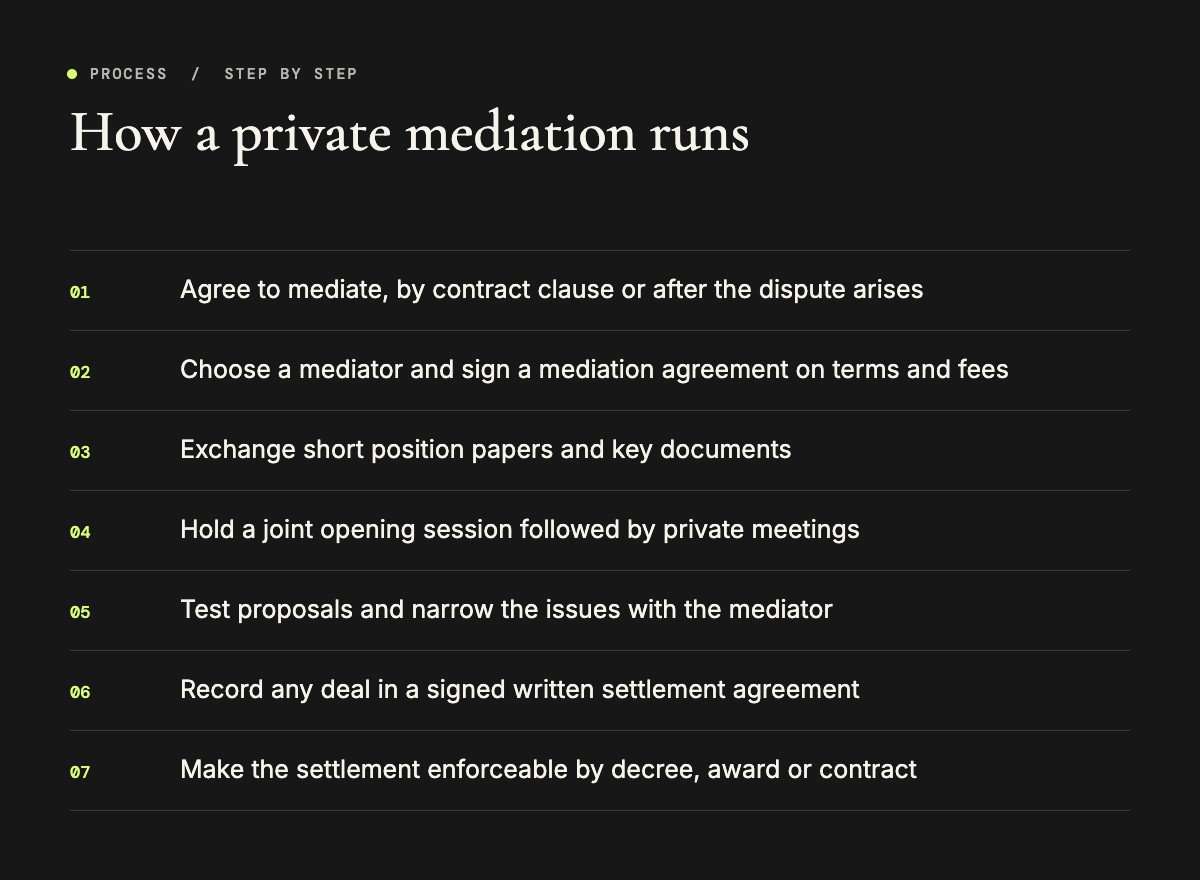
- Sections 89A and 89C of the Code of Civil Procedure 1908 provide for mediation at the trial and appellate stages of civil suits.
- Money loan courts refer cases to mediation after the written statement, with a 60-day period extendable by 30 days.
- The Legal Aid Services (Amendment) Ordinance 2025 made pre-case mediation through legal aid offices compulsory for listed disputes.
- The Commercial Court Ordinance 2026 provides for pre-suit mediation in commercial disputes.
- A private settlement should be turned into a decree, consent award or carefully drafted contract so that it can be enforced.
What mediation in Bangladesh means
Mediation is a structured negotiation led by a neutral third person, the mediator, who helps the parties reach their own settlement. The mediator does not decide who is right and cannot impose an outcome. That is the key difference from arbitration or a court trial.
In practice, mediation in Bangladesh takes two broad forms. Court-annexed mediation happens inside a pending case, because a statute requires the court to refer the dispute. Private mediation happens because the parties agree to it, either in their contract or after a dispute arises, and is run by a mediator or institution they choose.
Why it matters now
Court backlogs are severe, and reform since 2024 has pushed mediation earlier in the life of a dispute. For businesses and individuals, that means mediation is often a step you cannot skip, so it pays to prepare for it properly rather than treat it as a formality.
The legal framework at a glance
There is no single statute governing mediation in Bangladesh. Instead, mediation provisions appear across procedural and subject-specific laws. The table summarises the main routes.
| Route | Legal basis | When it happens | Key feature |
|---|---|---|---|
| Civil suits | Code of Civil Procedure 1908, s.89A | After the written statement | Court refers the dispute to mediation |
| Civil appeals | Code of Civil Procedure 1908, s.89C | At the appellate stage | Appellate court may settle by mediation |
| Loan recovery | Artha Rin Adalat Ain 2003 | After the written statement, also later stages | 60 days plus up to 30 days |
| Pre-case disputes | Legal Aid Services Act 2000, as amended in 2025 | Before filing listed cases | Run by legal aid offices |
| Family disputes | Family Courts Act 2023 | Before and during trial | Reconciliation stages built into procedure |
| Commercial disputes | Commercial Court Ordinance 2026 | Before filing a commercial suit | Pre-suit mediation in the new courts |
| Industrial disputes | Bangladesh Labour Act 2006, s.210 | Before strike, lockout or Labour Court | Conciliation by a government conciliator |
| Private and institutional | Contract; institutional rules | Any time the parties agree | Flexible, confidential, party-chosen mediator |
Court-annexed mediation in civil suits
The Code of Civil Procedure (Amendment) Act 2003 introduced section 89A, allowing courts to refer pending civil suits to mediation after the written statement is filed. A 2012 amendment replaced the discretionary "may" with "shall" in sections 89A and 89C, so that mediation became a standard stage of civil litigation. Commentators have noted that the mandatory effect depends on the government notification provided for in the Code, so check how the courts in your district apply it.
Who mediates
The court may conduct mediation itself, refer the dispute to the parties' lawyers or the parties, or appoint a mediator from a panel maintained by the District Judge. Panels typically include senior lawyers and retired judges. Legal aid officers have also been brought into court mediation work since 2017.
Timeline and outcome
Mediation under section 89A must generally be completed within 60 days of the mediator's appointment, extendable by 30 days. If the parties settle, the court records the compromise and passes a decree or order in its terms. If mediation fails, the suit proceeds to trial, and the judge who attempted mediation does not hear the case afterwards.
Everything said in mediation is confidential and cannot be used as evidence at trial. Where a suit settles through mediation, the law also provides for a refund of court fees in qualifying cases; ask your lawyer whether the refund conditions are met.
Appellate mediation
Section 89C extends the same idea to appeals. An appellate court can refer the dispute to mediation, and a settlement at that stage ends both the appeal and the underlying dispute. Parties who lost at trial often have more appetite for settlement at this point.
Mediation in money loan courts
Loan recovery is one of the busiest areas for mediation in Bangladesh. Recovery suits by banks and financial institutions go to the Artha Rin Adalat. Under section 22 of the Artha Rin Adalat Ain 2003, once the defendant files a written statement, the court refers the case to mediation. The parties may appoint as mediator a lawyer not engaged in the suit, a retired judge, a retired banker or another suitable person, and they agree the mediator's fees between themselves.
Mediation must finish within 60 days of the order, extendable by up to 30 days. Failed mediation can be attempted again before judgment under section 23, and mediation is also possible after decree under section 38 and in appeals or revisions under section 44A. For large claims, commentators note that a settlement above Tk 5 crore needs approval from the lender's managing director or chief executive, which can slow deals.
For borrowers, mediation is often the best chance to agree rescheduling or a structured payment plan before a decree and execution. For lenders, it can recover cash faster than a contested sale of mortgaged property.
Pre-case mediation through legal aid
The biggest recent change to mediation in Bangladesh is the Legal Aid Services (Amendment) Ordinance 2025, which took effect on 1 July 2025. It added a schedule of disputes for which mediation through the district legal aid office must be attempted before a case is filed. Reporting identifies the listed matters as family disputes under the Family Courts Act 2023, house rent disputes under the House Rent Control Act 1991, partition suits in Assistant Judge courts, pre-emption claims, maintenance of parents, dowry complaints under the Dowry Prohibition Act 2018 and certain complaints under the Women and Children Repression Prevention Act 2000.
The scheme started in 12 districts from 18 September 2025. A settlement signed by the parties and certified by the chief legal aid officer is reported to be final, binding and enforceable like a court order. If mediation fails, the dispute can then go to court.
The 2025 change was made by ordinance. Many ordinances were re-enacted, amended or dropped by Parliament in April 2026, and we could not confirm the current status of this one or whether it has been extended beyond the first 12 districts. Check with the district legal aid office or the National Legal Aid Services Organisation before filing a listed case.
Mediation in family disputes
Family courts have long had reconciliation, an early form of mediation in Bangladesh, built into their procedure. Under the Family Courts Act 2023, which replaced the Family Courts Ordinance 1985, the court attempts reconciliation before trial and may try again after evidence and before judgment. Dower, maintenance, restitution of conjugal rights, guardianship and custody disputes often settle at these stages.
Because family cases now also fall within the legal aid pre-case mediation scheme, many such disputes will meet a mediator before they meet a judge. Settlements on maintenance and custody should be precise about amounts, dates and contact arrangements to avoid fresh disputes. Our guide to divorce under Muslim law covers related procedure.
Mediation in commercial disputes
Commercial parties are increasingly using mediation in Bangladesh, whether because a contract requires it, because the new commercial court regime builds in pre-suit mediation, or simply to preserve a valuable relationship.
Under the Commercial Court Ordinance 2026
The Commercial Court Ordinance 2026 provides for pre-suit mediation before a commercial suit is filed in the new commercial courts. Reporting on the ordinance describes it as a precondition, but the detailed procedure and any rules should be checked in the current text. The ordinance was made in January 2026, and we could not confirm whether Parliament has re-enacted it.
Mediation clauses
Well-drafted contracts often contain a tiered clause: negotiation between senior managers, then mediation within a fixed period, then arbitration or litigation. A good clause names the institution or appointing body, fixes time limits and says that either party may start arbitration or seek urgent relief without waiting if a limitation period or asset risk demands it.
Institutional mediation
The Bangladesh International Arbitration Centre (BIAC) offers institutional mediation alongside arbitration. Cross-border parties also use international providers. Institutional support helps with mediator appointment, scheduling, venues and fee administration.
Industrial disputes and conciliation
Collective disputes between employers and workers follow their own route, with conciliation playing the role that mediation in Bangladesh plays elsewhere. Under section 210 of the Bangladesh Labour Act 2006, an industrial dispute must go through bipartite negotiation and then conciliation by a conciliator appointed by the government before a lawful strike or lockout, or a reference to arbitration or the Labour Court. The Labour (Amendment) Act 2026 made extensive changes to the Act, so confirm current timelines in the gazetted text.
Individual employment disputes, such as termination claims, are different and usually go to the Labour Court after a grievance notice. Mediation can still be useful there to agree terminal benefits.
How a private mediation runs
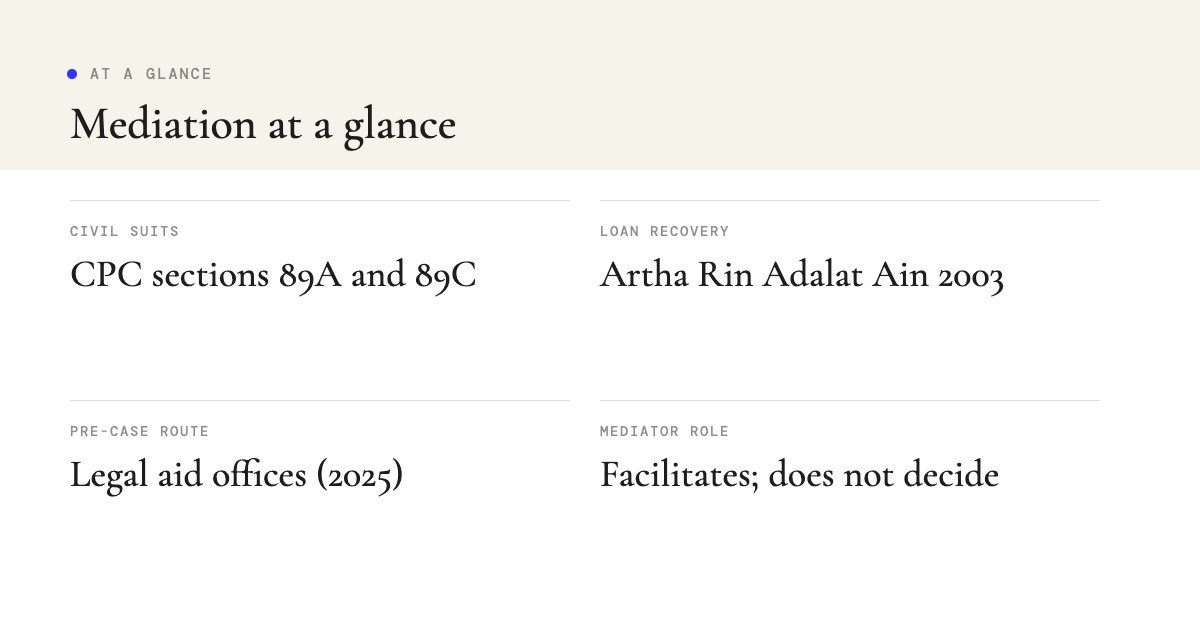
Private mediation in Bangladesh is flexible, but a clear structure gives the best chance of settlement. A typical process looks like this.
- Agree to mediate. Rely on the contract clause or sign a short submission agreement after the dispute arises.
- Appoint the mediator. Choose someone with subject-matter knowledge and settlement experience, and sign a mediation agreement covering fees, confidentiality and authority to settle.
- Prepare. Exchange short position papers and the key documents; avoid burying the mediator in paper.
- Open jointly. Each side briefly explains its position and interests in a joint session.
- Work in private sessions. The mediator meets each side separately to test arguments, explore options and carry proposals.
- Close the deal. Put any agreement in writing and have it signed on the day, even if a fuller document follows.
- Make it enforceable. Record the settlement as a compromise decree, a consent award or an enforceable contract with security.
Choosing a mediator and managing costs
For court-annexed mediation in Bangladesh, the court's panel or the statute narrows the choice. In private mediation, the parties choose, and the choice of mediator is often the single biggest factor in whether a deal is reached.
What to look for
- Neutrality. No prior relationship with either side, and full disclosure of any links.
- Relevant knowledge. Construction, banking, family or shareholder disputes each benefit from a mediator who understands the commercial or personal context.
- Settlement skill. A former judge or senior lawyer brings authority, but mediation technique matters as much as seniority.
- Language and format. Confirm the mediator can work in Bangla and English and handle online sessions where parties are abroad.
Costs and timing
Mediator fees in private mediation in Bangladesh are agreed between the parties and the mediator, usually as a daily or session rate shared equally. In the money loan courts, too, the Act leaves fees to agreement. Court-annexed mediation under the Code of Civil Procedure is generally low cost, and pre-case mediation through legal aid offices is designed to be free or close to it for eligible parties.
Most commercial mediations in Bangladesh need one to three sessions after preparation. Compared with years of litigation, even a fully paid private mediation is usually a modest expense, provided both sides come prepared to negotiate.
Enforcing a mediated settlement
A settlement reached in court-annexed mediation in Bangladesh becomes a decree or order of the court, enforceable like any other decree. A private settlement is, by default, a contract: if one side breaks it, the other must sue on the contract.
To strengthen enforcement, parties often record a private settlement as a compromise decree in a pending suit, ask an arbitral tribunal to record it as a consent award under the Arbitration Act 2001, or back it with security such as post-dated payment instruments, guarantees or mortgages. Our guide to the arbitration process in Bangladesh explains how consent awards fit in.
Cross-border settlements
The Singapore Convention on Mediation provides for direct enforcement of international mediated settlements between contracting States. As far as we can verify, Bangladesh has not signed it. A cross-border settlement involving a Bangladeshi party should therefore be structured for enforceability, typically as a consent award in an arbitration so that the New York Convention applies.
Preparing well for mediation in Bangladesh
The parties, not the mediator, decide whether mediation in Bangladesh succeeds. Preparation makes the difference.
- Bring decision-makers. Send someone with authority to settle, or at least direct access to the person who has it.
- Know your alternatives. Assess the realistic cost, time and risk of trial or arbitration before you arrive.
- Focus on interests. Payment timing, future business, confidentiality or reputation may matter more than the headline figure.
- Keep options open. Instalments, set-off, supply credits or rescheduling can bridge gaps that a single number cannot.
- Use lawyers well. Counsel should advise on risk and draft the settlement, not turn mediation into a mini-trial.
Frequently asked questions about mediation in Bangladesh
Is mediation compulsory in civil cases?
Sections 89A and 89C of the Code of Civil Procedure provide for mediation after the written statement and on appeal, and the 2012 amendment made referral the default. Practice varies by court, so check how your court applies it.
How long does court-annexed mediation take?
Under the CPC and the Artha Rin Adalat Ain, mediation should normally finish within 60 days, with a possible 30-day extension.
Is what I say in mediation confidential?
Yes. Statements and offers made in mediation are confidential and cannot be used as evidence if the case goes to trial.
Which disputes need legal aid mediation before filing?
Under the 2025 ordinance, listed disputes include family matters, house rent, partition, pre-emption, parents' maintenance, dowry and certain women and children cases. Confirm the current list and districts with the local legal aid office.
Can a foreign company mediate a dispute in Bangladesh?
Yes. Private and institutional mediation in Bangladesh is open to foreign parties, and online sessions are common. Plan how any settlement will be enforced, ideally through a consent award.
What if the other side breaks the settlement?
A court-recorded settlement can be executed as a decree. A private settlement must be enforced as a contract unless it was recorded as a consent award or decree.
How we can help
We represent clients in every form of mediation in Bangladesh, including court-annexed, legal aid and private mediation, act as counsel in commercial and family settlements, draft tiered dispute resolution clauses and turn settlements into enforceable decrees and consent awards. Learn more about our mediation and ADR practice.
Want to settle a dispute without a long trial?
We assess your position, prepare you for mediation and make sure any settlement can actually be enforced.
Book a consultationMediation and ADR practicePrimary sources: the Code of Civil Procedure 1908, Artha Rin Adalat Ain 2003 and Legal Aid Services Act 2000 on the Laws of Bangladesh portal; the National Legal Aid Services Organisation; the UNCITRAL texts on international mediation.
This article is general information about Bangladeshi law as of 2026 and is not legal advice. Mediation rules changed significantly in 2025 and 2026 and may change again; confirm the current law and procedure with official sources or a qualified lawyer before acting.

0 Comments