
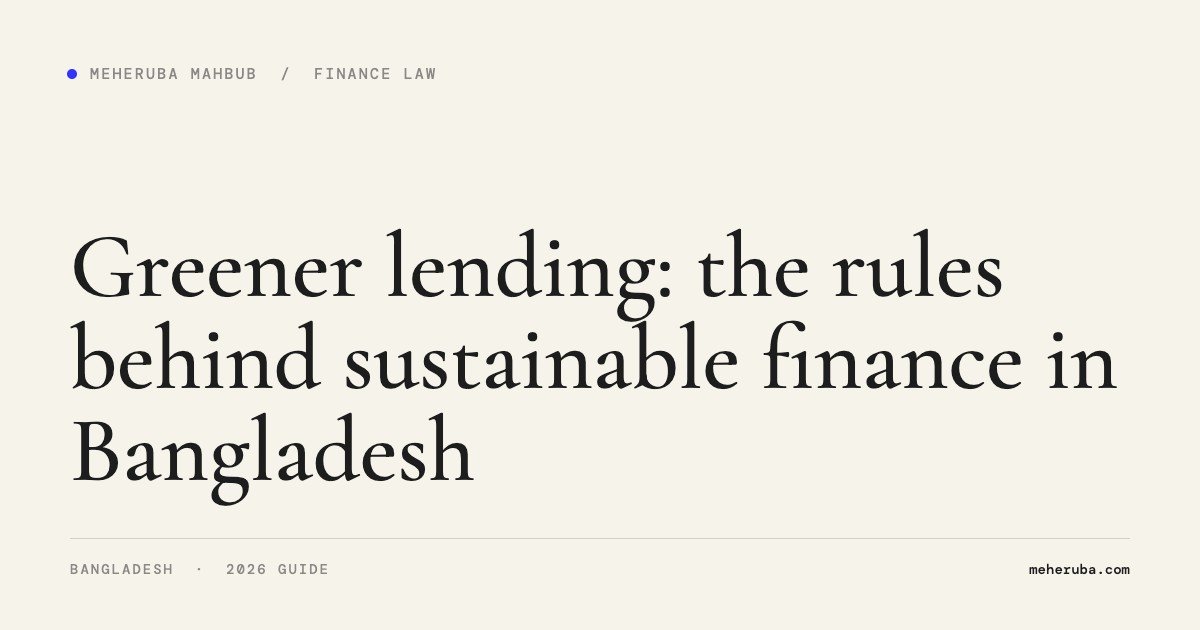
Green finance in Bangladesh is no longer a voluntary add-on for banks. Bangladesh Bank requires every bank and finance company to lend a set share of its book to green and sustainable projects, defines what counts through a taxonomy, and offers cheap refinance to borrowers who qualify.
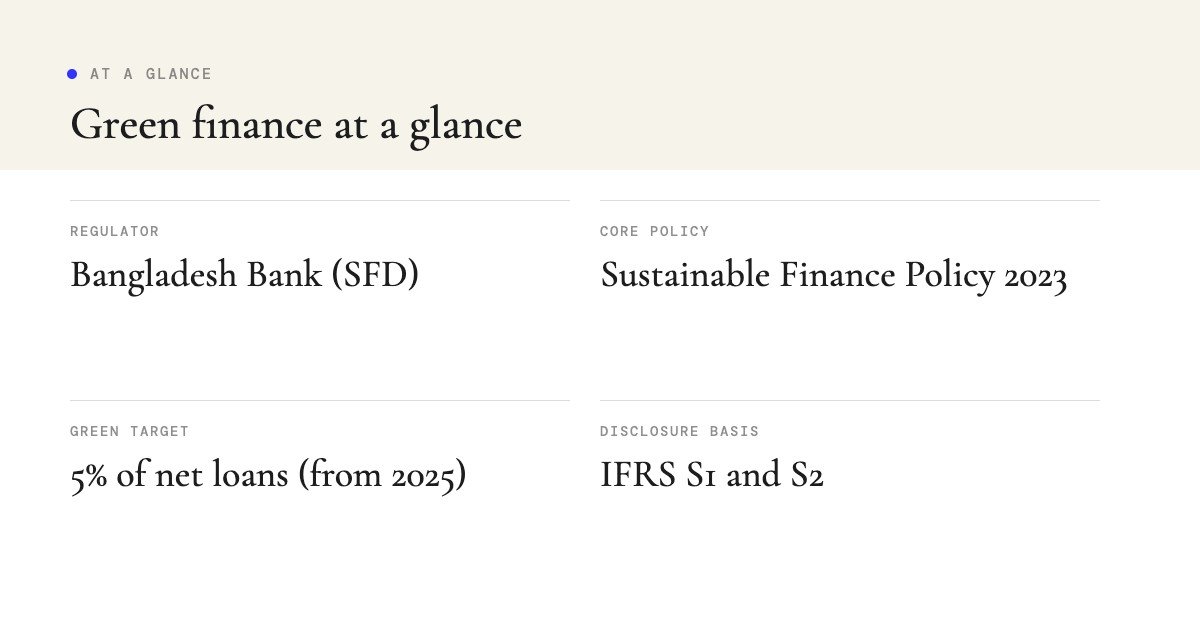
- The Sustainable Finance Policy for Banks and Financial Institutions, issued by SFD Circular No. 03 of 22 October 2023, is the core rulebook; it replaced the 2020 policy.
- From 2025, banks and finance companies are expected to direct at least 5% of net loans and advances to green finance and 40% to sustainable finance.
- A project counts as green only if it fits the taxonomy, contributes substantially to an environmental objective, does no significant harm to the others and meets minimum safeguards.
- Bangladesh Bank refinance windows, including a Tk 1,000 crore line launched in May 2026 from the Green Transformation Fund, can cut borrowing costs sharply.
- Banks must disclose climate-related information under a guideline based on IFRS S1 and S2, starting with financial years from January 2024.
Under the Invest Bangladesh Act 2026, effective 23 August 2026, the Bangladesh Investment Development Authority (BIDA), the Bangladesh Economic Zones Authority (BEZA) and the PPP Authority were merged into a single body, Invest Bangladesh. References below to BIDA, BEZA or the PPP Authority should be read as references to Invest Bangladesh. BEPZA continues as a separate authority.
Non-bank financial institutions are now governed by the Finance Company Act 2023, which replaced the Financial Institutions Act 1993; such institutions are now called finance companies. References below to the 1993 Act should be read accordingly.
What green finance in Bangladesh means
In everyday use, "green finance" is any loan, bond or investment that funds an environmentally beneficial project: solar panels on a factory roof, an effluent treatment plant, an energy-efficient boiler, a certified green building. For green finance in Bangladesh, though, the term has a regulatory meaning. Bangladesh Bank decides what a bank may report as green, and banks are measured against targets on that basis.
The policy uses three related labels. Sustainable finance is the widest; it covers sustainable agriculture, cottage, micro, small and medium enterprises (CMSMEs), socially responsible finance and other sustainability-linked lending, as well as green finance. Green finance is a narrower category of projects with clear environmental benefits. Climate finance looks at mitigation, adaptation and loss and damage, and links lending to Bangladesh's climate commitments.
For a borrower, the label matters for three reasons. A green loan may be eligible for cheaper refinance. A bank chasing its target may compete harder for the loan. And mislabelled lending can be reversed by Bangladesh Bank, with consequences for both sides.
The legal framework for green finance in Bangladesh
There is no standalone statute on green finance in Bangladesh. The rules are made by Bangladesh Bank under its general powers over banks and finance companies, chiefly the Bangladesh Bank Order 1972, the Bank Company Act 1991 and the Financial Institutions Act 2023. They are administered by the central bank's Sustainable Finance Department (SFD).
The main instruments
- Sustainable Finance Policy for Banks and Financial Institutions (October 2023). Issued by SFD Circular No. 03 of 22 October 2023, replacing SFD Circular No. 05 of 30 December 2020. It contains the sustainable finance taxonomy, the green taxonomy, the climate finance framework, targets and the rating methodology.
- Guidelines on Environmental and Social Risk Management (ESRM). Set out how banks screen and monitor the environmental and social risks of the projects they fund, using a due diligence tool.
- Guideline on Sustainability and Climate-related Financial Disclosure. Issued by SFD Circular No. 06 of 26 December 2023, based on IFRS S1 and IFRS S2.
- Refinance scheme circulars. Each Bangladesh Bank refinance window has its own circular setting eligibility, rates and tenors.
Outside banking regulation, environmental law sets the baseline. The Environment Conservation Act 1995 and the Environment Conservation Rules 2023 decide which projects need an environmental clearance certificate and in which category (green, yellow, orange or red). Banks rely on that clearance when they assess a project.
The January 2026 clean-up
In January 2026, SFD issued a further circular revoking parts of the 2023 policy and reclassifying several products to curb greenwashing. Health services in climate-vulnerable areas, maritime transport with low environmental due diligence ratings and certain IT solutions moved out of green finance into other sustainability-linked categories, while digital loans delivered through mobile financial services to climate-vulnerable areas (other than consumer finance) became green. Read the circular itself before relying on any classification, because the lists are detailed.

Sustainable finance and green finance targets
The central feature of green finance in Bangladesh is that targets are mandatory. Bangladesh Bank data reported in 2025 show that, from 2025, banks and finance companies are expected to set green finance at no less than 5% and sustainable finance at no less than 40% of their net loans and advances outstanding. For 2025 that translated into an industry-wide green finance target of about Tk 678 billion.
Performance feeds into Bangladesh Bank's annual sustainability rating of banks and finance companies, which looks at sustainable and green finance, green refinance, corporate social responsibility, core banking sustainability and green governance. A poor rating is reputational, and the policy also deals with consequences of non-compliance and rewards for strong performers.
Targets give borrowers leverage. A bank that is below its green finance target has a reason to price an eligible loan keenly. If your project qualifies, say so early, with the taxonomy item it falls under, and ask the bank how it will report the facility.
The green taxonomy: what qualifies
A loan does not become part of green finance in Bangladesh because the borrower says so. Under the 2023 policy, a project must pass a sequence of tests before a bank can count it.
- Exclusion list. The project must not be on the list of activities banks may not finance.
- Taxonomy fit. It must match an item in the green taxonomy, which lists 94 green products and projects for term finance, alongside green bonds, green investment and the greening of polluting industries.
- Substantial contribution. It must contribute substantially to at least one of six environmental objectives, such as climate change mitigation or pollution prevention.
- No significant harm. It must not significantly harm the other objectives.
- Minimum safeguards. It must meet basic social and governance standards.
Typical eligible projects
| Sector | Examples of eligible projects | Evidence banks usually ask for |
|---|---|---|
| Renewable energy | Rooftop and ground-mounted solar, biogas, solar irrigation | Technical specification, capacity, generation estimate |
| Energy efficiency | Efficient boilers, chillers, motors, LED retrofits | Energy audit, before-and-after consumption data |
| Pollution control | Effluent treatment plants, waste-to-resource, recycling | Environmental clearance, design, monitoring plan |
| Green buildings | Factories and offices meeting recognised green building standards | Certification or pre-certification documents |
| Water efficiency | Water recycling, rainwater harvesting, low-water processes | Water audit and projected savings |
| Climate resilience | Adaptation projects in climate-vulnerable areas | Location data and risk assessment |
The table is a guide, not the taxonomy itself. The definitive list, with thresholds and conditions, is in the policy annexes as amended in 2026.
Refinance schemes: cheaper money for green projects
Bangladesh Bank supports green finance in Bangladesh by lending to banks at low rates so that they can lend on cheaply to eligible borrowers. The schemes change often, but the structure is consistent: the central bank sets a maximum rate the borrower pays, a lower rate the bank pays, an eligibility list and a tenor.
The Green Transformation Fund
The Green Transformation Fund (GTF) began as a foreign currency facility for export-oriented manufacturers importing green machinery and now includes a Tk 5,000 crore taka fund. On 11 May 2026, Bangladesh Bank carved out a Tk 1,000 crore refinance line from it for rural and local industries. According to reports on the circular:
- borrowers pay no more than 5%, and participating banks pay 1% to Bangladesh Bank;
- individual entrepreneurs may borrow up to Tk 5 crore, and banks may finance up to 80% of the import or purchase cost;
- projects must source at least 10% of their electricity from renewables, and loan defaulters are excluded;
- tenors run from two to five years, including a grace period of up to six months;
- state-owned banks may participate, as may private and foreign banks with a non-performing loan ratio below 20%.
Other green refinance lines
Separate refinance schemes have long covered listed green products such as solar systems, biogas plants, effluent treatment and energy-efficient technology, and there are technology development and climate-resilience funds. Rates and limits are revised by circular, so ask your bank which window is currently open and what it pays.
Environmental and social due diligence
Due diligence is a fixed part of green finance in Bangladesh. Every bank must assess environmental and social risk before lending, whether or not the loan is labelled green. Under the ESRM guidelines, the bank screens the project against the exclusion list, rates its risk with an environmental and social due diligence (ESDD) tool, and sets conditions in the loan documents.
For borrowers, the practical consequences are predictable. Expect to provide the environmental clearance certificate and any renewal, fire and building approvals, effluent and emissions test results, and information on labour and community issues. High-risk projects will carry covenants on compliance, reporting and site visits, and a breach of those covenants can be an event of default. Our guide to getting an environment licence in Bangladesh explains the clearance process.
Many borrowers apply for a green loan while their environmental clearance has lapsed or no longer matches the plant's capacity. Banks will not count the loan as green, and may not lend at all, until the clearance is put right. Check it before you apply.
How to obtain green finance in Bangladesh, step by step
The process for a green term loan or refinance facility follows a familiar pattern at most banks. Preparation is what separates a quick approval from months of back and forth.
- Classify the project. Identify the taxonomy item it falls under and confirm it is not excluded.
- Fix the regulatory basics. Make sure the environmental clearance, trade licence, factory and fire approvals are valid and match the project.
- Build the technical case. Prepare specifications, quotations and data on expected energy, emissions or water savings.
- Approach the bank. Ask how it will classify the loan and whether a refinance window is available and has capacity.
- Complete due diligence. Answer the bank's ESDD questionnaire and host any site visit.
- Negotiate the documents. Review green-use covenants, reporting duties, and what happens if the loan is later reclassified.
- Report after drawdown. Provide utilisation evidence and periodic performance data for the life of the facility.
Green bonds and sukuk
Capital markets offer a second route to green finance in Bangladesh for larger issuers. Debt securities, including green bonds, are regulated by BSEC under the BSEC (Debt Securities) Rules 2021. The market is still small, but there have been landmark issues, including a green sukuk in 2021.
In September 2025, BSEC published a draft amendment to the Debt Securities Rules to define green and social bonds more closely and to introduce sustainability, gender and orange bonds, with reporting, monitoring and disclosure duties for issuers. We have not been able to confirm whether the amendment has been finalised, so check the current text with BSEC before structuring an issue. Separately, Bangladesh Bank has issued guidance on banks' participation in green bonds.
What issuers should prepare
- a green bond framework explaining eligible use of proceeds, project selection, management of proceeds and reporting;
- an external review or second-party opinion, which investors expect even where it is not mandatory;
- a reporting plan for allocation and impact over the life of the bond.
For listed companies, our debt capital markets practice covers the BSEC approval route.
Climate disclosure for banks and finance companies
Disclosure is the newest strand of green finance in Bangladesh. SFD Circular No. 06 of 26 December 2023 introduced the Guideline on Sustainability and Climate-related Financial Disclosure for Banks and Finance Companies, based on IFRS S1 and IFRS S2.
Disclosures go in the annual report, starting with financial years from January 2024 and phasing in over three years. Regulatory templates are submitted to Bangladesh Bank twice a year, and the reported information is subject to limited assurance. In addition, under the Sustainable Finance Policy, banks publish a sustainability report and disclose sustainable finance activity and the environmental performance of major clients.
The practical effect for corporate borrowers is a rising flow of questions from lenders about emissions, energy use and climate risk. Companies that can answer them cleanly will find green finance in Bangladesh easier and cheaper to obtain.
Greenwashing and legal risk
As targets bite, the temptation to stretch the label of green finance in Bangladesh grows. The January 2026 reclassification shows Bangladesh Bank is watching. The risks fall on both sides.
For banks
A bank that reports ineligible loans as green may have them reclassified, lose the benefit for target purposes, face recovery of refinance it drew, and suffer a lower sustainability rating. Persistent misreporting can lead to supervisory action under the Bank Company Act 1991 or the Financial Institutions Act 2023.
For borrowers
A borrower who used green loan proceeds for something else, or gave inaccurate project information, may breach its loan covenants. Refinance-backed loans usually allow the bank to reprice to a commercial rate or recall the facility if eligibility fails. Keep utilisation records and do not divert proceeds.
Green finance for exporters and foreign investors
Export-oriented manufacturers, especially in garments and textiles, are among the heaviest users of green finance in Bangladesh. International buyers increasingly ask suppliers for emissions data, renewable energy use and certified green factories, and lenders see those suppliers as lower-risk borrowers.
Foreign currency funding is part of the picture. The Green Transformation Fund started as a foreign currency window for export-oriented manufacturers importing green machinery, and development finance institutions lend to Bangladeshi companies for renewable energy and efficiency upgrades. Those lenders typically apply their own environmental and social standards on top of Bangladesh Bank's rules, so expect two layers of due diligence.
Foreign green loans
A green label does not change the foreign exchange rules. A loan from an offshore lender still needs to follow the foreign borrowing framework, including the scrutiny of long-term private foreign loans by BIDA and Bangladesh Bank. Build the approval timetable into the project plan. Our guide to banking and finance in Bangladesh explains how foreign loans are approved and registered.
Foreign investors setting up new plants should also consider green features at the design stage. It is far cheaper to qualify a new building or production line for green finance in Bangladesh than to retrofit one later.
Frequently asked questions about green finance in Bangladesh
Who regulates green lending in Bangladesh?
Bangladesh Bank, through its Sustainable Finance Department, under the Sustainable Finance Policy for Banks and Financial Institutions issued in October 2023 and later circulars. BSEC regulates green bonds.
What share of loans must banks put into green finance?
From 2025, banks and finance companies are expected to direct at least 5% of net loans and advances outstanding to green finance and at least 40% to sustainable finance, according to Bangladesh Bank data reported in 2025.
Can a small business get green refinance?
Yes. Several windows target CMSMEs and individual entrepreneurs, including the May 2026 Tk 1,000 crore line for rural and local industries, with borrowing up to Tk 5 crore at no more than 5%. Eligibility conditions apply.
Does my project need an environmental clearance certificate?
Most industrial projects do, depending on their category under the Environment Conservation Rules 2023. Banks will ask for a valid clearance before treating a loan as green.
Can a green loan be reclassified after approval?
Yes. If Bangladesh Bank changes the taxonomy or finds the loan ineligible, the bank may have to reclassify it. Your loan documents should say what happens to pricing in that case.
Are green bonds common in Bangladesh?
Not yet. The market is small, but BSEC regulates green bonds under the Debt Securities Rules 2021 and has proposed amendments to broaden sustainable bond types.
How we can help
We advise borrowers, banks and investors on green finance in Bangladesh: classifying projects under the taxonomy, structuring refinance-backed and green loans, negotiating covenants, preparing green bond frameworks and handling reclassification disputes. We also work alongside our environment and ESG team on clearances and due diligence. Learn more about our green and sustainable finance practice.
Planning a green project or green loan?
We check eligibility against the current taxonomy and circulars, prepare the regulatory file and negotiate the finance documents with your bank.
Book a consultationGreen finance practicePrimary sources: the Sustainable Finance Policy, ESRM guidelines, disclosure guideline and refinance circulars from Bangladesh Bank; the Debt Securities Rules 2021 and draft amendments from BSEC; environmental clearance rules from the Department of Environment; statutes on the Laws of Bangladesh portal.
This article is general information about Bangladeshi law as of 2026 and is not legal advice. Targets, refinance rates and taxonomy lists change by circular; confirm current requirements with Bangladesh Bank, your bank or a qualified lawyer before acting.



0 Comments