
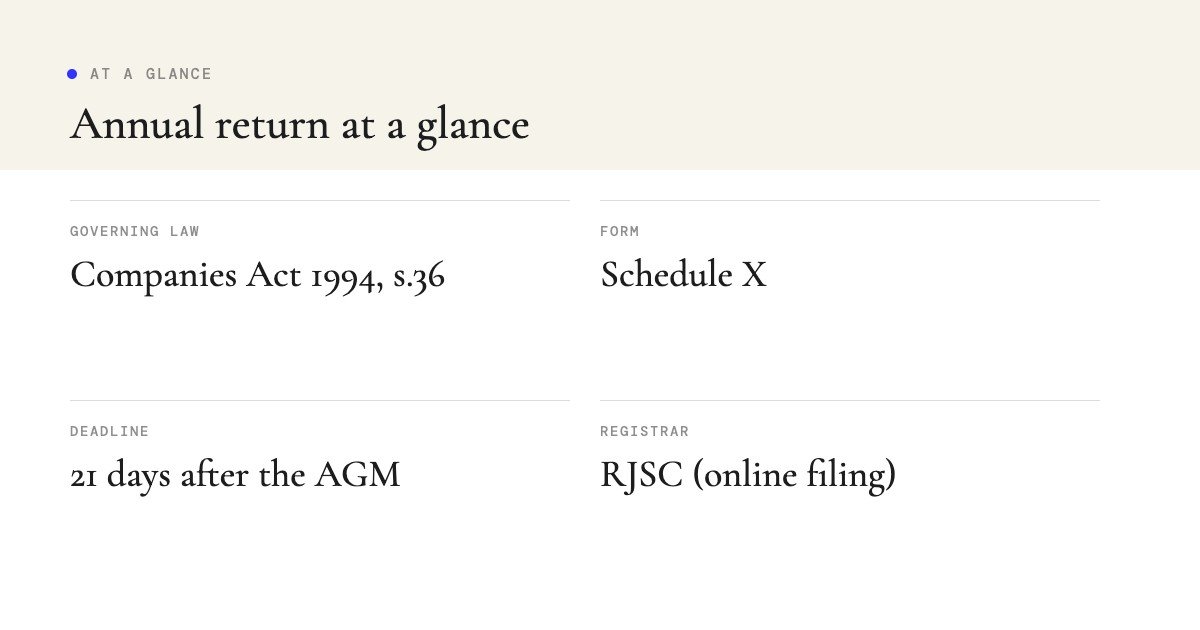
Annual return filing with RJSC is the one compliance task every Bangladeshi company with share capital must repeat each year: within 21 days of the annual general meeting, the company files Schedule X listing its members, shares and directors. Miss it and fines, blocked filings and awkward questions from banks follow.

- Section 36 of the Companies Act 1994 requires every company having a share capital to file an annual list of members and summary, known in practice as Schedule X.
- The return is due within 21 days after the annual general meeting, and the audited balance sheet and profit and loss account follow within 30 days of the AGM under section 190.
- The AGM itself must be held in each calendar year, with no more than 15 months between meetings; the first may be held within 18 months of incorporation.
- Late filing exposes the company and its officers to daily fines, RJSC late fees and practical blocks on later filings such as share transfers and capital increases.
- Years of missed returns can usually be regularised, but the order of steps matters and should be planned before anything is filed.
What annual return filing with RJSC actually involves
Every company registered under the Companies Act 1994 keeps a register of members. Once a year, a company having a share capital must send a snapshot of that register to the Registrar of Joint Stock Companies and Firms (RJSC). That snapshot is the annual return.
The Act calls it the annual list of members and summary. Practitioners call it Schedule X, after the schedule of the Act that prescribes its form. Whatever the name, annual return filing with RJSC gives the public register an up-to-date picture of who owns the company, how much capital has been issued and paid up, and who sits on the board.
Because the return is public, banks, investors and government agencies treat a certified copy of the latest Schedule X as the authoritative statement of ownership. A stale return quickly becomes a commercial problem.
The legal basis: section 36 and Schedule X
Section 36 requires every company having a share capital to make the list at least once in every year, with the first list due within eighteen months of incorporation. The list and summary are kept in a separate part of the register of members and a signed copy is filed with the Registrar.
The copy must be signed by two directors, one of whom is the managing director, or by a director where there is no managing director. A private company must also send a certificate, signed by a director, confirming that it has not issued any invitation to the public to subscribe for its shares or debentures. That certificate protects the company's private status.
Who must file and who is covered differently
The obligation in section 36 applies to companies having a share capital. In practice, annual return filing with RJSC covers almost every private and public limited company in Bangladesh, including subsidiaries of foreign groups.
- Private limited companies. The largest group. They file Schedule X with the private company certificate.
- Public limited companies. They file the same return, and listed companies also have disclosure duties to the Bangladesh Securities and Exchange Commission and the stock exchanges.
- One person companies. An OPC, introduced by the Companies (Amendment) Act 2020, still has share capital and still files a yearly return, although decisions of the sole member are recorded in writing rather than at a conventional meeting. We confirm the OPC-specific filing rules case by case.
- Guarantee companies without share capital. These have their own reporting requirements rather than the share-capital list.
- Branches of foreign companies. A branch is not a Bangladeshi company. It has separate filing duties under the part of the Act dealing with foreign companies, together with its permission from Invest Bangladesh (formerly BIDA).
A dormant company is still a company. Unless it has been struck off or wound up, the duty to hold an AGM and complete annual return filing with RJSC continues every year, even if the company did no business at all. Dormancy is the most common reason we find five or more years of missed returns.
The deadlines: AGM first, then 21 days
The deadline for annual return filing with RJSC is tied to the annual general meeting, so the AGM timetable comes first. Getting the sequence right is the whole game.
The AGM timetable
Under section 81, every company must hold an annual general meeting in each calendar year, and not more than fifteen months may pass between one AGM and the next. A company may hold its first AGM within eighteen months of incorporation, and then need not hold one in the year of incorporation or the following year.
The Registrar has a limited power to extend the time for holding an AGM, on application and for a special reason. An extension is discretionary and short, so it should be sought before the deadline passes, not after.
The accounts that go to the AGM
Section 183 requires the board to lay a balance sheet and profit and loss account before the AGM. For AGMs after the first, the accounts must be made up to a date not more than nine months before the meeting, or twelve months for a company with business interests outside Bangladesh. The Registrar may extend that period by up to three months on an application made in time. The accounts must be audited, and the auditor's report is read at the meeting.
The filing deadlines
| Document | Deadline | Statutory basis |
|---|---|---|
| First annual list and summary | Within 18 months of incorporation | Companies Act 1994, s.36(1) |
| Annual return (Schedule X) | Within 21 days after the first or only ordinary general meeting of the year | s.36 |
| Audited balance sheet and profit and loss account | Within 30 days of the date the accounts were laid at the AGM | s.190(1) |
| Accounts where no AGM was held | 30 days from the last day on which the AGM should have been held | s.190(1) |
| Company income tax return | By the company Tax Day under the Income Tax Act 2023 | Separate NBR obligation |
The 21-day clock runs from the date of the meeting, not from the end of the financial year. A company that holds its AGM on 20 December has until 10 January to complete annual return filing with RJSC, even though the calendar year has turned.
What goes into Schedule X
Schedule X has two parts: a list of persons who are members on the day of the AGM, and a summary of the company's capital position. The details must match the register of members, the register of directors and the company's filings since the last return.
| Part of the return | Information required | Where to source it |
|---|---|---|
| Company details | Name, registration number, registered office address | Certificate of incorporation, latest Form VI |
| Share capital summary | Authorised capital, number and class of shares issued, amount called up and paid | Memorandum, allotment returns, bank records |
| List of members | Name, address, nationality and number of shares held by each member | Register of members |
| Transfers | Shares transferred since the last return, with dates | Transfer register and filed transfer instruments |
| Charges | Total indebtedness secured by registered mortgages and charges | Register of charges, RJSC charge filings |
| Officers | Directors, managing director and manager, with their particulars | Register of directors, latest Form XII |
Consistency is what RJSC checks
RJSC compares the new return with what is already on its file. If the paid-up capital in Schedule X is higher than any allotment the company has reported, or a director appears who was never notified on Form XII, the filing will be queried or rejected. Annual return filing with RJSC therefore works best as the final step of a year in which every change was reported as it happened.
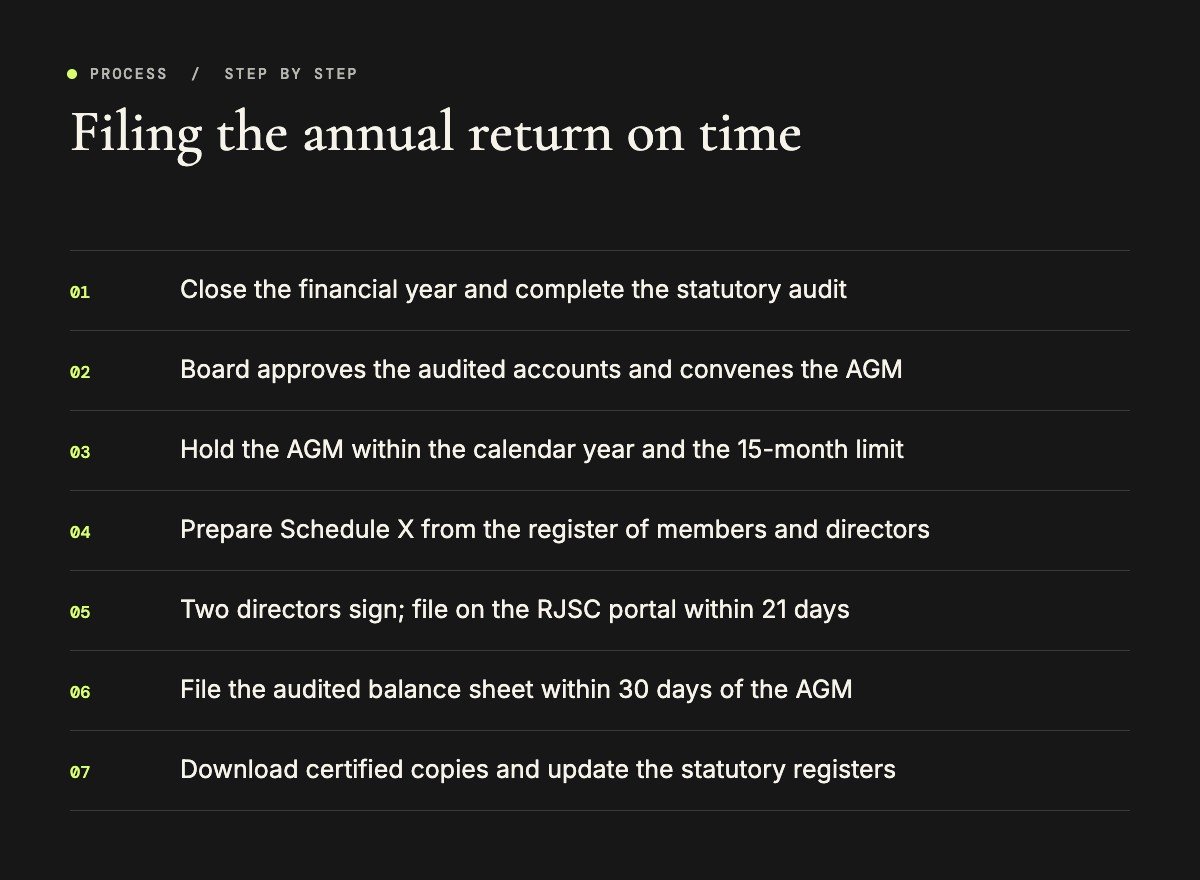
Step-by-step process for annual return filing with RJSC
For a typical private company with a June or December year end, the yearly cycle looks like this.
- Close the year and audit the accounts. Every company, whatever its size, must have its accounts audited by a chartered accountant appointed under the Act.
- Hold the board meeting. The directors approve the audited accounts and the directors' report, fix the date, time and place of the AGM and approve the notice. Record the decisions in signed minutes.
- Serve notice and hold the AGM. Send notice in the form and period required by the articles and the Act. At the meeting, members adopt the accounts, declare any dividend, elect or re-elect directors and appoint the auditor for the next year.
- Prepare Schedule X. Draw the list of members as it stood on the date of the AGM, complete the capital summary and cross-check every figure against the registers and earlier RJSC filings.
- Sign and file within 21 days. Two directors, including the managing director, sign the return. Add the private company certificate where applicable, upload the documents through the RJSC online system and pay the filing fee.
- File the audited accounts within 30 days. Upload the audited balance sheet and profit and loss account, signed as section 190 requires, with the auditor's report. Where the AGM did not adopt the accounts, annex a statement of that fact and the reasons.
- Close the loop. Download certified copies once RJSC accepts the filing, update the minute book and registers, and diarise next year's AGM date.
Fees for filing are set by the RJSC fee schedule and are paid online at the time of submission. Fees and late charges are revised from time to time, so confirm the current schedule on the RJSC website before filing.
Filing on the RJSC online system
RJSC moved its company services online several years ago, and annual return filing with RJSC is now done electronically. The company, or its authorised agent, logs in to the RJSC e-services portal, selects the return, enters or uploads the Schedule X data and attaches scanned signed copies.
In our experience, most rejected filings fail for avoidable reasons: a missing signature page, a director's name spelled differently from the earlier Form XII, or shareholdings that do not match registered transfers. A short checklist before annual return filing with RJSC removes nearly all of these.
Before annual return filing with RJSC, keep ready the signed board and AGM minutes, the audited accounts, the current statutory registers, copies of every RJSC filing since the last return, and identity details for each director and member.
Consequences of late annual return filing with RJSC
Late filing is rarely prosecuted on its own, but its consequences compound: statutory fines, RJSC late charges and practical blocks.
Statutory fines
Under section 36, if a company fails to comply, the company and every officer who knowingly and wilfully authorises or permits the default is liable to a fine of up to two hundred taka for every day the default continues. Section 190 adds a daily fine of up to one hundred taka for failing to file the audited accounts. Directors who fail to take reasonable steps to lay proper accounts before the AGM face separate fines under section 183.
These are maximum fines a court may impose; they are not automatic. But daily fines over several years add up, and they attach to individual officers, not only to the company. Late annual return filing with RJSC is therefore a director's problem as well as the company's.
RJSC late charges and blocked filings
Separately from court fines, RJSC charges additional fees for documents filed after the statutory time, under its fee schedule. In practice, RJSC also expects a company's annual returns to be up to date before it processes other changes. A company that wants to register a share transfer, increase its authorised capital, change its name or appoint a foreign director often discovers at that moment that it must first file several years of missed returns.
| Missed obligation | Typical consequence |
|---|---|
| Schedule X not filed | Daily fine exposure; RJSC late fees; transfers and other changes held up |
| Audited accounts not filed | Daily fine exposure; problems with bank credit files and tenders |
| AGM not held | Members may ask the court to order a meeting; accounts deadline still runs |
| Several years in default | Risk of being treated as defunct and struck off; due diligence red flag |
Commercial and regulatory knock-on effects
Banks ask for a certified copy of the latest Schedule X when opening accounts, renewing credit lines or changing signatories, and procurement entities ask for it in tenders. Invest Bangladesh (formerly BIDA) and the Department of Immigration and Passports rely on company records when processing work permits and visas for foreign staff. Buyers in a share purchase treat gaps in annual return filing with RJSC as a sign that the register of members itself may be unreliable.
A company that has stopped filing for several years also risks being treated by the Registrar as a defunct company and struck off the register. Restoration is possible through the court, but it is slow and expensive compared with filing on time.
The RJSC file and the NBR file are separate. A company can be fully compliant with its income tax returns and still be years behind with annual return filing with RJSC, or the reverse. Lenders and investors now check both, so treat them as one annual compliance calendar.
How to catch up on missed annual returns
Companies that have fallen behind usually ask whether they can simply file everything at once. Often they can, but the route depends on what actually happened in the missing years. Before filing anything, establish the facts.
- Reconstruct the record. Pull the company's RJSC file and identify the last return accepted, then list every allotment, transfer and director change since then.
- Check the meetings. Were AGMs actually held, and were the accounts audited each year? If audits were missed, those must be completed first, because the accounts are the foundation of the AGM.
- Regularise interim changes. File any missing Form XII, allotment and transfer documents so that each year's return will reconcile with the record.
- File the returns in sequence. Submit each missing year's Schedule X and accounts in date order, paying the late fees RJSC calculates.
Where AGMs were genuinely never held, catch-up annual return filing with RJSC must not recite meetings that did not take place. That situation needs advice on holding the overdue meetings properly and describing the history accurately.
Changes you must report during the year
The annual return is a summary, not a substitute for event-driven filings. Several changes must be reported to RJSC when they happen, and next year's annual return filing with RJSC will only reconcile if they were.
- Directors and officers. Appointments, resignations and changes in particulars are notified on Form XII, generally within 14 days.
- Share transfers. Transfers are executed on the prescribed instrument, stamped and registered by the board. Our guide to company share transfer in Bangladesh explains the steps.
- Allotments. New shares issued for cash or other consideration must be reported through a return of allotment.
- Charges. Mortgages and charges created by the company must be registered within 21 days under section 159.
- Registered office. A change of registered office is notified on Form VI within the period set by the Act.
Each of these decisions starts with a properly drafted resolution. Our guide to the board resolution process covers how to minute them.
Annual return filing with RJSC for foreign-owned companies
For a subsidiary owned by a foreign parent, the annual return carries extra weight. Schedule X is the public evidence that the foreign shareholder holds the shares its inward remittances paid for. When the company later remits dividends or the parent sells its shares, the bank handling the remittance will usually ask for the audited accounts and the RJSC record of shareholding.
Foreign directors should give passport details in the same form every year, because inconsistent spellings cause queries. Where directors sign abroad, plan courier time before the 21-day window for annual return filing with RJSC opens.
Common mistakes and how to avoid them
- Treating the tax return as the annual return. They are separate filings to separate authorities.
- Counting 21 days from year end. The clock runs from the AGM date.
- Holding no AGM because shareholders are related. Family companies still need a formal meeting and minutes.
- Unreported changes. Directors or transfers that appear for the first time in Schedule X trigger queries.
- Single signature. The return needs two directors, including the managing director, where there is one.
Our guide to company income tax return filing covers the NBR side of the same annual calendar.
Frequently asked questions about annual return filing with RJSC
What is the deadline for filing Schedule X?
Within 21 days after the first or only ordinary general meeting of the year, under section 36 of the Companies Act 1994. The first list is due within eighteen months of incorporation. The audited accounts follow within 30 days of the AGM under section 190.
Does a company with no business activity still have to file?
Yes. Until a company is struck off or wound up, it must hold an AGM, audit its accounts and file its annual return every year, even if it traded nothing.
What happens if we file late?
The company and officers in default face possible fines of up to two hundred taka per day under section 36, RJSC charges late fees under its schedule, and RJSC may hold up other filings until the arrears are cleared.
Who must sign the annual return?
Two directors, one of whom is the managing director, or a director where there is no managing director. A private company also attaches a director's certificate that it has made no public invitation to subscribe for its shares or debentures.
Can we file several years of missed returns at once?
Usually yes, in date order and with late fees, once the audits, meetings and interim filings for each year are in order. Where meetings were never held, take advice before filing.
Is the annual return the same as the income tax return?
No. The annual return goes to RJSC under the Companies Act 1994; the company income tax return goes to the NBR under the Income Tax Act 2023. Both are due every year.
How we can help
We run the annual compliance calendar for private companies, foreign-owned subsidiaries and family businesses: board and AGM minutes, Schedule X, accounts filing and certified copies. We also regularise companies that have fallen years behind, reconciling the register before anything is filed. Learn more about our corporate law practice.
Behind on your RJSC filings?
We review your RJSC file, plan the catch-up in the right order and handle each annual return and accounts filing for you.
Book a consultationCorporate practicePrimary sources: the Companies Act 1994, sections 36, 81, 159, 183 and 190, on the Laws of Bangladesh portal; filing services and fee schedule of the Registrar of Joint Stock Companies and Firms; investment services of Invest Bangladesh.
This article is general information about Bangladeshi law as of 2026 and is not legal advice. Fees, forms and procedures change; confirm current requirements with RJSC or a qualified lawyer before acting.




0 Comments