
A power purchase agreement in Bangladesh is, for most independent power producers, a long-term contract with one buyer: the Bangladesh Power Development Board. Everything that makes a project bankable, from tariff to fuel, currency, termination and arbitration, lives in how that contract and its companion agreements share risk.
- BPDB is the single buyer for almost all grid-connected private generation; the PPA sits alongside an implementation agreement with the Government, a land lease and a fuel supply agreement.
- Since 2024 the old negotiated, unsolicited model has been dismantled: the Speedy Supply of Power and Energy (Special Provision) Act 2010 was repealed by ordinance in November 2024 and new capacity is tendered competitively.
- Recent BPDB solar tenders (2025 and April 2026) offer 20-year PPAs without a sovereign guarantee, which shifts payment risk to sponsors and lenders.
- Fuel and dispatch risk, not construction risk, is now the largest commercial issue: several gas-fired plants have sat idle for lack of gas.
- Existing contracts are being reviewed and renegotiated, so termination, change-in-law and dispute clauses matter more than ever.
Under the Invest Bangladesh Act 2026, effective 23 August 2026, the Bangladesh Investment Development Authority (BIDA), the Bangladesh Economic Zones Authority (BEZA) and the PPP Authority were merged into a single body, Invest Bangladesh. References below to BIDA, BEZA or the PPP Authority should be read as references to Invest Bangladesh. BEPZA continues as a separate authority.
How a power purchase agreement in Bangladesh is structured
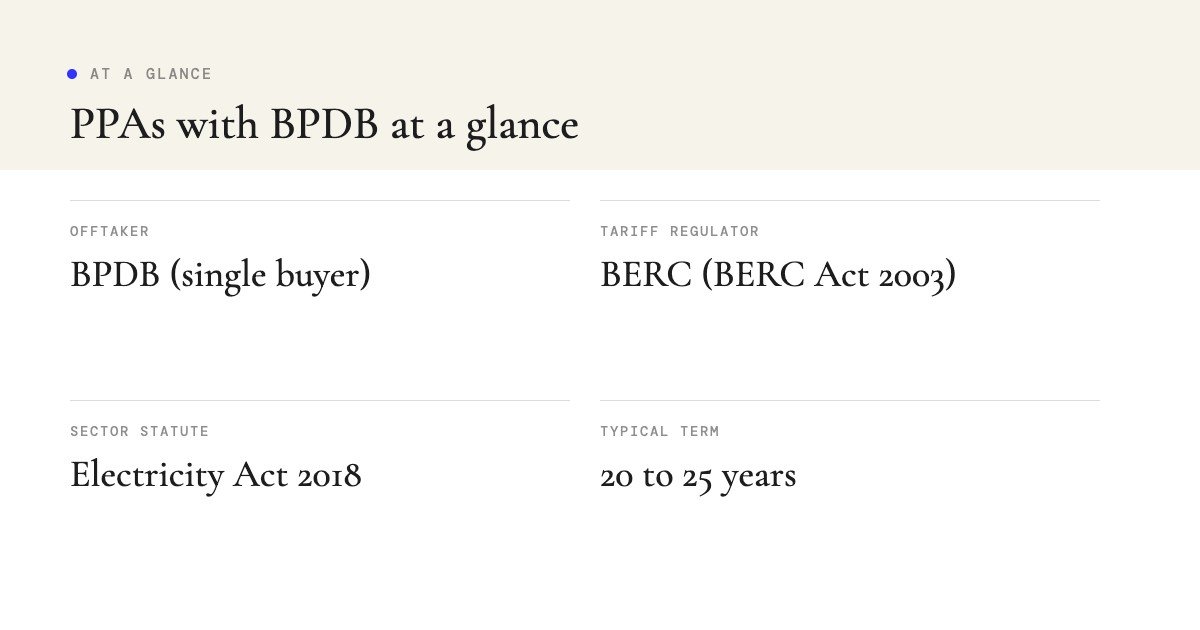
Bangladesh runs a single-buyer power market. Private plants sell their output to the Bangladesh Power Development Board (BPDB), a statutory body created under the Bangladesh Power Development Boards Order 1972. BPDB then sells bulk power to the distribution companies.
A power purchase agreement in Bangladesh is therefore rarely a standalone document. For a typical independent power producer (IPP) it is one contract in a stack of five or six, and the risk allocation only makes sense when you read them together.
The usual contract stack
| Contract | Counterparty | What it does |
|---|---|---|
| Power purchase agreement | BPDB | Sale of capacity and energy, tariff, dispatch, metering, billing, termination |
| Implementation agreement | Government, acting through the Power Division | Government support, tax treatment, political risk cover, payment support for BPDB where given |
| Land lease | BPDB, a state entity or private owner | Site access for the life of the project |
| Fuel supply agreement | Petrobangla or its companies, an LNG or coal supplier | Quantity, quality, price and shortfall remedies for fuel |
| Grid or interconnection arrangements | PGCB or a distribution company | Evacuation line, substation and connection point |
| Direct agreements | Lenders, BPDB and Government | Notice, cure and step-in rights for financiers |
The Power Cell under the Power Division has historically run IPP procurement, while BPDB signs and administers the PPA. Generation licences are issued by the Bangladesh Energy Regulatory Commission (BERC) under the BERC Act 2003, and the Electricity Act 2018 governs generation, transmission and safety more generally.
Policy documents that still matter
The Private Sector Power Generation Policy of Bangladesh (1996, revised 2004) set the template for most legacy IPP contracts: sovereign-backed payment support, tax holidays and international arbitration. For renewables, the Renewable Energy Policy 2025 now sets the direction, with competitive tenders and a stated goal of sharply increasing the renewable share of generation. Neither policy overrides the contract; they explain why a power purchase agreement in Bangladesh reads as it does.
The 2024 to 2026 reset: what changed for PPAs
Anyone who last looked at a power purchase agreement in Bangladesh before 2024 needs to update their assumptions. Four changes stand out.
End of the special-provision regime
From 2010 many rental, quick-rental and IPP contracts were awarded without open tender under the Speedy Supply of Power and Energy (Special Provision) Act 2010, which also limited court challenges. That Act was repealed by ordinance in late November 2024. Contracts already signed under it were not automatically cancelled, but they became subject to government review. A national review committee was set up to examine past power and energy deals, and it reported anomalies in several of them, including the Adani Godda import contract.
Tariff setting returned to BERC
On 27 August 2024 an ordinance abolished section 34Ka of the BERC Act 2003, which had allowed the Government to change electricity and gas prices by executive order without a BERC public hearing. Retail and bulk price changes now go back through BERC. That does not change a signed IPP tariff, but it does affect BPDB's revenue, and therefore its ability to pay generators on time.
Competitive tenders and no sovereign guarantee
BPDB has moved to open, competitive tenders for new capacity. Its solar rounds from December 2024 offered 20-year offtake to private investors with no government equity. Reports on the April 2026 tender for 495MW of grid-tied solar describe a one-stage, two-envelope process, a 20-year PPA, purchase of all energy produced, and no sovereign guarantee. Industry commentary blamed the weak response to the earlier 5,238MW round largely on that missing guarantee.
Renegotiation of legacy contracts
In May 2025 BPDB asked the owner of the 718MW Meghnaghat LNG-based plant to propose a tariff reduction, describing it as its first such request. Further renegotiation of contracts signed between 2009 and 2024 is widely expected under the new Parliament. Sponsors should assume their existing PPA will be read closely, clause by clause.
Tariff design in a power purchase agreement in Bangladesh
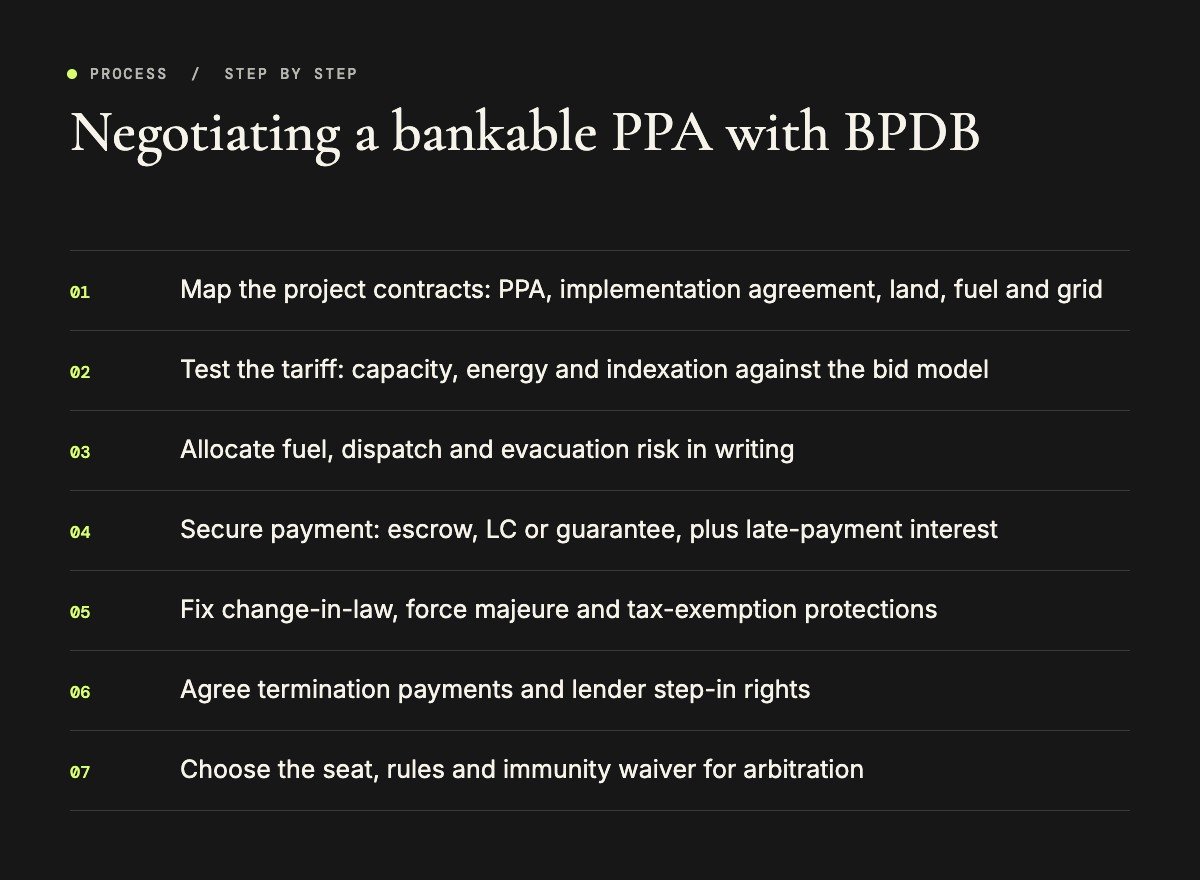
The tariff in a thermal power purchase agreement in Bangladesh usually has two parts. The first, the capacity payment, pays for making the plant available and recovers capital cost, debt service, fixed operation and maintenance and return. The second, the energy payment, pays for each kilowatt-hour actually delivered and passes through fuel and variable operating cost.
The capacity payment is what makes a thermal plant bankable, and it is also what drew public criticism: plants that were available but not dispatched still received it. New solar tenders avoid the issue because they pay only for energy delivered. A solar power purchase agreement in Bangladesh is therefore closer to a pure energy contract, which moves resource and curtailment risk to the generator.
Indexation and currency
Legacy tariffs for foreign-funded plants are often denominated or indexed in US dollars and paid in Taka at the prevailing exchange rate. The sharp depreciation of the Taka since 2022 made that protection very valuable to sponsors and very costly to BPDB. Expect indexation to be a central point in any renegotiation and in new tenders.
Read the tariff schedule with the financial model open. We regularly find that the indexation formula, the heat-rate assumptions or the availability definition in the PPA do not match what the bid model assumed. Those mismatches only show up years later, when an invoice is disputed.
Risk allocation with BPDB: the core matrix
The table below summarises how risk is commonly shared in a thermal power purchase agreement in Bangladesh and where newer solar contracts differ. Every project is negotiated, so treat this as a starting map, not a rule.
| Risk | Usual bearer (legacy thermal) | Trend in new tenders |
|---|---|---|
| Construction cost and delay | Generator, with liquidated damages for late commercial operation | Generator; tender security and performance security at stake |
| Plant performance and availability | Generator, through availability targets and capacity deductions | Generator, through lost energy revenue |
| Fuel availability | Shared; often BPDB or the state fuel supplier bears shortfall | Not relevant for solar; resource risk on generator |
| Dispatch and curtailment | BPDB, through capacity payment and deemed energy | Increasingly on generator unless deemed energy is agreed |
| Grid and evacuation | Usually BPDB or PGCB for the line beyond the connection point | Projects sited near existing substations to limit this risk |
| Exchange rate | BPDB, through dollar indexation | Under pressure; check the bid documents |
| Change in law and tax | BPDB or Government, with tariff adjustment | Narrower protection; read carefully |
| Payment default by BPDB | Government support under the implementation agreement | No sovereign guarantee in recent rounds |
The pattern is clear. Older contracts placed most market and political risk on the state. Newer ones push more onto the private side. Lenders price that shift, and sponsors must decide whether the tariff they bid covers it.
Fuel supply and dispatch risk
Gas shortage is the defining commercial risk for thermal plants. In May 2025 Petrobangla was reported to be supplying around 1,024 mmcfd against demand of about 2,420 mmcfd. Three large combined-cycle plants at Meghnaghat were reported to be nearly idle for lack of gas and incomplete evacuation infrastructure.
Matching the PPA to the fuel contract
The single most important drafting task in a thermal power purchase agreement in Bangladesh is to make the PPA and the fuel supply agreement fit together. If the fuel supplier can curtail gas without liability, but the PPA treats the resulting unavailability as the generator's fault, the generator is squeezed between two contracts. The fix is a clear rule in the PPA that fuel shortfall caused by the designated supplier counts as BPDB risk, with deemed availability or deemed energy payments.
Dispatch instructions
Plants are dispatched by the National Load Despatch Centre operated by the Power Grid Company of Bangladesh. The PPA should say how instructions are given and recorded, how ramp rates and minimum load are treated, and what happens to revenue when the plant is backed down for grid reasons. For renewables, curtailment caps and compensation for curtailment above a threshold are now essential terms.
Payment security and currency risk
BPDB buys power at a cost well above what it recovers from bulk tariffs, and the gap is covered by government subsidy. When subsidy releases slow, BPDB payments to IPPs fall behind. Arrears to private generators, including the Adani dispute over roughly 496 million US dollars reported in late 2025, show that payment risk is real.
Sponsors and lenders should look for layered protection in any power purchase agreement in Bangladesh:
- Payment terms. A fixed invoicing cycle, a short due date and a clear disputed-invoice procedure, so that undisputed sums are paid while the rest is resolved.
- Late-payment interest. A defined rate that accrues automatically, with no requirement to serve demands first.
- Security instrument. A revolving letter of credit, escrow account or other liquidity support sized to a set number of months of payments.
- Government support. Where available, an obligation in the implementation agreement for the Government to fund BPDB's payment obligations. Recent tenders say this will not be offered, so check what alternative assurance is described.
- Convertibility. Comfort on conversion and remittance of foreign-currency debt service and dividends through the banking channel, in line with Bangladesh Bank foreign exchange rules.
Foreign loans and Bangladesh Bank
Foreign-currency project debt must meet Bangladesh Bank requirements and, for long-term private foreign borrowing, the scrutiny process now run with Invest Bangladesh (which absorbed BIDA in August 2026). Build approval timelines into the financing plan; a power purchase agreement in Bangladesh that is signed before the loan structure is cleared can leave the project without funds at financial close.
Change in law, tax and force majeure
A long-term power purchase agreement in Bangladesh will outlive several governments and many Finance Acts. The change-in-law clause decides who pays when the rules move.
Change in law
A good clause defines "law" widely (statutes, ordinances, SROs, BERC orders, Bangladesh Bank circulars), covers changes in interpretation by a competent authority, and gives a tariff adjustment or compensation formula with a minimum threshold. It should also cover the loss of a tax exemption promised in the implementation agreement. For renewable plants reaching commercial operation between July 2025 and June 2030, a stepped income tax exemption over fifteen years was announced; confirm the current notification before relying on it.
Force majeure
A power purchase agreement in Bangladesh usually splits force majeure into natural events (floods, cyclones, earthquakes) and political events (war, strikes, expropriation, government action). The difference matters: during political force majeure the state side commonly continues capacity payments, while during natural force majeure each side bears its own loss. Make sure prolonged force majeure gives a right to terminate with a defined payment, and that the force majeure regime in the fuel contract mirrors the PPA.
Section 56 of the Contract Act 1872 (frustration) applies only where the contract does not already allocate the risk. A detailed force majeure clause usually displaces it. Do not rely on frustration as a backstop.
Termination, buy-out and lender protection
Termination provisions are where a power purchase agreement in Bangladesh turns from a sales contract into a credit instrument. Lenders lend against the termination payment as much as against the tariff.
Events of default
Generator defaults typically include failure to reach commercial operation by a long-stop date, sustained low availability, abandonment and insolvency. BPDB defaults include payment failure beyond a cure period and breach of material obligations. Government events, such as expropriation or a change in law that makes performance unlawful, sit with the state side.
Termination payments
The common structure is a buy-out by BPDB or the Government. On BPDB or Government default, the payment covers outstanding debt, breakage costs and equity return. On generator default, it is usually limited to some or all of the outstanding senior debt, so that lenders are protected even when the sponsor fails. On prolonged force majeure, it often sits in between.
Direct agreements and step-in
Lenders need a direct agreement under which BPDB and the Government must notify them of any default, give them extra time to cure, and allow them or a substitute to step in and take over the project company's rights. Without it, a terminated PPA leaves the lenders with a plant that has no buyer.
Disputes under a power purchase agreement in Bangladesh
Most PPAs provide for escalation to senior management, then an expert for technical and billing questions, then arbitration. Smaller and older contracts often choose arbitration seated in Dhaka under the Arbitration Act 2001. Larger foreign-financed projects commonly choose a seat such as Singapore or London and institutional rules such as SIAC, ICC or UNCITRAL.
Lessons from recent disputes
In November 2025 the High Court Division reportedly stayed a Singapore-seated arbitration started by Adani against BPDB until a court-ordered committee examining the contract had reported. Whatever the final outcome, the episode shows that a foreign seat does not stop a party from going to the Bangladeshi courts, and that allegations of corruption in contract formation can delay arbitration for months.
Drafting points
- Include an express waiver of sovereign immunity from suit and execution by BPDB and the Government, limited as needed to commercial assets.
- Choose the seat deliberately; it decides which court supervises the arbitration and whether section 7A of the Arbitration Act 2001 (interim relief) can be used.
- Remember that a foreign award must be enforced in Bangladesh through the courts under the Arbitration Act 2001, which gives effect to the New York Convention. Our team at enforcement of awards handles that stage.
Responding to a renegotiation request from BPDB
Sponsors of legacy projects increasingly receive letters asking them to reduce tariffs, waive arrears or accept a review. A signed power purchase agreement in Bangladesh remains binding, and BPDB cannot amend it unilaterally. But refusing to engage carries political and payment risk. A structured response protects your position.
- Read the whole contract stack. Check the PPA, implementation agreement, direct agreements and finance documents for amendment, consent and notice requirements before replying.
- Notify lenders early. Most loan agreements prohibit amending the PPA without lender consent. Silence can itself be a breach.
- Reserve rights in writing. Reply that you will discuss the proposal without waiving any right under the PPA, including to interest on late payments.
- Separate undisputed sums. Insist that undisputed invoices continue to be paid while any review proceeds.
- Prepare the evidence. Assemble the tender file, approvals, board minutes and the financial model, since any review will test how the contract was awarded and priced.
- Model the trade. Value what you are asked to give up against what you could secure: faster payment, a guarantee, an extended term or clarity on fuel supply.
- Document any change formally. Use a written amendment approved by the competent authorities and, where required, by BERC, so that the new terms are binding on both sides.
Checklist for new bidders in 2026
For a new tender, the bid documents largely dictate the form of contract, but there is usually room to clarify through pre-bid queries. Before committing to a 2026 power purchase agreement in Bangladesh, confirm the following:
- What security replaces a sovereign guarantee, and whether lenders will accept it.
- Whether the tariff is paid in Taka, dollars or Taka indexed to dollars, and how the exchange rate is set.
- Who builds and pays for the evacuation line, and what happens if the substation is not ready.
- How curtailment is measured and compensated.
- Whether land is provided by the state or must be acquired privately, and how title is verified.
- Which approvals are needed from BERC, the Department of Environment and Invest Bangladesh, and who bears delay.
- The governing law, the arbitration seat and the immunity waiver.
Our separate guide to arbitration in Bangladesh explains how Dhaka-seated proceedings run if you accept a local seat.
Frequently asked questions about power purchase agreement in Bangladesh
Who signs a power purchase agreement in Bangladesh on the buyer side?
For grid-connected private plants it is almost always the Bangladesh Power Development Board. The Government, acting through the Power Division, signs the separate implementation agreement where one is used.
Are old contracts made under the 2010 special-provision Act still valid?
Repeal of the Act in November 2024 did not automatically cancel contracts made under it. They remain in force but are subject to government review, and a contract tainted by proven corruption could be challenged on general contract law grounds.
Do new solar PPAs include capacity payments?
No. Recent BPDB solar tenders pay for energy delivered, with BPDB committing to buy all output for 20 years. That shifts resource and curtailment risk to the generator, so curtailment terms need close attention.
Is a sovereign guarantee available?
Legacy projects often had government payment support. BPDB's 2025 and 2026 solar tenders were reported to offer no sovereign guarantee, relying on alternative assurances. Check the specific tender documents.
Can BPDB change the tariff without our consent?
No. A PPA tariff can be changed only as the contract allows, for example by indexation, change-in-law adjustment or a signed amendment. BERC's role over retail and bulk tariffs does not alter a signed IPP tariff.
How we can help
We advise sponsors, lenders and contractors on every stage of a power purchase agreement in Bangladesh: bid review and pre-bid queries, negotiation with BPDB and the Power Division, financing and security, renegotiation requests and arbitration. Learn more about our project finance practice and our wider infrastructure and energy work.
Bidding for or renegotiating a PPA?
We review the PPA, implementation agreement and finance documents together and tell you where the real risk sits before you sign or reply.
Book a consultationProject finance practicePrimary sources: the BERC Act 2003, Electricity Act 2018 and Arbitration Act 2001 on the Laws of Bangladesh portal; tender notices from the Bangladesh Power Development Board; tariff orders from the Bangladesh Energy Regulatory Commission; reporting in The Financial Express (May 2025) and The Business Standard (April 2026).
This article is general information about Bangladeshi law as of October 2026 and is not legal advice. Power sector policy, tender terms and the status of legacy contracts are changing quickly; take specific advice on your project documents before acting.

0 Comments