
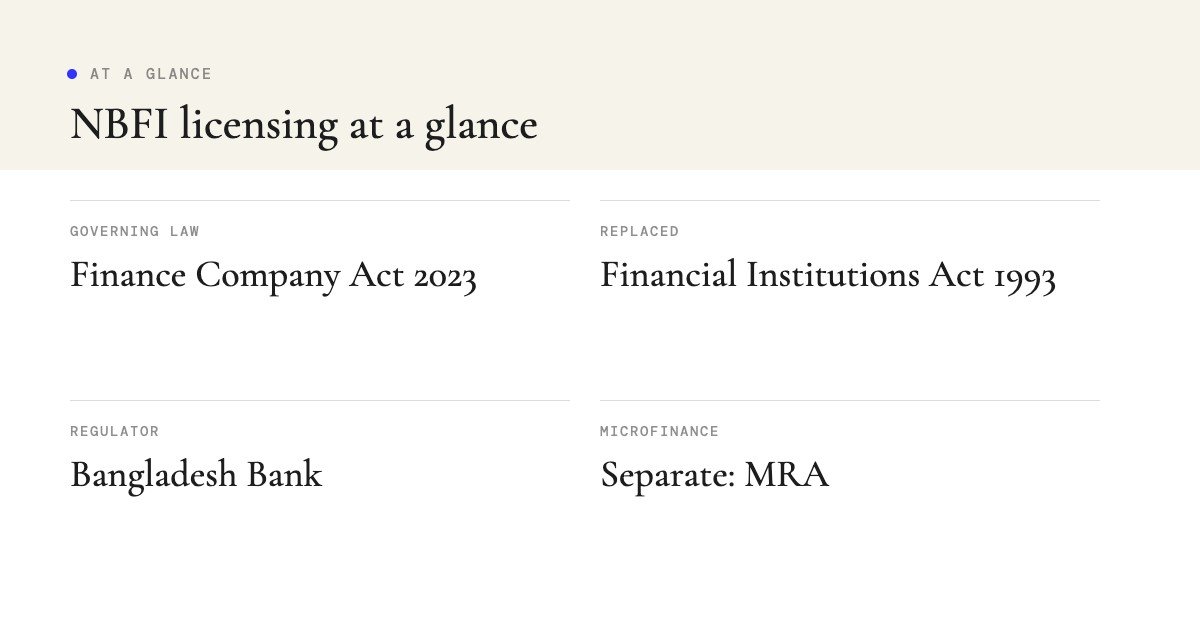
An NBFI licence in Bangladesh is now a licence to operate as a finance company under the Finance Company Act 2023, which replaced the Financial Institutions Act 1993. Bangladesh Bank grants and supervises these licences, and after several finance company failures, it has become far more demanding about sponsors, capital and governance.

- Non-bank financial institutions are now called finance companies and are licensed by Bangladesh Bank under the Finance Company Act 2023, passed in November 2023.
- A licence is needed to carry on finance company business such as term lending, leasing, factoring and accepting term deposits from the public within the limits the law allows.
- Bangladesh Bank sets minimum capital, fit and proper tests for sponsors and directors, and prudential rules on capital adequacy, provisioning and single-borrower exposure.
- The sector has been under stress: in January 2026, six finance companies were reported to be set for liquidation while three were given time to recover.
- Microfinance institutions are licensed separately by the Microcredit Regulatory Authority, and payment service providers by Bangladesh Bank under payment system rules.
What an NBFI licence in Bangladesh covers
Bangladesh's financial system includes scheduled banks, finance companies, insurers, capital market intermediaries and microfinance institutions. Finance companies, previously called non-bank financial institutions or NBFIs, provide term loans, lease finance, housing finance, SME finance, factoring and other credit, and may accept term deposits subject to restrictions. They cannot offer current accounts or cheque books in the way banks do.
An NBFI licence in Bangladesh is therefore required for any company that wants to carry on this type of business as its main activity. Operating finance company business without a licence is an offence, and Bangladesh Bank has powers to stop unlicensed lending and deposit-taking. Our banking and financial services practice advises on whether a business model needs a licence.
The 2023 Act
The Finance Company Act 2023 replaced the Financial Institutions Act 1993 after years of concern about weak governance and large defaults in parts of the sector. It updated definitions, strengthened Bangladesh Bank's powers over licensing, directors and management, tightened rules on related-party lending and expanded supervisory tools. There is no "Financial Institutions Act 2023"; references to that name are mistaken.
Which activities need a finance company licence
| Activity | Licence needed | Regulator |
|---|---|---|
| Term lending, leasing, factoring, housing finance as main business | Finance company licence | Bangladesh Bank |
| Accepting term deposits from the public | Finance company licence, within limits | Bangladesh Bank |
| Microcredit to low-income borrowers through NGOs | Microcredit licence | Microcredit Regulatory Authority |
| Payment services, wallets and payment system operation | Payment system licence | Bangladesh Bank (payment systems) |
| Merchant banking, asset management, brokerage | Capital market registration | BSEC |
| Commercial banking | Bank licence | Bangladesh Bank under the Bank Company Act 1991 |
Fintech lenders and buy-now-pay-later platforms should look closely at this table. Lending from their own balance sheet as a business, or funding loans with public money, can require a finance company licence or a partnership with a licensed lender.

Capital and sponsor requirements
Bangladesh Bank sets the minimum paid-up capital for finance companies. Historically the requirement was Tk 100 crore, and Bangladesh Bank can revise it by regulation or circular under the 2023 Act. Applicants should confirm the current figure with Bangladesh Bank before planning, and should expect to show that capital comes from legitimate, documented sources.
Sponsors and directors must pass fit and proper tests covering integrity, financial soundness, experience and absence of loan default or criminal records. Bangladesh Bank checks the Credit Information Bureau and other records. Concentration of ownership in a single family or group, and connections to other financial institutions, are scrutinised closely given the sector's history of related-party lending.
Bangladesh Bank has granted few new finance company licences in recent years and has focused on cleaning up the existing sector. A new applicant needs a compelling case: strong sponsors, a clear niche, robust governance and realistic projections. Acquiring or recapitalising an existing licensed company may sometimes be more practical than a new licence.
Applying for an NBFI licence in Bangladesh
The licensing process involves several stages and close engagement with Bangladesh Bank's relevant department. A typical sequence is as follows.
- Feasibility and structure. Define the business model, target customers, funding sources and products, and confirm that a finance company licence is the right route.
- Sponsors and capital. Identify sponsors who meet fit and proper criteria, document the source of capital and plan shareholding within any limits.
- Application. Submit the application to Bangladesh Bank with the business plan, financial projections, sponsor information, proposed board and management, and draft memorandum and articles.
- Assessment. Bangladesh Bank reviews the application, conducts background checks and may ask for changes or more information.
- In-principle approval. If satisfied, Bangladesh Bank may issue a letter of intent or in-principle approval with conditions.
- Incorporation and capital. Incorporate the company with RJSC or amend an existing company's documents, inject paid-up capital and set up systems, policies and premises.
- Final licence. On meeting the conditions, Bangladesh Bank issues the licence, and the company begins operations under supervision.
The process can take a long time, and outcomes depend heavily on Bangladesh Bank's policy at the time. Early informal engagement with the regulator, through counsel, often clarifies expectations before a formal application.
Governance requirements
The Finance Company Act 2023 and Bangladesh Bank guidelines impose detailed governance requirements. These include limits on the number of directors from one family, independent directors, board committees for audit and risk, qualifications and approval of the chief executive, and restrictions on directors' involvement in management.
Bangladesh Bank can remove directors or the chief executive, appoint observers or administrators and supersede boards in serious cases. Related-party transactions, including loans to directors, sponsors and their businesses, are tightly restricted. A finance company that holds an NBFI licence in Bangladesh must build its board and policies around these rules from the start. Our corporate governance practice helps design compliant structures.
Prudential rules and ongoing compliance
Once licensed, a finance company must comply with Bangladesh Bank's prudential regulations. Key areas include:
- Capital adequacy. Maintaining regulatory capital against risk-weighted assets.
- Loan classification and provisioning. Classifying overdue loans and setting aside provisions under Bangladesh Bank rules.
- Exposure limits. Limits on lending to a single borrower or group and to related parties.
- Liquidity. Maintaining required liquid assets and managing deposit maturities.
- Reporting. Regular returns, audited accounts and disclosures to Bangladesh Bank.
- AML and KYC. Compliance with the Money Laundering Prevention Act 2012 and BFIU instructions.
- Consumer protection. Fair disclosure of terms, complaint handling and responsible lending.
Lending rates became market-based after Bangladesh Bank abolished the SMART reference rate on 8 May 2024, and since April 2026 Bangladesh Bank publishes daily transaction-based money market benchmarks that lenders can use for floating-rate pricing.
The sector reset: liquidation and resolution
Several finance companies suffered large defaults and governance failures over the past decade, leaving depositors unable to withdraw funds. Since 2024, Bangladesh Bank has pursued a more forceful approach. In January 2026, The Daily Star reported that six finance companies were set for liquidation while three were given time to recover, and that Bangladesh Bank planned to seek government funds to support depositors.
For investors considering an NBFI licence in Bangladesh, this context cuts both ways. Regulatory scrutiny is intense, but a cleaner, smaller sector may offer opportunities for well-capitalised, well-governed entrants or acquirers of viable companies. Due diligence on any existing finance company should examine asset quality, related-party exposures, deposit liabilities and any regulatory actions.
Deposit protection for finance company depositors has been discussed in proposed legislation, but depositors should not assume coverage equivalent to bank deposit insurance unless the law clearly provides it. Check the current position before placing large deposits.
Acquiring or investing in a finance company
Changes in ownership of a finance company require Bangladesh Bank approval, especially where a person or group acquires a significant shareholding or control. Listed finance companies are also subject to BSEC rules on takeovers and disclosure. Foreign investors need to consider foreign exchange rules for bringing in capital and repatriating returns, and any limits on foreign ownership set by policy.
An acquisition plan should include regulatory approvals as conditions, a thorough review of the loan book and provisioning, an assessment of litigation and recovery cases in the Artha Rin Adalat, and a plan for governance changes Bangladesh Bank may require. Our mergers and acquisitions practice advises on financial sector deals.
Alternatives to a full licence
Not every finance-related business needs an NBFI licence in Bangladesh. Depending on the model, alternatives include partnering with a licensed bank or finance company as originator or service provider, obtaining a payment service licence for payment-only businesses, operating as a microfinance institution under the MRA, or structuring investment products through BSEC-regulated vehicles. Each has its own requirements and limits, and some fintech models need careful structuring to avoid inadvertently conducting licensed business.
For many technology-led lenders, a partnership with a licensed finance company, combined with proper data protection and consumer disclosure, is the fastest compliant route to market.
Documents checklist for an NBFI licence in Bangladesh
A well-organised file shortens the review. Bangladesh Bank's application format changes from time to time, but an application for an NBFI licence in Bangladesh usually includes the following documents and information.
- A covering application signed by the proposed sponsors, setting out the name, objects and proposed capital of the finance company.
- A detailed business plan with a five-year financial projection, product list, target market, funding strategy and branch plan.
- Personal and financial information for every sponsor and proposed director, including tax returns, net worth statements, Credit Information Bureau clearance and declarations on defaults and litigation.
- Evidence of the source of funds for the paid-up capital, such as bank statements, audited accounts of corporate sponsors and tax records.
- Draft memorandum and articles of association consistent with the Finance Company Act 2023 and Bangladesh Bank governance rules.
- Proposed organisation chart, the chief executive's profile and the key policies for credit, risk, AML and internal control.
- A technology plan covering the core financial system, data security and business continuity.
Gaps and inconsistencies between these documents are a common cause of delay, so counsel and financial advisers should reconcile them before filing.
Timeline and costs
There is no fixed statutory timeline for an NBFI licence in Bangladesh. Review usually takes many months and can stretch longer when Bangladesh Bank asks for changes to sponsors, capital structure or the business plan. After in-principle approval, the sponsors must complete incorporation, capital injection and operational readiness within the period Bangladesh Bank sets, failing which the approval may lapse.
Costs include application and licence fees prescribed by Bangladesh Bank, RJSC registration fees and stamp duty on the authorised capital, professional fees for legal, audit and consulting work, and the cost of premises, systems and staff before the first loan is made. Sponsors should budget for a long pre-revenue period and keep the capital in a form that can be evidenced easily.
Common reasons applications fail
Experience with Bangladesh Bank shows that an application for an NBFI licence in Bangladesh is most often refused or stalled for a handful of reasons:
- Weak sponsors. Sponsors with loan defaults, unexplained wealth or links to troubled institutions rarely pass the fit and proper test.
- Undocumented capital. Capital that cannot be traced through banking channels and tax records raises money laundering concerns.
- Generic business plans. Plans that repeat what existing finance companies already do, without a clear niche or funding model, do not persuade the regulator.
- Concentrated control. Ownership structures that give one family or group dominant control, or that hide beneficial owners, are scrutinised and often rejected.
- Poor governance design. Boards without genuine independent directors or risk oversight do not match the 2023 Act's expectations.
Foreign investors and an NBFI licence in Bangladesh
Foreign banks, development finance institutions and strategic investors can participate in Bangladesh's finance company sector, subject to Bangladesh Bank approval and foreign exchange rules. Foreign capital must come through banking channels and be reported so that dividends and divestment proceeds can later be repatriated. Investment registration and facilitation is handled by Invest Bangladesh (formerly BIDA), but the licence itself always comes from Bangladesh Bank.
A foreign sponsor seeking an NBFI licence in Bangladesh should prepare evidence of home-country regulation, group financial statements and a letter of comfort, and should consider joint ventures with reputable local partners. Our foreign investment practice advises on entry structures and approvals.
Tax and accounting points
Finance companies are taxed under the Income Tax Act 2023 at the rate set for their category in each year's Finance Act, and must withhold tax on interest paid to depositors. They prepare accounts under International Financial Reporting Standards as adopted in Bangladesh, together with Bangladesh Bank's provisioning rules, and listed companies must also meet BSEC disclosure requirements. Tax planning should form part of the business plan submitted with any application for an NBFI licence in Bangladesh, because projected returns depend on it.
Frequently asked questions about nbfi licence in bangladesh
Which law governs NBFIs in Bangladesh now?
The Finance Company Act 2023, which replaced the Financial Institutions Act 1993. NBFIs are now called finance companies and are licensed by Bangladesh Bank.
What is the minimum capital for a finance company?
Bangladesh Bank sets it. The historical requirement was Tk 100 crore; confirm the current figure with Bangladesh Bank before planning an application.
Can a finance company take deposits?
It may accept term deposits within limits set by law and Bangladesh Bank, but it cannot offer demand deposits or cheque facilities like a bank.
Do microfinance NGOs need a finance company licence?
No. Microcredit institutions are licensed by the Microcredit Regulatory Authority under separate law.
Is Bangladesh Bank issuing new licences?
Few new licences have been granted recently as the regulator focuses on resolving weak finance companies. Strong applicants with clear business cases can still apply.
Do fintech lenders need a licence?
It depends on the model. Lending as a business or funding loans with public money may require a licence or a partnership with a licensed lender.
How we can help
We advise sponsors, investors and fintech companies on the NBFI licence in Bangladesh: licensing strategy, applications to Bangladesh Bank, governance frameworks, acquisitions of finance companies, compliance and regulatory actions. Learn more about our banking and financial services practice.
Planning a finance company or fintech lending model?
We map the licensing route, prepare your Bangladesh Bank application and build a governance framework that will stand up to scrutiny.
Book a consultationFinancial services practicePrimary sources: the Finance Company Act 2023, Bank Company Act 1991 and Money Laundering Prevention Act 2012 on the Laws of Bangladesh portal; licensing and prudential rules of Bangladesh Bank; the Microcredit Regulatory Authority; The Daily Star report of 27 January 2026 on finance company liquidations.
This article is general information about Bangladeshi financial regulation as of October 2026 and is not legal advice. Capital requirements, licensing policy and resolution decisions change; confirm the current position with Bangladesh Bank or a qualified lawyer before acting.


0 Comments