
Congestion at Chattogram and Mongla, cargo delays and shifting freight markets make a charter party dispute a regular event for shipowners, charterers and traders dealing with Bangladesh. Most disputes concern demurrage, laytime, off-hire, freight and cargo claims. Understanding the contract, the time bars and the tools available in Bangladesh, especially ship arrest in the High Court Division, often decides whether money is actually recovered.
- A charter party dispute is usually governed by the charter's own terms, often on standard forms such as GENCON, NYPE or BIMCO forms, with English law and London arbitration.
- Demurrage and laytime claims turn on the notice of readiness, the statement of facts and the charter's laytime exceptions.
- The High Court Division exercises admiralty jurisdiction under the Admiralty Court Act 2000 and can arrest ships to secure maritime claims.
- Foreign arbitral awards can be enforced in Bangladesh under the Arbitration Act 2001 and the New York Convention.
- Strict contractual time bars for demurrage claims and documents are a common trap.
Common types of charter disputes
Charter parties come in two main forms. Under a voyage charter, the owner carries cargo for a specific voyage for freight, and delays in loading or discharging lead to demurrage claims. Under a time charter, the charterer hires the vessel for a period and pays hire, and disputes often concern off-hire, speed and consumption, and redelivery.
A typical charter party dispute involving Bangladesh concerns waiting time at anchorage, lighterage operations at outer anchorage, port congestion, cargo documentation, customs delays or disputes over the quality and quantity of bulk cargoes such as grain, fertiliser, cement clinker, coal and steel. Our admiralty and maritime practice acts for owners, charterers, P&I clubs and cargo interests.
Laytime and demurrage in a charter party dispute
Laytime is the time allowed for loading or discharging without extra payment. Once laytime expires, the charterer pays demurrage at the agreed daily rate. If the charterer finishes early, the charter may provide for despatch, payable by the owner.
Laytime calculations depend on when a valid notice of readiness was tendered, whether the vessel was an arrived ship, how weekends, holidays and bad weather are treated, and whether exceptions such as strikes or port congestion apply. Small differences in interpretation can change a demurrage claim by tens of thousands of dollars, which is why the statement of facts must be checked carefully in any charter party dispute.
Notice of readiness and arrival
A valid notice of readiness generally requires the vessel to have arrived at the agreed place, whether berth or port depending on the charter, and to be ready in all respects to load or discharge. At busy Bangladeshi ports, vessels often wait at anchorage. Berth charters, port charters and "whether in berth or not" clauses allocate the risk of waiting time differently.
Invalid notices, for example tendered before the vessel was ready or before free pratique or customs clearance where required, can delay the start of laytime and reduce demurrage. Documenting the vessel's arrival and readiness is therefore crucial.
Time bars in a charter party dispute
Many charters require demurrage claims to be submitted with supporting documents within a short period after discharge, sometimes 60 or 90 days. Failure to comply can bar the claim entirely. The Hague Rules one-year time bar may also apply to cargo claims incorporated into the charter.
Calendar every time bar as soon as a charter party dispute arises, and submit claims with full documentation, including the notice of readiness, statement of facts, pumping logs where relevant and laytime calculation.
Off-hire and time charter disputes
Under time charters, hire stops during off-hire periods caused by events such as breakdown, deficiency of crew or detention for reasons attributable to the vessel. Charterers frequently deduct hire for alleged off-hire or underperformance, and owners respond by suspending service or claiming unpaid hire.
Speed and consumption claims depend on weather routing data and the charter's performance warranties. Expert evidence from weather routing companies is often decisive in this kind of charter party dispute.
Arbitration of a charter party dispute
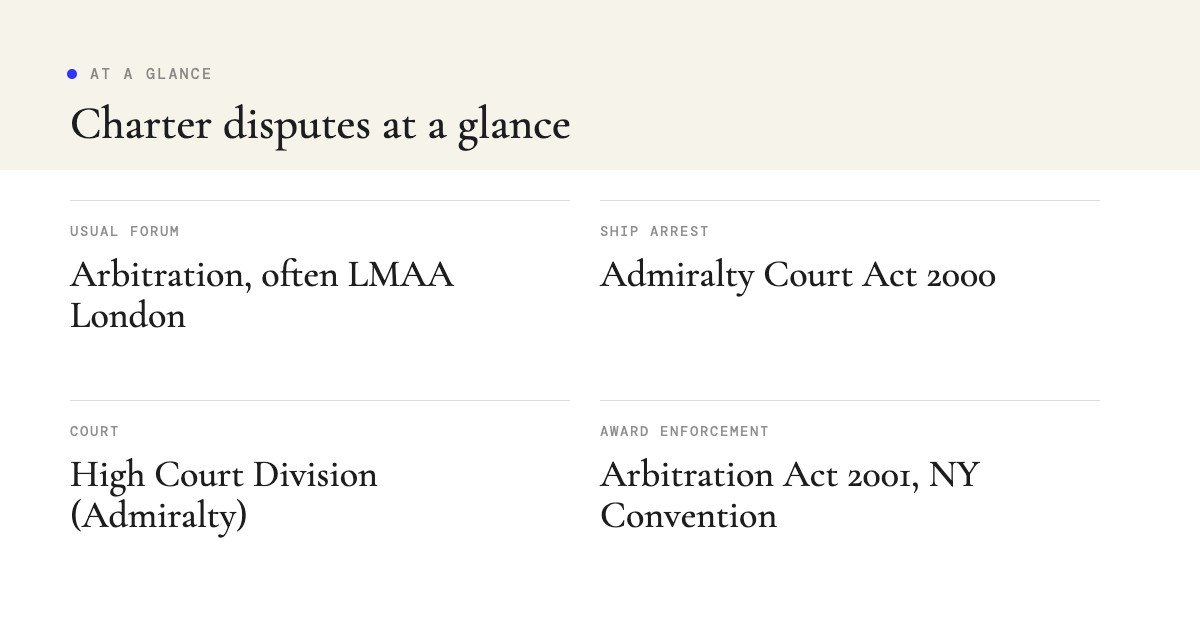
Most charter parties provide for arbitration in London under the London Maritime Arbitrators Association terms, or in Singapore or other centres. Small claims procedures are available for lower-value disputes. Arbitration is private, specialised and usually faster than court litigation.
Bangladeshi parties can also agree arbitration in Dhaka under the Arbitration Act 2001. Wherever the seat, the award must ultimately be enforced where the losing party has assets, which brings Bangladeshi enforcement rules into play. See our guide to arbitration in Bangladesh.
Ship arrest in a charter party dispute in Bangladesh
The Admiralty Court Act 2000 gives the High Court Division admiralty jurisdiction over a list of maritime claims, including claims arising from agreements relating to the carriage of goods or the use or hire of a ship, which covers charter claims. A claimant can apply for the arrest of the vessel to obtain security for its claim, including in support of arbitration abroad.
Arrest is a powerful tool because a detained vessel loses earnings every day, encouraging the owner or its P&I club to provide security, often a letter of undertaking or bank guarantee. The applicant must usually show a prima facie maritime claim and may be required to provide counter-security or an undertaking in damages.
Step by step
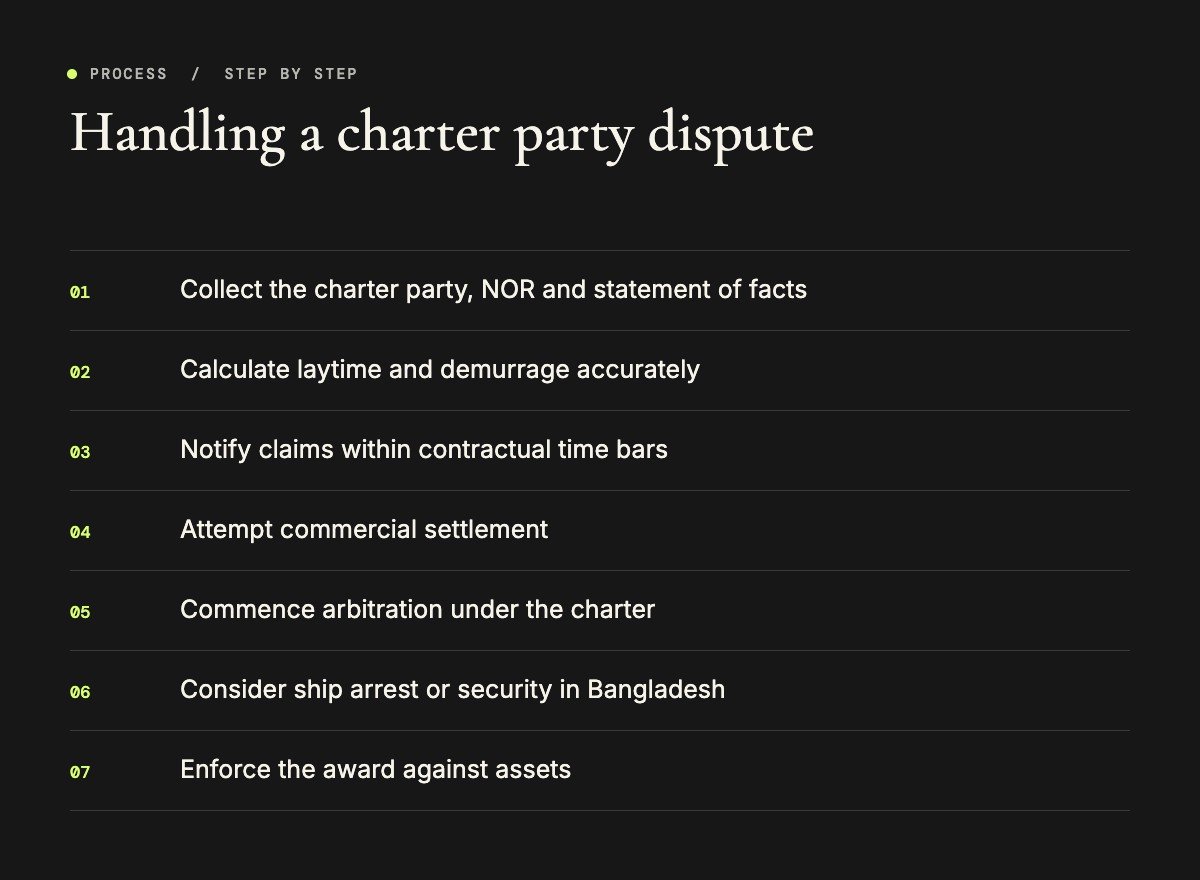
- Collect documents. Charter party, recap, notice of readiness, statement of facts, bills of lading and correspondence.
- Calculate the claim. Prepare a careful laytime and demurrage or hire calculation.
- Observe time bars. Submit claims with documents within contractual deadlines.
- Negotiate. Many disputes settle once both sides review calculations.
- Commence arbitration. Appoint an arbitrator in accordance with the clause.
- Obtain security. Consider ship arrest in Bangladesh or elsewhere.
- Enforce. Enforce the award against assets, including in Bangladesh.
If the vessel is due to call at a Bangladeshi port, act quickly. Arrest applications can be prepared in advance so that the order is obtained while the ship is within jurisdiction. Once she sails, the opportunity to secure the claim may be lost.
Enforcing awards in Bangladesh
Bangladesh is a party to the New York Convention, and foreign arbitral awards are enforceable under section 45 of the Arbitration Act 2001, subject to the limited refusal grounds in section 46. Domestic awards are enforced as decrees under section 44. Enforcement proceedings require the original or certified award and arbitration agreement, with translations where necessary.
Charterers and receivers based in Bangladesh often have assets such as bank accounts, cargo receivables or property that can be attached once the award is recognised. A successful charter party dispute therefore needs an enforcement plan from the outset. Our enforcement practice handles these applications.
Lighterage and outer anchorage operations
Large bulk carriers often cannot berth at Chattogram and discharge at outer anchorage into lighter vessels. This creates particular risks: weather interruptions, shortage of lighters, cargo shortages during transhipment and disputes over who bears lighterage costs and time. A charter party dispute arising from lighterage frequently depends on whether the charter designates a safe anchorage as the discharge place, how lighterage time counts towards laytime and who arranges and pays for lighters.
Clear charter clauses addressing outer anchorage discharge, lighter availability and weather working days significantly reduce the risk of a charter party dispute on Bangladesh voyages.
Cargo claims and bills of lading
Cargo receivers in Bangladesh may bring claims for shortage or damage against carriers under bills of lading, which often incorporate the charter party terms. The Carriage of Goods by Sea Act 1925 applies the Hague Rules to outward shipments from Bangladesh, and the bill of lading terms govern many inward shipments. Receivers frequently seek to arrest the carrying vessel to obtain security for cargo claims.
Owners then look to charterers under the charter's indemnities and inter-club agreements for cargo claims. Coordinating these layers is a common feature of a complex charter party dispute.
Sale contracts and demurrage pass-through
Traders often sit between owners and receivers, with demurrage terms in both the charter and the sale contract. Mismatches between the two contracts, such as different laytime rates or notice provisions, leave the trader exposed. Aligning charter and sale terms helps traders pass demurrage liability down the chain rather than absorbing it.
Settlement strategies
Many claims settle once both sides exchange detailed calculations and supporting documents. Owners can strengthen their position by presenting clear laytime statements, and charterers by identifying specific exceptions such as weather, holidays or owner-caused delays. In a charter party dispute where the amounts are modest, the cost of arbitration may exceed the claim, so early negotiation, mediation or the small claims procedure under arbitration rules often makes commercial sense.
Where the counterparty is based in Bangladesh, a clear demand letter from local counsel, explaining the arrest and enforcement options, frequently encourages payment without formal proceedings. Settling a charter party dispute early also preserves commercial relationships in a market where the same owners, charterers and receivers deal with each other repeatedly.
Practical tips for owners and charterers
- Use clear clauses for anchorage discharge, lighterage and congestion.
- Keep accurate logs, notices and statements of facts signed by agents.
- Diarise every contractual time bar.
- Check P&I club or FD&D cover for legal costs.
- Identify Bangladeshi assets and vessel movements early.
Wrongful arrest risk
Arrest is powerful but carries risk. If an arrest is obtained without a genuine claim, or in bad faith, the shipowner may seek damages for wrongful arrest and the release of any counter-security. Bangladeshi courts expect applicants to make full and frank disclosure. Claimants should therefore present an honest calculation, disclose the arbitration clause and any defences raised, and be ready to provide an undertaking or counter-security if the court requires it. Responsible use of arrest keeps the remedy credible and protects the claimant from costly counterclaims that could outweigh the original demand.
Freight and hire payments
Disputes over unpaid freight or hire often involve liens. Owners may exercise a lien on cargo for unpaid freight or on sub-freights for unpaid hire, if the charter allows. Exercising liens at Bangladeshi ports requires care, because cargo may be needed urgently by receivers and local authorities, and wrongful exercise can expose owners to claims.
Frequently asked questions about charter party dispute
Can a ship be arrested in Bangladesh for unpaid demurrage?
Yes, charter claims fall within the Admiralty Court Act 2000, subject to the court's requirements.
Which law usually governs charter parties?
English law is the most common choice, with London arbitration.
What is a notice of readiness?
Notice that the vessel has arrived and is ready to load or discharge; it usually triggers laytime.
Are there time limits for demurrage claims?
Many charters require claims with documents within a short period after discharge.
Can a London award be enforced in Bangladesh?
Yes, under the Arbitration Act 2001 and the New York Convention.
Which court hears admiralty cases?
The High Court Division of the Supreme Court of Bangladesh.
How we can help
We advise on every charter party dispute involving Bangladesh, from laytime calculations and time bars to ship arrest, arbitration support and award enforcement. Learn more about our admiralty practice, our shipping team and our Chattogram desk.
Vessel calling in Bangladesh?
We act fast to secure claims through arrest and negotiate settlement.
Book a consultationAdmiralty practicePrimary sources: the Admiralty Court Act 2000 and Arbitration Act 2001 on the Laws of Bangladesh portal; admiralty cause lists from the Supreme Court of Bangladesh; Convention information from New York Convention.
This article is general information about Bangladeshi maritime law as of October 2026 and is not legal advice. Charter terms vary widely; review your contract with counsel.



0 Comments