
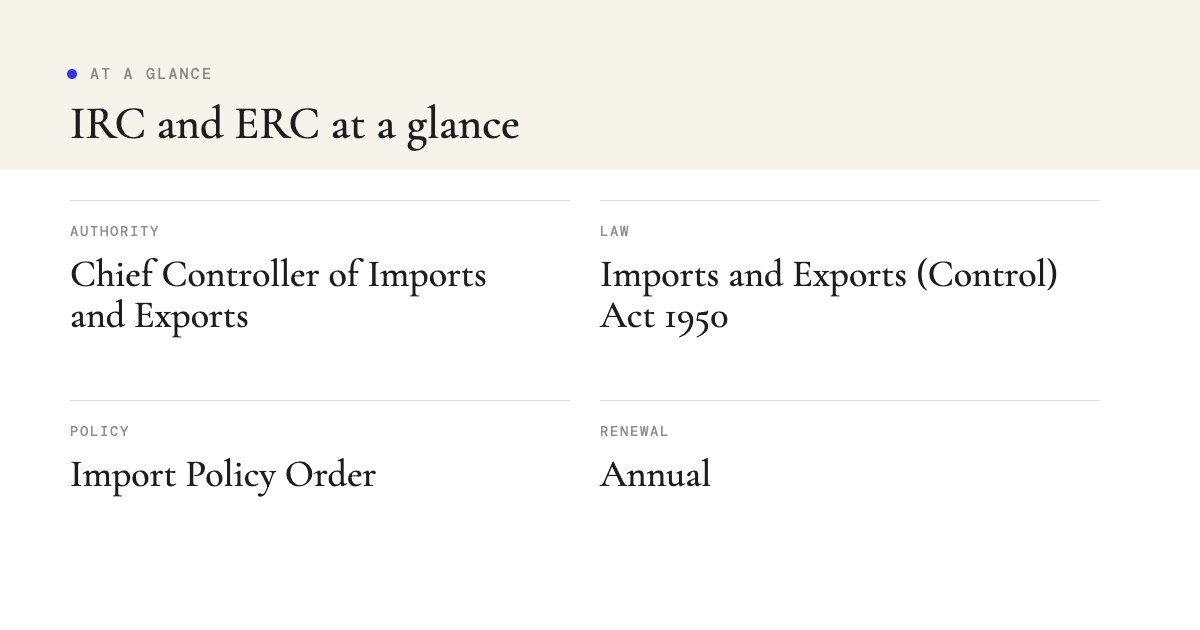
Before a business can open a letter of credit and bring goods into the country, it usually needs an import registration certificate in Bangladesh, known as an IRC. Exporters need an export registration certificate, or ERC. Both are issued by the Office of the Chief Controller of Imports and Exports under the Imports and Exports (Control) Act 1950, and both must be renewed every year.
- An import registration certificate in Bangladesh is required for most commercial and industrial imports through banking channels.
- The Office of the Chief Controller of Imports and Exports (CCI&E) issues IRCs, ERCs and indenting registrations.
- There are separate IRC categories for commercial importers and industrial importers, with fees based on the annual import value slab.
- Applications are made online, with trade licence, TIN, VAT registration, chamber membership and bank documents.
- Certificates must be renewed annually, and banks will not open LCs on expired certificates.
Under the Invest Bangladesh Act 2026, effective 23 August 2026, the Bangladesh Investment Development Authority (BIDA), the Bangladesh Economic Zones Authority (BEZA) and the PPP Authority were merged into a single body, Invest Bangladesh. References below to BIDA, BEZA or the PPP Authority should be read as references to Invest Bangladesh. BEPZA continues as a separate authority.
What an IRC is and who needs one
An IRC is a registration that allows a person or business to import goods into Bangladesh for commercial sale or industrial use. Banks require a valid IRC before opening import letters of credit or processing import payments, and customs authorities check it during clearance.
Traders importing goods for resale need a commercial IRC, while manufacturers importing raw materials, machinery and spare parts need an industrial IRC. Certain imports, such as personal baggage or goods by specific exemption, do not require an import registration certificate in Bangladesh. Our regulatory compliance practice helps businesses obtain and maintain these registrations.
The legal framework for an import registration certificate in Bangladesh
The Imports and Exports (Control) Act 1950 empowers the government to regulate imports and exports. The Importers, Exporters and Indentors (Registration) Order, issued under the Act, sets out registration requirements, categories and fees. The Import Policy Order, issued periodically by the Ministry of Commerce, sets out which goods can be imported and on what conditions.
The Office of the Chief Controller of Imports and Exports, under the Ministry of Commerce, administers registrations through its head office in Dhaka and regional offices in major cities.
IRC, ERC and indenting registration
| Registration | Who needs it |
|---|---|
| Commercial IRC | Traders importing goods for resale |
| Industrial IRC | Manufacturers importing raw materials, machinery and spares for their own production |
| Export registration certificate (ERC) | Businesses exporting goods from Bangladesh |
| Indenting registration | Local agents of foreign suppliers who procure orders on commission |
A business may need more than one registration. A garment manufacturer, for example, typically needs an industrial IRC for imported inputs and an ERC for exports.
Documents for an import registration certificate in Bangladesh
- Valid trade licence from the city corporation, municipality or union parishad.
- Taxpayer identification number (TIN) certificate.
- VAT registration (BIN) certificate.
- Membership certificate of a recognised chamber of commerce or trade association.
- Bank solvency certificate or encashment certificate.
- Certificate of incorporation, memorandum and articles, and list of directors for companies; partnership deed for firms.
- Photographs and national ID of the owner or directors.
- For industrial IRC, factory documents such as the investment registration and relevant licences.
Requirements change from time to time, so applicants should check the current checklist on the CCI&E online system before applying for an import registration certificate in Bangladesh.
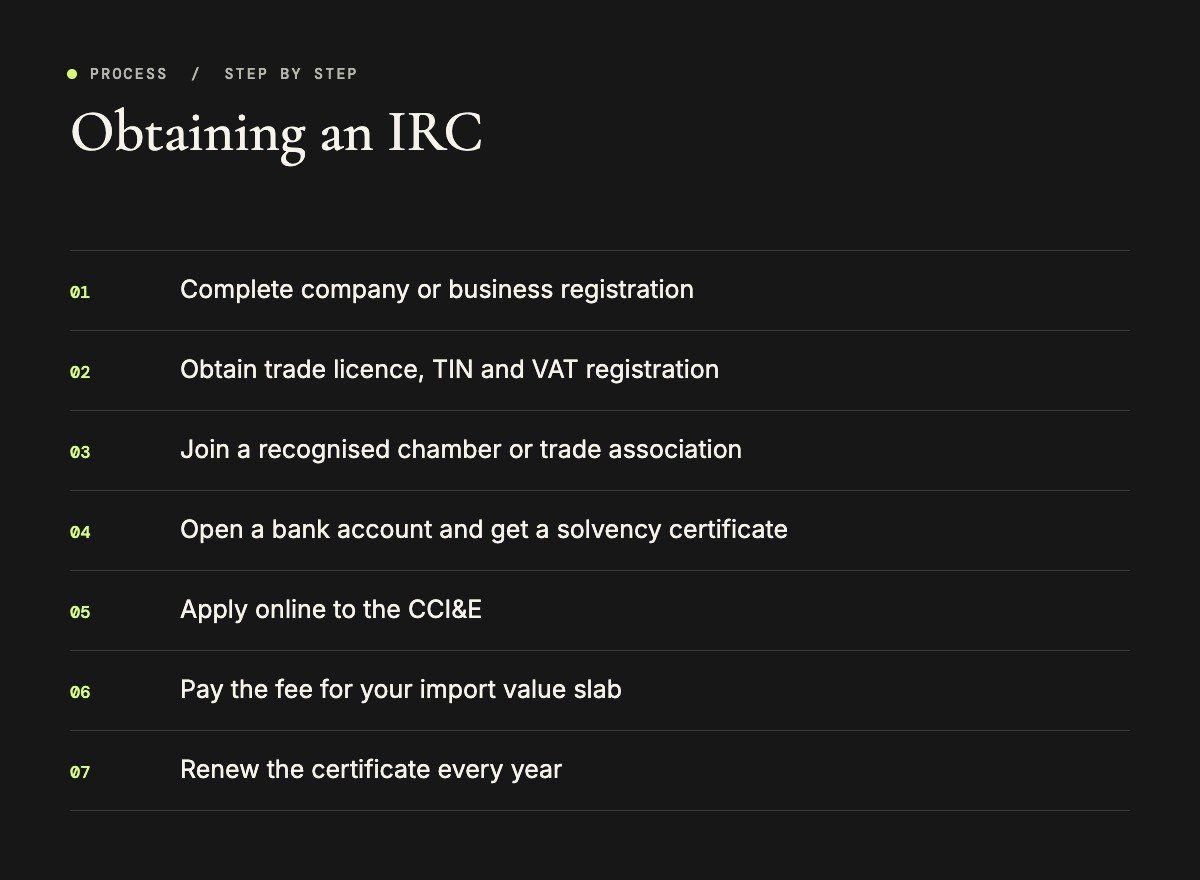
Applying online step by step
- Register the business. Incorporate the company or register the firm.
- Obtain basic licences. Trade licence, TIN and VAT registration.
- Join a chamber. Obtain membership of a recognised chamber or association.
- Bank documents. Open a bank account and obtain a solvency certificate.
- Apply online. Submit the application and documents through the CCI&E online licensing system.
- Pay fees. Pay the registration fee for the selected import value slab, plus VAT.
- Receive the certificate. Download or collect the certificate after verification.
Choose the import value slab carefully. If your annual imports exceed the limit of your IRC category, you will need to upgrade before opening further LCs. Plan for growth when applying, especially in the first year of operations.
Fees and import value slabs
IRC fees depend on the category and the maximum annual import value permitted. Higher slabs carry higher registration and renewal fees. Fees are set by government order and are revised periodically, and VAT is added. Applicants should confirm the current fee schedule on the CCI&E website before payment.
Renewal fees are payable each year. Late renewal may attract additional fees and, more importantly, prevents the business from opening new LCs until renewal is complete.
Renewing an import registration certificate in Bangladesh
An import registration certificate in Bangladesh must be renewed every financial year. Renewal is done online by paying the renewal fee and updating any changed information. Banks check the renewal status before opening LCs or releasing import documents.
Businesses should set reminders well before the renewal deadline. Changes in the company name, address, ownership or directors should be updated with the CCI&E promptly, as mismatches with bank and customs records can delay shipments.
Common problems with an import registration certificate in Bangladesh
- Expired trade licence or VAT registration causing rejection.
- Mismatch between company name in different documents.
- Choosing too low an import value slab.
- Failure to renew before opening a new LC.
- Importing goods outside the scope of an industrial IRC.
Foreign-owned companies and new investors
Foreign-owned companies setting up in Bangladesh often need an import registration certificate in Bangladesh early, to import machinery and raw materials. The investment registration with Invest Bangladesh, which replaced BIDA in 2026, is commonly required for an industrial IRC. Companies in export processing zones obtain import and export permits through BEPZA rather than the CCI&E, while economic zone enterprises follow the procedures of the zone authority.
New investors should sequence their registrations carefully: incorporation, trade licence, TIN, VAT registration, investment registration and then the import registration certificate in Bangladesh, so that the first shipments are not delayed.
Customs and VAT interaction
Customs authorities verify the IRC during clearance and charge customs duty, supplementary duty, VAT, advance income tax and advance tax as applicable. Importers registered for VAT can generally claim input credit for VAT paid at import, subject to VAT law. Advance income tax paid at import can be adjusted against final tax liability in many cases. Accurate classification and valuation of goods avoid disputes and penalties at the port.
Penalties for importing without registration
Importing goods without a valid import registration certificate in Bangladesh, or beyond the permitted value, can result in refusal of bank services, confiscation or detention of goods, fines under customs law and action under the Imports and Exports (Control) Act. Misuse of an industrial IRC to import goods for resale is treated seriously and can lead to cancellation of the registration.
Export registration certificate in detail
Exporters apply for an ERC through the same online system, with similar documents: trade licence, TIN, VAT registration, chamber or association membership and bank documents. Garment exporters typically also need membership of BGMEA or BKMEA, which issue utilisation declarations and other export documents. The ERC must be renewed annually and is checked by banks when processing export LCs and remittances.
Many manufacturers hold both an ERC and an import registration certificate in Bangladesh, because they import inputs and export finished goods. Back-to-back LC arrangements and bonded warehouse licences add further compliance layers for export-oriented industries.
Indenting agents
Local agents representing foreign suppliers, who earn commission on orders placed with their principals, need indenting registration from the CCI&E. Indentors do not import on their own account, so they do not need an import registration certificate in Bangladesh for that activity, but they must keep their registration current and receive commission through banking channels in line with foreign exchange rules.
Small businesses and e-commerce importers
Online sellers who import goods for resale, whether through formal shipments or courier, generally need a commercial IRC once they import through banking channels on a commercial scale. Courier imports for commercial purposes are subject to customs rules and limits. Small businesses should not rely on personal or gift import channels for regular commercial stock, as customs may treat this as evasion. Obtaining an import registration certificate in Bangladesh early lets a growing e-commerce business open LCs, claim VAT input credit and present proper documents to marketplaces and payment providers.
Keeping records
Importers should keep copies of every certificate, renewal receipt, LC, bill of entry and customs assessment for at least the period required by tax and customs law. These records are needed for audits by the National Board of Revenue, Bangladesh Bank inspections of banks and any disputes with customs. A simple compliance calendar tracking the renewal dates of the trade licence, VAT registration, chamber membership and import registration certificate in Bangladesh prevents last-minute problems.
Restricted and banned imports
Registration does not mean any product can be imported. The Import Policy Order lists banned items and restricted items that need permits, certificates or clearances, such as radioactivity testing for certain food products, BSTI certification for listed goods, drug registration with the Directorate General of Drug Administration for medicines, telecom equipment approval from BTRC and environmental clearance for certain chemicals. Importers should check product-specific conditions before placing orders, because goods that arrive without the required permit can be held at the port, incur demurrage and storage charges, or even be confiscated. Working with an experienced clearing and forwarding agent and checking requirements with the relevant authority in advance avoids these costly delays.
The policy also sets conditions for second-hand goods, reconditioned vehicles and capital machinery, including age limits and inspection requirements in some cases.
Changes in ownership or business
When a company changes its name, address, directors or ownership, or converts from a firm to a company, the registration must be updated or a new one obtained. Mergers and acquisitions should include a review of import and export registrations in due diligence, because an asset buyer generally cannot use the seller's certificate and will need its own before importing.
Legal advisers can coordinate these updates with the RJSC, tax authorities and banks so that trade continues without interruption during a transaction or restructuring.
Frequently asked questions about import registration certificate in bangladesh
Who issues the IRC?
The Office of the Chief Controller of Imports and Exports under the Ministry of Commerce.
Can I apply online?
Yes, through the CCI&E online licensing system.
How often must the IRC be renewed?
Every year.
What is the difference between commercial and industrial IRC?
Commercial is for resale; industrial is for imports used in the importer's own production.
Do exporters need a separate certificate?
Yes, an export registration certificate (ERC).
Do foreign-owned companies need an IRC?
Yes, if they import goods; companies in EPZs follow BEPZA procedures.
How we can help
We help businesses obtain and renew an import registration certificate in Bangladesh, ERCs and indenting registrations, and resolve compliance issues with banks and customs. Learn more about our regulatory compliance practice, our trade finance team and our guide to trade licences.
Starting to import or export?
We handle registrations so you can focus on trade.
Book a consultationCompliance practicePrimary sources: registration services of the Office of the Chief Controller of Imports and Exports; the Import Policy Order from the Ministry of Commerce; the Imports and Exports (Control) Act 1950 on the Laws of Bangladesh portal.
This article is general information about Bangladeshi trade regulation as of October 2026 and is not legal advice. Fees and document checklists change; check current CCI&E requirements.



0 Comments