
When a foreign company earns dividends, interest, royalties or service fees from Bangladesh, both countries may want to tax the same income. A double taxation treaty in Bangladesh allocates taxing rights between the two states and often reduces Bangladeshi withholding tax. Treaty relief is valuable but not automatic: the recipient must prove residence and entitlement, and the payer must apply the rules correctly.
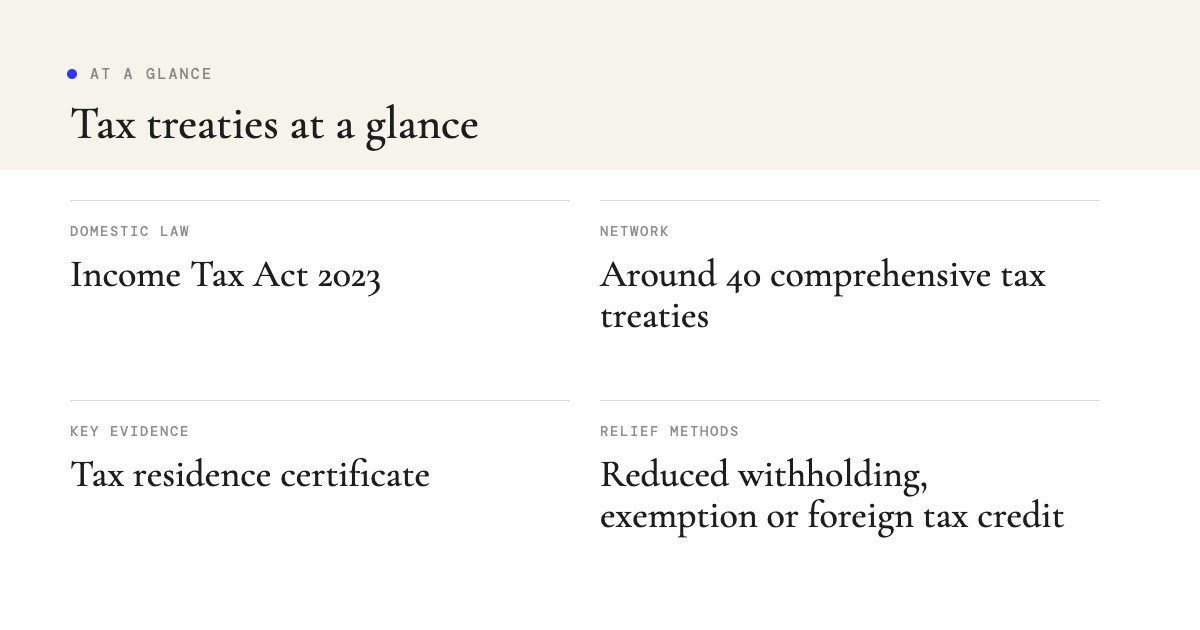
- Bangladesh has a network of comprehensive double taxation agreements with around 40 countries, including the UK, the US, China, India, Japan, Singapore, Germany and others.
- Treaties can reduce Bangladeshi withholding tax on dividends, interest and royalties, and limit taxation of business profits to a permanent establishment.
- A tax residence certificate from the recipient’s home tax authority is the key document for claiming treaty benefits.
- Treaty provisions generally prevail over domestic law where they are more favourable, but domestic procedures must still be followed.
- Residents of Bangladesh can claim foreign tax credits for tax paid abroad on foreign income, subject to limits.
How a double taxation treaty in Bangladesh works
Double taxation agreements, mostly based on the OECD and UN model conventions, define who is a resident, which country may tax each type of income, and the maximum rate the source country can charge. Where both countries may tax, the residence country gives relief by exemption or credit. Treaties also include non-discrimination, mutual agreement procedures for resolving disputes, and exchange of information between tax authorities.
Our tax law practice advises foreign investors and Bangladeshi companies on treaty planning and claims.
Partners in a double taxation treaty in Bangladesh
Bangladesh’s treaty network includes many major trading and investment partners in Asia, Europe, the Middle East and North America, such as the United Kingdom, the United States, Canada, China, India, Japan, South Korea, Singapore, Malaysia, Thailand, Germany, France, the Netherlands, Switzerland, Saudi Arabia and the United Arab Emirates, among others. Investors should confirm that the treaty with their country is in force and check its specific provisions, as rates and definitions differ. The list of treaties is published by the National Board of Revenue.
Benefits under a double taxation treaty in Bangladesh
| Income | Domestic position | Typical treaty effect |
|---|---|---|
| Dividends | Withholding tax on dividends to non-residents | Reduced rate, often 10% to 15%, sometimes lower for substantial holdings |
| Interest | Withholding on interest paid abroad | Reduced rate, often around 10%, with exemptions for some government lenders |
| Royalties and technical fees | Withholding on royalties and fees | Reduced rate, commonly 10% or similar |
| Business profits | Tax on Bangladesh-source income | Taxable only if attributable to a permanent establishment |
| Capital gains | Tax on gains from Bangladeshi assets | Varies by treaty and asset type |
Rates in the table are indicative only; each treaty must be checked individually.
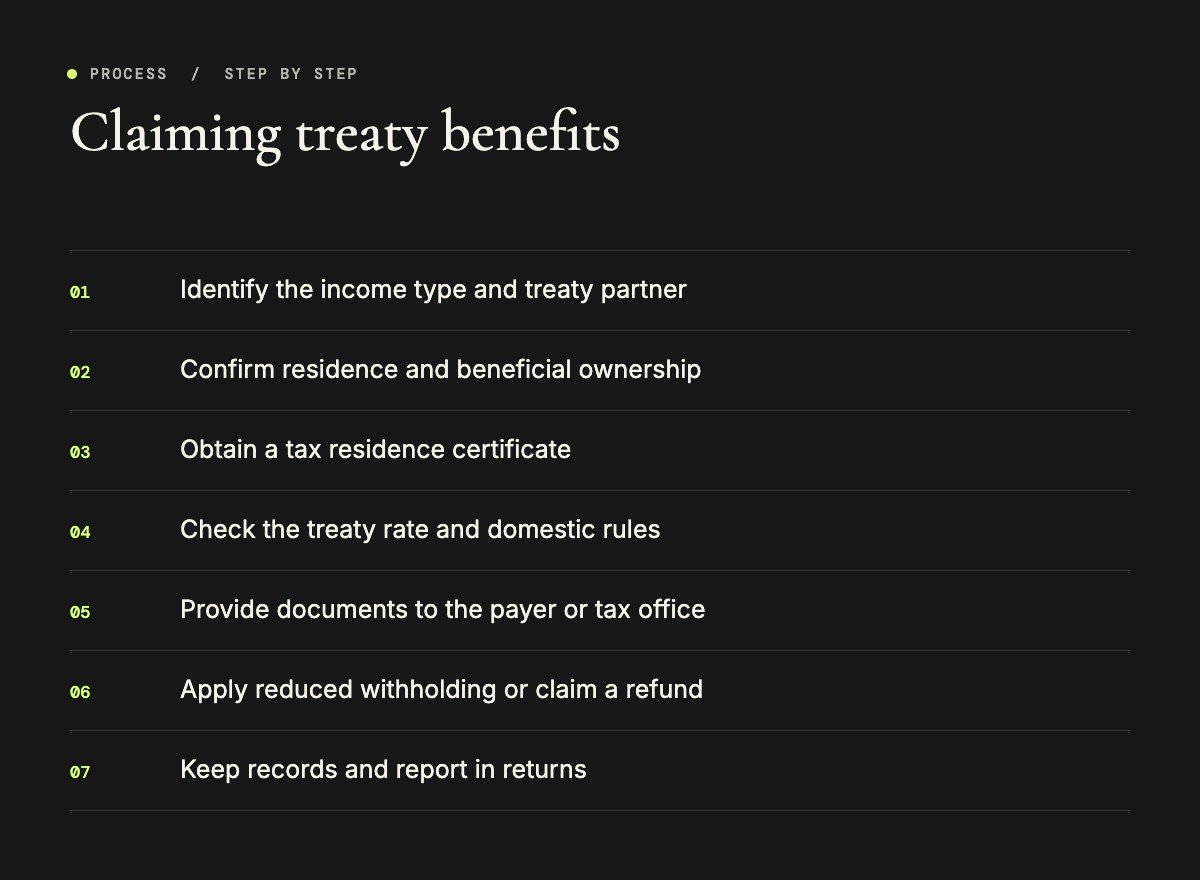
Claiming treaty benefits step by step
- Identify the income. Classify the payment and the relevant treaty article.
- Confirm entitlement. Check residence, beneficial ownership and any limitation clauses.
- Residence certificate. Obtain a certificate from the home tax authority for the relevant year.
- Check rates. Compare treaty and domestic rates and apply the lower one where permitted.
- Provide documents. Give the payer the certificate, declarations and any required approvals.
- Withhold or refund. Apply the reduced rate at payment or claim a refund afterwards.
- Record and report. Keep documentation and report correctly in tax returns.
Payers who apply a treaty rate without proper documents risk being held liable for the shortfall in withholding. Insist on a valid residence certificate before applying a reduced rate.
Documents for a double taxation treaty in Bangladesh claim
The tax residence certificate is issued by the recipient’s home tax authority and confirms that the recipient is resident there for treaty purposes for a given period. Payers and tax officials may also ask for a declaration of beneficial ownership, confirmation that the recipient has no permanent establishment in Bangladesh, and copies of the underlying agreements. Certificates should cover the period in which the income is paid and may need to be renewed annually. Without them, a double taxation treaty in Bangladesh cannot be relied on in practice.
Withholding and the payer’s role
Bangladeshi payers are responsible for deducting tax at source on payments to non-residents under the Income Tax Act 2023. Where a treaty provides a lower rate, the payer may apply it if the documentation is satisfactory, and in some cases prior confirmation from tax authorities is sought. Banks processing outward remittances also check tax deduction certificates before transferring funds abroad. Coordination between the payer, its bank and the recipient avoids delays in payment.
Permanent establishment under a double taxation treaty in Bangladesh
Foreign companies sending staff to Bangladesh, running projects, or operating through dependent agents may create a permanent establishment, making their business profits taxable in Bangladesh. Treaties define permanent establishment, including construction projects lasting longer than a set period and service presence tests in some treaties. Planning the duration and nature of activities, and documenting contracts carefully, helps manage this risk under a double taxation treaty in Bangladesh.
Foreign tax credits for Bangladeshi residents
Bangladeshi resident individuals and companies earning income abroad may claim credit for foreign tax paid, either under a treaty or under domestic law, limited to the Bangladeshi tax attributable to that income. Proper evidence of foreign tax paid is required. This is relevant for Bangladeshi companies expanding overseas and individuals with foreign employment or investment income.
Refunds of excess withholding
If tax was withheld at the full domestic rate even though a treaty rate applied, the recipient may claim a refund of the excess. This usually requires filing a return or a refund application in Bangladesh, supported by the residence certificate, proof of withholding and the underlying agreement. Refund processes can be slow, so obtaining the treaty rate at source is preferable. Recipients should track deadlines for refund claims under the Income Tax Act 2023, because late claims may be rejected even where a double taxation treaty in Bangladesh clearly applied.
Anti-abuse rules and beneficial ownership
Treaty benefits for dividends, interest and royalties are generally available only to the beneficial owner of the income, not to conduit entities that pass it on to others. Many modern treaties and the Multilateral Instrument influence anti-abuse standards such as the principal purpose test. Tax authorities increasingly scrutinise structures that route investment through low-tax jurisdictions purely to access treaty benefits. Investors should ensure their holding companies have genuine substance and commercial reasons.
Mutual agreement procedure
Where a taxpayer believes that the actions of one or both countries result in taxation not in accordance with the treaty, it can present its case to the competent authority of its residence country under the mutual agreement procedure. The competent authorities then try to resolve the issue. This procedure runs alongside domestic remedies such as a tax appeal in Bangladesh, and time limits for initiating it are set in each treaty. It can be useful in transfer pricing disputes and permanent establishment cases.
Interaction with foreign exchange rules
Even when treaty relief reduces tax, outward payments must comply with Bangladesh Bank rules. Remittances of royalties, technical fees and dividends require supporting documents, and some payments, such as royalties and technical assistance fees above certain thresholds, may need registration or approval with Invest Bangladesh or Bangladesh Bank. Planning tax and foreign exchange together ensures that money can actually leave the country at the expected cost.
Common mistakes
Frequent problems include missing or expired residence certificates, applying the wrong treaty article, ignoring permanent establishment exposure, assuming the treaty rate applies automatically, and failing to reconcile withholding in tax returns. Each can lead to assessments, interest and penalties. A short checklist for each cross-border payment, reviewed by the finance team, prevents most of these errors in applying a double taxation treaty in Bangladesh.
Individuals and the double taxation treaty in Bangladesh
Treaties also matter for individuals. Expatriates working in Bangladesh may be taxed in both countries; treaty tie-breaker rules determine residence where both countries treat the person as resident, and the employment article sets when salary is taxable in Bangladesh. Short-term assignments below certain thresholds may be exempt if conditions are met. Bangladeshi nationals working abroad may claim relief for foreign tax on their earnings. Individuals should keep records of days spent in each country and payslips showing tax withheld.
Planning investments with treaties in mind
Investors choosing a holding jurisdiction for Bangladeshi investments should compare treaty rates on dividends, interest and capital gains, the substance requirements in that jurisdiction, and the broader tax and legal environment. A jurisdiction with a favourable double taxation treaty in Bangladesh may reduce leakage on repatriated profits, but only if the holding company has real substance and the structure has commercial purpose. Decisions should be made before investing, because restructuring later can trigger taxes.
Transfer pricing and the double taxation treaty in Bangladesh
Cross-border payments between related parties, such as management fees, royalties and interest, must comply with Bangladesh’s transfer pricing rules in the Income Tax Act 2023, requiring arm’s length pricing and documentation. Treaty relief on withholding does not protect against transfer pricing adjustments, which may disallow deductions or recharacterise payments. Treaties provide a mechanism for corresponding adjustments through mutual agreement, which can relieve resulting double taxation.
Checklist for finance teams
Before each cross-border payment, confirm the recipient’s country and treaty status, obtain a current residence certificate and beneficial ownership declaration, identify the correct treaty article and rate, check foreign exchange documentation, deduct and deposit tax on time, issue a withholding certificate, and file the related returns. Reviewing this checklist quarterly keeps compliance on track.
Keeping a central register of treaty claims, certificates and expiry dates makes audits far easier and helps new staff apply the rules consistently across the business and its group companies.
External advisers can review the register annually to catch changes in treaties or domestic rules that affect existing payment streams.
This small investment of time often prevents costly assessments and interest later.
Frequently asked questions about double taxation treaty in bangladesh
How many tax treaties does Bangladesh have?
Around 40 comprehensive double taxation agreements.
What document proves treaty entitlement?
A tax residence certificate from the recipient’s home country, with supporting declarations.
Do treaties override domestic law?
Generally, more favourable treaty provisions apply, subject to domestic procedures.
Can I get a refund if too much tax was withheld?
Yes, by applying to the tax authority with supporting documents, within time limits.
What is a permanent establishment?
A fixed place of business or certain other presence that makes business profits taxable in Bangladesh.
Can Bangladeshi residents claim foreign tax credit?
Yes, subject to the Income Tax Act 2023 and treaty provisions.
How we can help
We advise on every double taxation treaty in Bangladesh question, from structuring investments and documenting claims to refunds and disputes. See our tax law practice, our foreign direct investment team and our corporate practice.
Paying or receiving cross-border income?
We make sure you only pay tax once, and correctly.
Book a consultationTax lawPrimary sources: the Income Tax Act 2023 on Laws of Bangladesh; treaty texts and guidance from the National Board of Revenue; foreign exchange rules from Bangladesh Bank.
This article is general information about Bangladeshi tax law as of October 2026 and is not tax advice. Treaty rates and domestic rules vary; check the specific treaty and current law.




0 Comments