
Textile dyeing, washing, tanneries, pharmaceuticals and chemical plants generate wastewater that can poison rivers and groundwater. An effluent treatment plant in Bangladesh is a legal requirement for many such industries before they can obtain environmental clearance, and running it properly every day is a condition of keeping that clearance. Regulators, courts and international buyers all scrutinise ETP compliance closely.

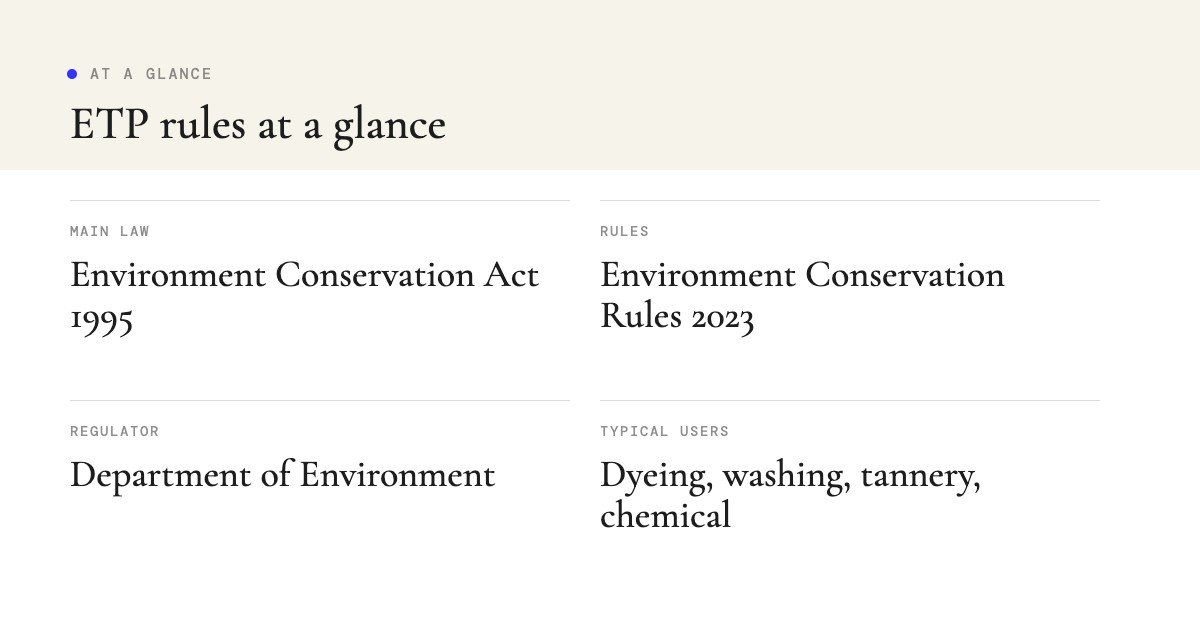
- The Environment Conservation Act 1995 and the Environment Conservation Rules 2023 require industries that generate liquid waste to treat it to prescribed standards before discharge.
- Industries in the higher-risk orange and red categories generally need an effluent treatment plant as a condition of environmental clearance.
- The ETP must be designed for the factory's actual effluent and operated continuously, not just during inspections.
- The Department of Environment can fine, order closure or disconnect utilities for non-compliance, and environment courts hear related cases.
- International buyers and brands require ETP compliance and often conduct their own wastewater testing.
Why ETPs matter
Untreated industrial wastewater has severely polluted rivers around Dhaka, including the Buriganga, Turag and Shitalakshya, harming public health, fisheries and agriculture. An effluent treatment plant in Bangladesh removes or reduces pollutants such as dyes, chemicals, heavy metals and organic matter so that discharged water meets legal standards.
Beyond legal compliance, ETP performance affects a factory's reputation, export orders and access to finance. Our environment and ESG practice advises manufacturers on clearance, compliance and enforcement.
The legal framework for an effluent treatment plant in Bangladesh
The Environment Conservation Act 1995 empowers the Department of Environment to control pollution, set standards and issue environmental clearance certificates. The Environment Conservation Rules 2023, issued in March 2023 to replace the 1997 Rules, classify industries into green, yellow, orange and red categories according to their environmental impact, set the clearance process and prescribe standards for effluent discharge.
The Environment Court Act 2010 establishes environment courts and appellate courts to try offences and hear compensation claims. The High Court Division has also issued directions in public interest litigation requiring ETP installation and river protection.
Which industries need an ETP
| Category | Examples | ETP requirement |
|---|---|---|
| Green | Low-impact activities | Generally not required |
| Yellow | Moderate-impact industries | Depends on liquid waste generated |
| Orange | Many manufacturing industries with liquid effluent | Usually required where wastewater is generated |
| Red | Dyeing, washing, tanneries, chemicals, pharmaceuticals and similar | Required, with detailed environmental assessment |
The exact classification depends on the schedules to the 2023 Rules. Businesses should check their category carefully, because it determines the clearance process, documents required and whether an effluent treatment plant in Bangladesh is mandatory for their operations.
Environmental clearance and ETP approval
For orange and red category projects, the clearance process usually involves site clearance, an environmental impact assessment or initial environmental examination, approval of the ETP design and, after construction and commissioning, the environmental clearance certificate. The Department of Environment reviews the ETP's design capacity, treatment process and expected discharge quality.
Environmental clearance must be renewed periodically. Renewal often depends on evidence that the ETP is operating effectively, including test reports and operation records. See our guide to environmental clearance in Bangladesh.
Discharge standards for an effluent treatment plant in Bangladesh
The 2023 Rules prescribe standards for parameters such as biochemical oxygen demand, chemical oxygen demand, total suspended solids, pH, temperature, colour and specific pollutants including heavy metals, with stricter limits for some industries. Standards may differ depending on whether effluent is discharged into inland surface water, public sewers or irrigated land.
An effluent treatment plant in Bangladesh must be designed and operated to meet these standards consistently, accounting for variations in production and chemical use.
Operating an effluent treatment plant in Bangladesh
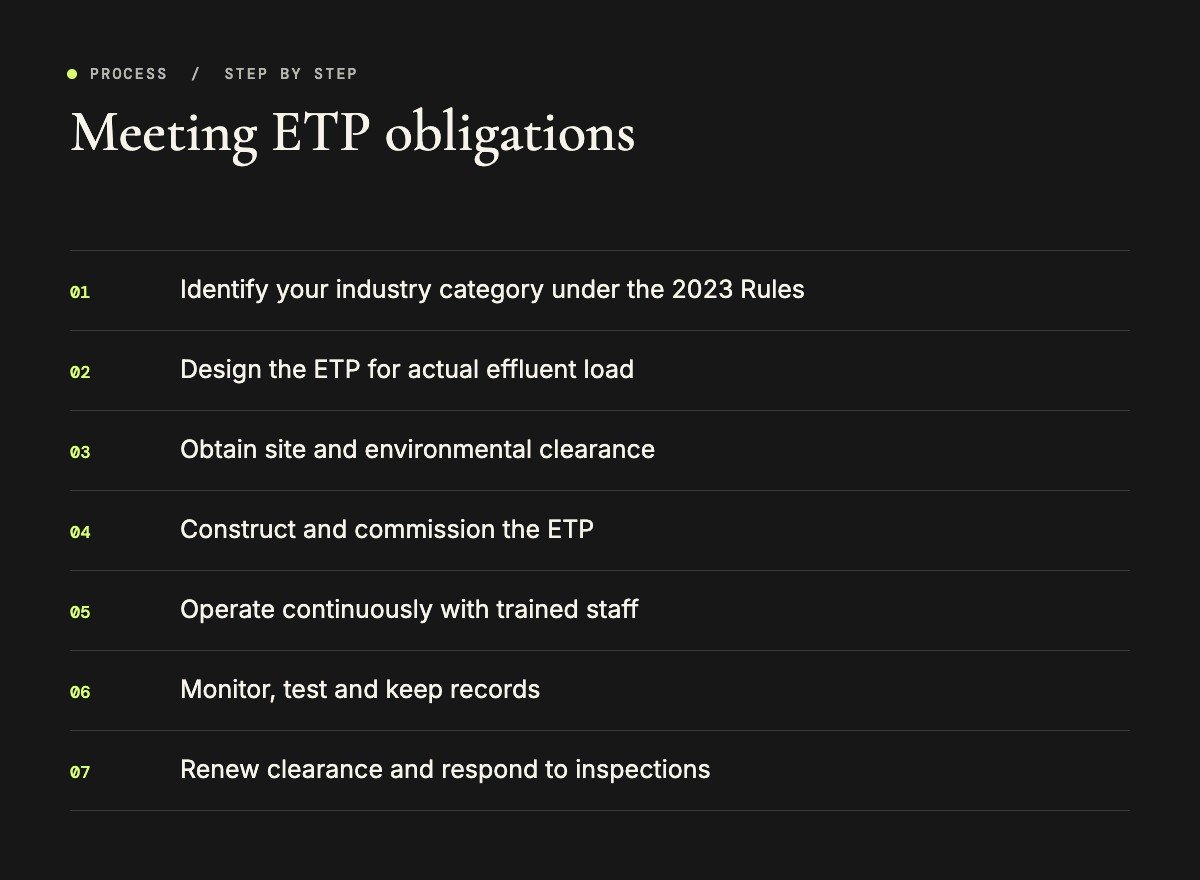
- Classify. Confirm the industry category and applicable standards.
- Design. Size the ETP for peak effluent volume and pollutant load.
- Approve. Obtain Department of Environment approval of the design.
- Commission. Construct, test and commission before production begins.
- Operate. Run continuously with trained operators and adequate chemicals and power.
- Monitor. Test inlet and outlet quality regularly and keep logs.
- Maintain. Manage sludge safely and maintain equipment.
The most common enforcement problem is not the absence of an ETP but switching it off to save electricity and chemicals. Electricity meters, flow meters and chemical purchase records can reveal this. Keep complete operating records, because they are your best evidence of continuous compliance.
Sludge management
ETPs produce sludge that may contain hazardous chemicals and heavy metals. The 2023 Rules and hazardous waste rules require safe handling, storage and disposal of such waste. Dumping sludge on land or in water bodies is an offence. Factories should use authorised disposal methods and keep records of sludge quantities and disposal.
Enforcement against an effluent treatment plant in Bangladesh
The Department of Environment inspects factories, tests effluent and can impose compensation for environmental damage, issue directions, order closure of operations and request disconnection of utilities. Offences under the Environment Conservation Act can lead to imprisonment and fines, and cases can be brought in environment courts. Mobile courts have also fined factories for running without functional ETPs.
Repeat violations attract heavier penalties and can lead to permanent closure. For an effluent treatment plant in Bangladesh, consistent compliance is far cheaper than enforcement.
Central ETPs and industrial zones
In some industrial estates, export processing zones and economic zones, a central effluent treatment plant serves multiple factories. The tannery industry's relocation from Hazaribagh to the Savar tannery estate, with a central ETP, is the best-known example, and its performance has been the subject of significant scrutiny and court proceedings. Factories connected to a central plant must still pre-treat effluent where required and pay charges, and remain responsible for complying with discharge conditions.
Where a central plant underperforms, individual factories may face enforcement and buyer pressure even if they have no direct control over the facility, so contracts with the operator should address performance and liability. An effluent treatment plant in Bangladesh shared among many users needs clear governance.
Buyer requirements and global standards
International apparel brands increasingly require suppliers to meet wastewater guidelines set by industry initiatives, conduct regular testing at accredited laboratories and disclose results. These requirements can be stricter than national standards. Failure to meet them can lead to lost orders. For export-oriented factories, an effluent treatment plant in Bangladesh must therefore meet both legal and buyer standards.
Water efficiency and zero liquid discharge
Reducing water use cuts both treatment costs and environmental impact. Many factories now invest in water recycling, low-liquor-ratio dyeing machines and rainwater harvesting. Some aim for zero liquid discharge, treating and reusing all wastewater. Groundwater depletion around Dhaka makes water efficiency increasingly important, and regulators may tighten groundwater extraction rules. Combining water efficiency with a well-run effluent treatment plant in Bangladesh helps factories stay ahead of regulatory and buyer expectations.
Online monitoring and transparency
Regulators have moved towards real-time monitoring of effluent quality for high-impact industries, using sensors and data connections to report key parameters. Where such requirements apply, factories must keep monitoring equipment calibrated and connected. Tampering with monitoring systems is treated very seriously. Even where online monitoring is not mandatory, installing flow meters and recording data strengthens a factory's ability to show that its effluent treatment plant in Bangladesh runs continuously.
Some brands publish supplier wastewater data, and civil society groups track river pollution. Transparency can protect compliant factories by distinguishing them from polluters.
Financing an ETP
Building and operating an effluent treatment plant in Bangladesh requires significant investment. Green financing schemes from Bangladesh Bank and development partners have offered lower-cost loans for ETPs, water recycling and cleaner production technologies, subject to eligibility criteria. Factories should explore these options with their banks and keep documentation showing the environmental benefits of the investment.
Responding to an inspection or notice
When the Department of Environment inspects a factory or issues a notice, management should cooperate, provide operating records and test reports, and take legal advice on any allegations. Prompt corrective action, such as repairing equipment, increasing treatment capacity or improving operator training, should be documented and reported. Where a hearing is offered before compensation is imposed, present evidence carefully. A cooperative, well-documented response often reduces penalties and helps restore clearance for an effluent treatment plant in Bangladesh that has fallen short.
Choosing ETP technology
ETPs use physical, chemical and biological processes, or combinations of them. Physico-chemical treatment removes suspended solids and some colour using coagulants and settling, while biological treatment uses microorganisms to break down organic pollutants. Advanced options include membrane filtration and reverse osmosis for water reuse. The right design depends on the type of production, chemicals used, effluent volume and discharge route. Combined physico-chemical and biological systems are common for textile dyeing because they handle both colour and organic load. Choosing a reputable designer and contractor, with performance guarantees in the contract, reduces the risk of a plant that cannot meet standards once production starts.
Operator training
An ETP is only as good as the people running it. Operators need training in chemical dosing, monitoring, troubleshooting and safety. Factories should keep training records and standard operating procedures, and assign clear responsibility at management level for ETP performance.
Community relations
Neighbouring communities are often the first to notice pollution. Factories that engage openly with local people, respond to complaints and share information build goodwill and reduce the risk of conflicts and legal challenges.
Directors' responsibility
Environmental offences by companies can lead to liability for directors and managers who were in charge of the business, unless they show the offence occurred without their knowledge or that they exercised due diligence. Boards should therefore receive regular reports on ETP performance, test results, inspections and complaints, approve budgets for operation and upgrades, and ensure that cost-cutting never comes at the expense of compliance. Documented board oversight is both good governance and an important defence if enforcement action arises. Lenders and investors increasingly ask for the same information as part of their environmental and social due diligence.
Treating environmental compliance as a core part of the business, rather than an afterthought, protects the factory's licence to operate and its long-term relationships with customers, lenders and the community.
Frequently asked questions about effluent treatment plant in bangladesh
Which law requires an ETP?
The Environment Conservation Act 1995 and Environment Conservation Rules 2023.
Which factories need an ETP?
Generally orange and red category industries that generate liquid waste, such as dyeing and washing plants.
Who regulates ETPs?
The Department of Environment.
Can a factory share a central ETP?
Yes, where a central ETP is approved and operating, such as in some industrial estates and zones.
What happens if the ETP is not running?
Fines, compensation, closure orders, utility disconnection and prosecution are possible.
Do buyers check ETPs?
Yes, many brands require wastewater testing and compliance with their own standards.
How we can help
We advise manufacturers on effluent treatment plant in Bangladesh obligations, environmental clearance, inspections, enforcement proceedings and buyer audits. Learn more about our environment and ESG practice, our manufacturing team and our compliance practice.
Facing an environmental inspection?
We help factories comply and respond effectively to regulators.
Book a consultationEnvironment practicePrimary sources: the Environment Conservation Act 1995, Environment Conservation Rules 2023 and Environment Court Act 2010 on the Laws of Bangladesh portal; clearance services from the Department of Environment.
This article is general information about Bangladeshi environmental law as of October 2026 and is not legal advice. Standards and procedures may change; confirm current requirements with the Department of Environment.




0 Comments