
Contractors, suppliers and consultants working with ministries, state-owned enterprises and local authorities often face delayed payments, wrongful termination, unfair tender decisions or debarment. A government contract dispute in Bangladesh follows special rules: procurement complaint procedures, mandatory notices before suing the government, arbitration clauses in standard contracts and the High Court Division’s writ jurisdiction for public law wrongs.

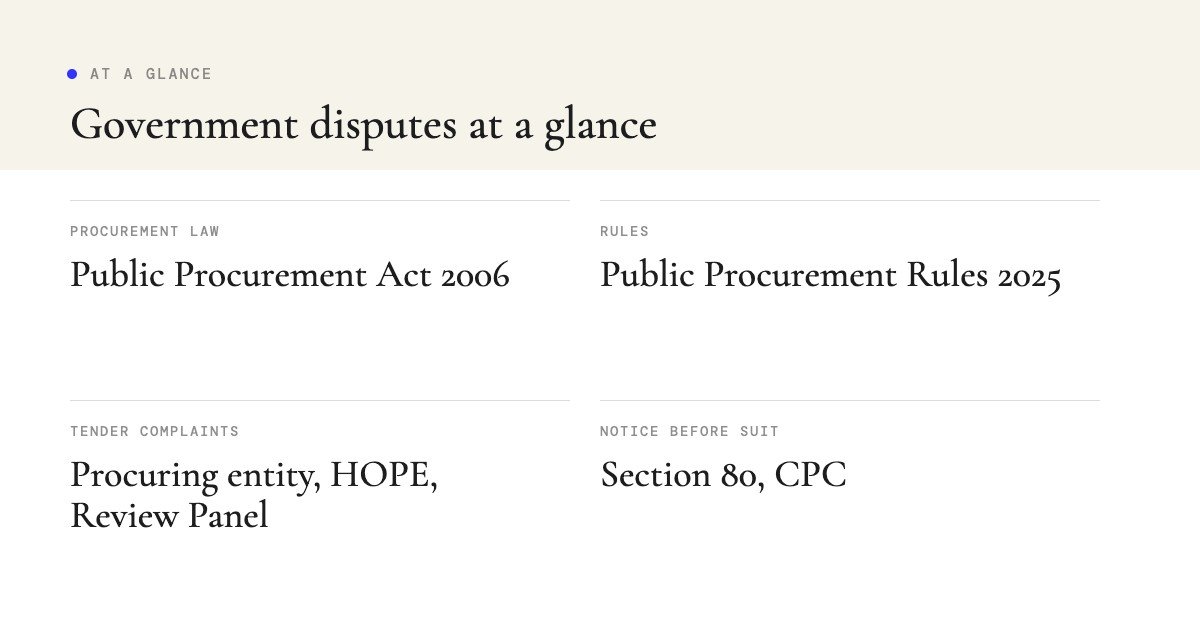
- Public procurement is governed by the Public Procurement Act 2006 and the Public Procurement Rules 2025, in force from 28 September 2025.
- Tender-stage complaints follow a structured process: the procuring entity, the head of the procuring entity and then a Review Panel.
- Contract-stage disputes usually follow the contract's dispute clause, often adjudication and arbitration under the Arbitration Act 2001.
- Before suing the government, section 80 of the Code of Civil Procedure requires written notice, generally two months in advance.
- Writ petitions can challenge public law wrongs such as arbitrary debarment, but purely contractual claims are usually left to arbitration or civil courts.
Why government disputes are different
Public bodies act under statutory powers and procurement rules designed to ensure transparency and value for money. Their contracts usually use standard documents issued by the Central Procurement Technical Unit, now renamed the Bangladesh Public Procurement Authority, or by development partners. These documents contain detailed dispute resolution clauses. In addition, special procedural rules apply when suing the government.
Understanding these rules early is essential in any government contract dispute in Bangladesh, because missing a deadline or skipping a mandatory step can bar a claim. Our public and administrative law practice and government sector team act for contractors and public bodies.
The legal framework for a government contract dispute in Bangladesh
The Public Procurement Act 2006 sets the principles and procedures for procurement by government ministries, departments, state-owned enterprises and other public bodies. The Public Procurement Rules 2025, in force from 28 September 2025, replaced the 2008 Rules and introduced updated procedures, including debarment of up to two years and a Debarment Review Board. An amendment ordinance to the Act was later enacted by Parliament in April 2026.
Other relevant laws include the Contract Act 1872, the Arbitration Act 2001, the Code of Civil Procedure 1908 and the Constitution, which provides for writ jurisdiction under Article 102.

Tender-stage government contract dispute in Bangladesh
| Stage | Body | Purpose |
|---|---|---|
| First | Procuring entity | Complaint against actions or decisions in the tender process |
| Second | Head of the procuring entity | Review if the first response is unsatisfactory |
| Third | Review Panel | Independent review of procurement decisions |
| Further | High Court Division | Writ petition on public law grounds |
The Act and Rules set short deadlines for each stage and may require a security deposit for Review Panel applications. Bidders who believe they were unfairly disqualified or that the award was improper must act quickly, because once a contract is signed, remedies become more limited.
Contract-stage government contract dispute in Bangladesh
Once a contract is signed, disputes typically concern delayed payments, variations, extensions of time, liquidated damages, termination, price adjustment and certification of work. Standard government contracts often provide for amicable settlement, then adjudication or a dispute board, and finally arbitration under the Arbitration Act 2001.
Contractors should follow the notice requirements in the contract strictly, such as claims for extension of time or additional payment within specified periods. Failure to give timely notice is a common reason claims fail in a government contract dispute in Bangladesh. See our construction disputes practice.
Arbitrating a government contract dispute in Bangladesh
Where the contract includes an arbitration clause, disputes are generally referred to arbitration, usually seated in Dhaka. Public bodies are bound by arbitration agreements like private parties, and awards can be enforced under the Arbitration Act 2001, although enforcement against the government involves practical challenges, including budget approvals for payment.
Contracts funded by development partners, such as the World Bank or Asian Development Bank, may use FIDIC-based conditions with dispute boards and international arbitration rules. See our guide to arbitration in Bangladesh.
Suing the government
Section 80 of the Code of Civil Procedure requires that no suit be instituted against the government or a public officer for acts done in official capacity until two months after written notice has been delivered, stating the cause of action, the name and address of the plaintiff and the relief claimed. The purpose is to give the government an opportunity to settle.
Suits filed without proper notice may be dismissed. In urgent cases, courts have considered whether interim relief can be sought, but compliance with section 80 remains critical in a government contract dispute in Bangladesh that goes to a civil court.
Writ petitions in a government contract dispute in Bangladesh
The High Court Division can issue writs under Article 102 against public authorities acting without lawful authority, in breach of natural justice or arbitrarily. Courts have held that purely contractual disputes are generally not suitable for writ jurisdiction, especially where disputed facts or an arbitration clause exist. However, writs may be available where a public body acts arbitrarily or unlawfully in the exercise of statutory powers, such as unlawful cancellation of a tender, discriminatory treatment or debarment without a hearing.
See our guide to writs in Bangladesh.
Step by step
- Review the documents. Contract, tender documents, procurement rules and correspondence.
- Raise the issue. Write to the procuring entity promptly with supporting documents.
- Use tender complaints. For tender disputes, follow the complaint stages within deadlines.
- Follow the contract. Use notice, adjudication and escalation provisions.
- Arbitrate. Commence arbitration where the contract provides.
- Serve notice. Serve section 80 notice before filing a civil suit.
- Consider writ. Challenge public law wrongs in the High Court Division.
Keep a contemporaneous record of instructions, delays and site events. In a government contract dispute in Bangladesh, the contractor usually bears the burden of proving entitlement, and officials change frequently. Good records are often the only reliable evidence years later.
Debarment and blacklisting
The Public Procurement Rules 2025 allow procuring entities and the procurement authority to debar contractors for misconduct such as corrupt practices, fraud, collusion or serious non-performance, for periods of up to two years. A Debarment Review Board hears challenges. Debarment can exclude a contractor from all public procurement, so it often becomes the most damaging aspect of a government contract dispute in Bangladesh.
Contractors facing debarment should respond fully to show-cause notices, request hearings, present evidence and use the Review Board. If the process breaches natural justice or the law, a writ petition may be available. Development partners maintain their own sanctions systems, which can lead to cross-debarment.
Recovering unpaid bills
Delayed payment is the most frequent complaint. Contractors should check the contract's payment terms, certification procedures and interest on late payment. Written demands, escalation to senior officials and the ministry, and reference to the contract's dispute mechanism are usually the first steps. Where funds are delayed for budget reasons, negotiation and documentation often achieve more than immediate litigation, but a well-prepared arbitration claim adds pressure.
Recovering money is often the main goal in a government contract dispute in Bangladesh, so contractors should consider practical enforcement from the outset.
Termination by the procuring entity
Government contracts typically allow termination for contractor default and sometimes for convenience. Termination for default usually requires notice and an opportunity to remedy. Wrongful termination can lead to claims for damages, release of performance security and payment for work done. Contractors should challenge improper encashment of performance securities promptly, as courts generally treat bank guarantees as independent obligations and intervene only in limited circumstances such as fraud.
Foreign contractors and development partner projects
Foreign contractors on large infrastructure and energy projects often work under contracts financed by development partners or foreign governments. These contracts may provide for international arbitration under ICC or UNCITRAL rules, and the financing agreements may give lenders a role in disputes. A government contract dispute in Bangladesh involving a foreign contractor should consider applicable bilateral investment treaties, which may offer investor-state arbitration for certain government actions, as well as the contract itself.
Payments to foreign contractors also involve foreign exchange approvals and tax withholding, which can become additional sources of dispute if delayed.
Negotiation and settlement
Many disputes with public bodies are resolved through negotiation, especially where officials recognise the contractor's entitlement but need proper documentation to justify payment. Presenting a clear claim with contract references, evidence and calculations, and engaging at the right level of the ministry or enterprise, often resolves a government contract dispute in Bangladesh without formal proceedings. Settlement agreements with public bodies may require internal approvals, so allow time for these.
Practical tips for contractors
- Read the special conditions of contract, not just the general conditions.
- Give every contractual notice in writing and on time.
- Keep site diaries, minutes and correspondence organised.
- Track deadlines for tender complaints and claims carefully.
- Avoid informal arrangements that are not recorded in writing.
Following these tips makes it far easier to succeed if a government contract dispute in Bangladesh later goes to adjudication, arbitration or court.
Price adjustment and inflation
Long-term public contracts are affected by inflation, exchange rate movements and changes in the price of materials such as steel, cement and bitumen. Some contracts include price adjustment formulas, while others are fixed-price. When costs rise sharply, contractors may seek relief through variation claims, price adjustment provisions or negotiation. The procurement rules and contract conditions determine what is permissible, and public bodies are often cautious about approving increases without clear contractual grounds. Contractors should document cost changes carefully, using official indices and invoices, and raise claims within the time allowed by the contract.
Liquidated damages for delay
Public bodies frequently deduct liquidated damages for late completion. Contractors can challenge deductions where delays were caused by the employer, such as late handover of site, delayed approvals, design changes or late payments, and where extensions of time should have been granted. Courts apply section 74 of the Contract Act 1872, awarding reasonable compensation up to the stipulated amount.
Frequently asked questions about government contract dispute in bangladesh
Which rules govern public procurement?
The Public Procurement Act 2006 and Public Procurement Rules 2025.
How do I challenge a tender decision?
Complain to the procuring entity, then the head of the procuring entity, then the Review Panel, within deadlines.
Do I need to give notice before suing the government?
Yes, section 80 CPC generally requires two months' written notice.
Can I file a writ over unpaid bills?
Purely contractual claims are usually for arbitration or civil courts, not writs.
Can debarment be challenged?
Yes, through the Debarment Review Board under the 2025 Rules and, on public law grounds, by writ.
Are arbitration clauses enforceable against public bodies?
Yes, public bodies are bound by arbitration agreements.
How we can help
We act in every kind of government contract dispute in Bangladesh, from tender complaints and Review Panel applications to arbitration, civil suits and writ petitions. Learn more about our public and administrative law practice and our Supreme Court practice.
Dispute with a public body?
We identify the right forum and deadlines, then act quickly.
Book a consultationPublic law practicePrimary sources: the Public Procurement Act 2006 and Code of Civil Procedure 1908 on the Laws of Bangladesh portal; procurement rules and standard documents from the public procurement authority; e-tendering via e-GP.
This article is general information about Bangladeshi public law as of October 2026 and is not legal advice. Deadlines are strict; take advice promptly.




0 Comments