
ICC arbitration in Bangladesh is the default dispute route for a large share of the country's cross-border deals: power purchase agreements, EPC and FIDIC contracts, telecoms, aircraft leases and supply contracts. Knowing how the ICC process interacts with Bangladeshi law decides whether an award ends in payment or in years of resistance.
- ICC is the institution most often named in international contracts with Bangladeshi counterparties, partly because FIDIC forms and many lender documents refer disputes to ICC by default.
- Revised ICC Arbitration Rules took effect on 1 June 2026: Terms of Reference are optional, the fixed six-month award deadline is gone, early determination is expressly available and the expedited threshold rises to USD 4 million for new agreements.
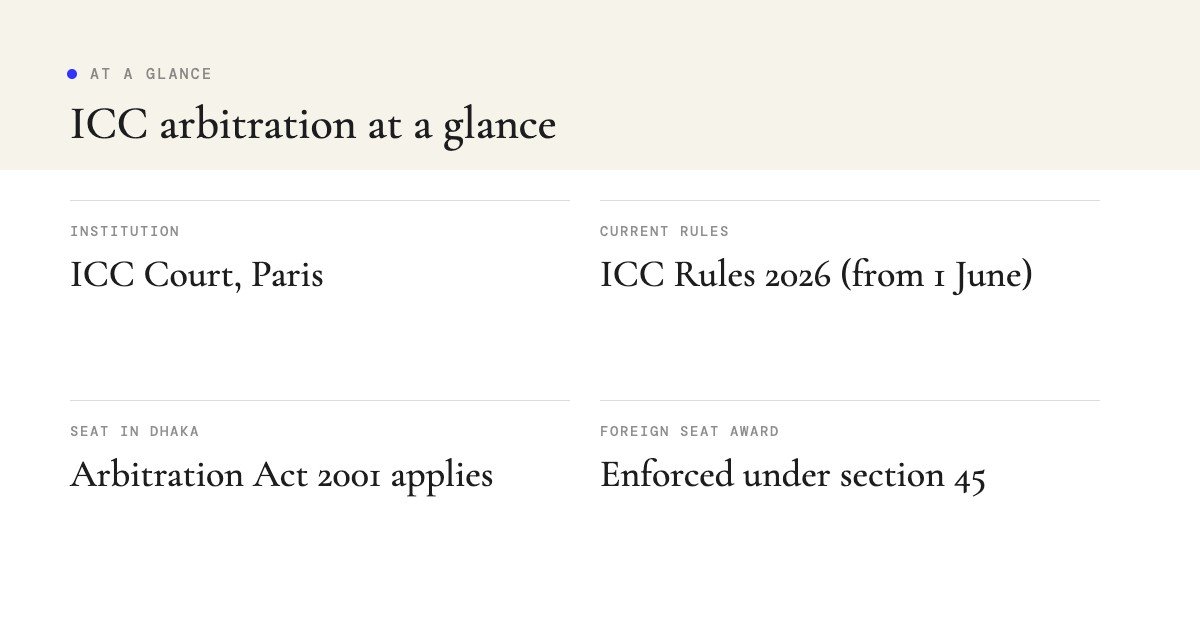
- If the seat is Dhaka, the Arbitration Act 2001 governs the arbitration and any challenge; if the seat is abroad, the award is enforced in Bangladesh under section 45 of that Act.
- Past ICC cases involving Bangladeshi state entities show that the real battle is often at enforcement, sometimes decades after the award.
- Careful drafting of the seat, governing law, language and authority to arbitrate prevents most later jurisdiction fights.
Why ICC arbitration in Bangladesh matters
The International Chamber of Commerce's International Court of Arbitration, based in Paris, administers arbitrations worldwide under the ICC Rules. For Bangladeshi companies, state-owned enterprises and the foreign businesses that contract with them, it is the most familiar international institution, alongside SIAC and LCIA.
There are good reasons for that. Foreign lenders and investors want a neutral forum outside the local courts. Contractors on donor-funded infrastructure use FIDIC conditions, whose standard dispute clause refers final disputes to ICC arbitration. And ICC's scrutiny of draft awards gives parties some comfort that the award will be enforceable. The result is that ICC arbitration in Bangladesh-related disputes runs across power, gas, telecoms, aviation, shipping, construction and trade.
ICC Bangladesh, the national committee
ICC Bangladesh, the national committee based in Dhaka, promotes ICC rules and services locally, runs training and can be invited by the ICC Court to propose arbitrators. It does not administer cases; every ICC case is administered by the Secretariat of the ICC Court, wherever the seat is.
Lessons from ICC cases involving Bangladeshi parties
Bangladeshi parties have been on both sides of ICC arbitration in Bangladesh and abroad for decades. Two well-documented episodes show the risks and the eventual pay-off.
Court interference under the old law
In the Saipem dispute with Petrobangla over a gas pipeline contract, Bangladeshi courts in 2000 revoked the authority of an ICC tribunal seated in Dhaka under the old Arbitration Act 1940 and restrained the arbitration. The tribunal continued and issued an award. In 2009 an ICSID tribunal held that the Bangladeshi court orders breached the Italy-Bangladesh bilateral investment treaty. The Arbitration Act 2001, modelled on the UNCITRAL Model Law, now limits court intervention, but the case still shapes how foreign parties choose the seat.
Enforcement that took two decades
In August 2025, Global Arbitration Review reported that Bangladesh had paid ICC awards issued more than twenty years earlier to a US power company, after enforcement proceedings in the United States, mediation and a stay of arrest warrants against visiting state officials. The lesson for both sides is the same: an ICC award against a Bangladeshi state entity does not expire quietly, and resisting payment can create costs far beyond the award itself.
For state-owned counterparties, check at signing who has authority to agree to arbitration and whether ministry or cabinet approval is needed. Authority objections are among the first defences raised by public bodies, and they are much easier to defeat if the approvals are on file.
The 2026 ICC Rules: what changed
The ICC published revised Arbitration Rules on 22 May 2026, effective 1 June 2026, replacing the 2021 Rules. ICC arbitrations commenced from that date generally run under the 2026 Rules unless the parties agreed otherwise. The table summarises the changes that matter most for ICC arbitration in Bangladesh-related contracts.
| Issue | 2021 Rules | 2026 Rules |
|---|---|---|
| Terms of Reference | Mandatory | Optional, at the tribunal's discretion |
| Time limit for final award | Six months from Terms of Reference, usually extended | Set and extended case by case by the ICC Court |
| Early determination | Inferred from case management powers | Express procedure for manifestly unmeritorious claims or defences (Article 30) |
| Expedited procedure threshold | USD 3 million | USD 4 million for agreements concluded on or after 1 June 2026 |
| Highly expedited option | None | Opt-in procedure with a sole arbitrator and award within three months of the first case management conference |
| Emergency arbitrator | Available against signatories | Can extend to non-signatories on a prima facie basis; ex parte preliminary orders possible |
What the changes mean for Bangladeshi parties
Optional Terms of Reference and a flexible award deadline should shorten the early phase of a case, which suits parties that want quicker results. The early determination procedure is useful against weak claims, but a Bangladeshi respondent should expect claimants to use it against technical defences such as limitation or lack of authority, so those defences need evidence from the start.
The highly expedited option allows parties to agree to an unreasoned award. Think carefully before agreeing to that in a contract where enforcement may be needed in Bangladesh, since an award without reasons invites arguments at the enforcement stage, even where the parties consented.
Choosing the seat for ICC arbitration in Bangladesh-related contracts
The ICC Rules govern procedure, but the seat decides which national arbitration law applies and which courts can set the award aside. For ICC arbitration in Bangladesh-related contracts, that choice matters more than the institution.
| Seat | Supervisory law | Setting-aside court | Practical points |
|---|---|---|---|
| Dhaka | Arbitration Act 2001 | High Court Division for international commercial arbitration | Local court support available; enforcement as a domestic award |
| Singapore | International Arbitration Act | Singapore High Court | Neutral, close to Bangladesh, strong court support |
| London | Arbitration Act 1996, as amended in 2025 | English High Court | Common for finance and shipping; English-law contracts |
| Paris or Geneva | French or Swiss law | Local courts | Used in some energy and European contracts |
An ICC case seated in Dhaka
Parties can agree to ICC rules with a Dhaka seat, which makes it ICC arbitration in Bangladesh in the strict legal sense. The Arbitration Act 2001 then applies alongside the Rules. Under section 2(c), an arbitration is an international commercial arbitration if at least one party is foreign, by nationality, residence or incorporation, or is a foreign government. Applications to set aside such an award go to the High Court Division within 60 days of receipt under section 42, on the grounds in section 43.
A Dhaka seat gives access to interim measures from Bangladeshi courts under section 7A and lets the winner enforce directly as a decree under section 44. Against that, foreign parties sometimes worry about delay in court challenges, which is why many contracts choose Singapore or London while keeping hearings in Dhaka for convenience.
A foreign seat and enforcement at home
When the seat is abroad, the Arbitration Act 2001 largely stops applying, except sections 45 to 47 on enforcement. The winning party applies to the Court of the District Judge, Dhaka, under section 45, and the debtor can resist only on the New York Convention grounds in section 46. Bangladesh acceded to the Convention in 1992 without reservations. Our enforcement of awards practice handles these applications.
Drafting an ICC clause for a Bangladeshi counterparty
Most problems in ICC arbitration in Bangladesh trace back to a clause drafted in a hurry. A good clause takes five minutes more and saves months.
- Use the ICC model clause. Refer all disputes to arbitration under the Rules of Arbitration of the International Chamber of Commerce, and name the institution correctly.
- State the seat. Write "the seat of arbitration shall be Singapore" or "Dhaka", not just a venue for hearings.
- Fix the number of arbitrators. Three for large or complex disputes; one for smaller ones.
- Choose the language. English is standard; say so, and deal with Bangla documents through translation.
- Choose the governing law. State the law of the contract and, ideally, the law of the arbitration agreement.
- Cover multi-contract projects. Use compatible clauses in the EPC, supply and guarantee documents so related disputes can be joined or consolidated.
Public contracts and procurement rules
Contracts with ministries and statutory bodies often follow standard documents under the Public Procurement Act 2006 and the Public Procurement Rules 2025, which commonly provide for arbitration in Bangladesh under the 2001 Act. Donor-funded projects may instead use FIDIC or lender-required clauses with ICC. Read the particular conditions; the general conditions are often amended on exactly this point, so not every public contract leads to ICC arbitration in Bangladesh or abroad.
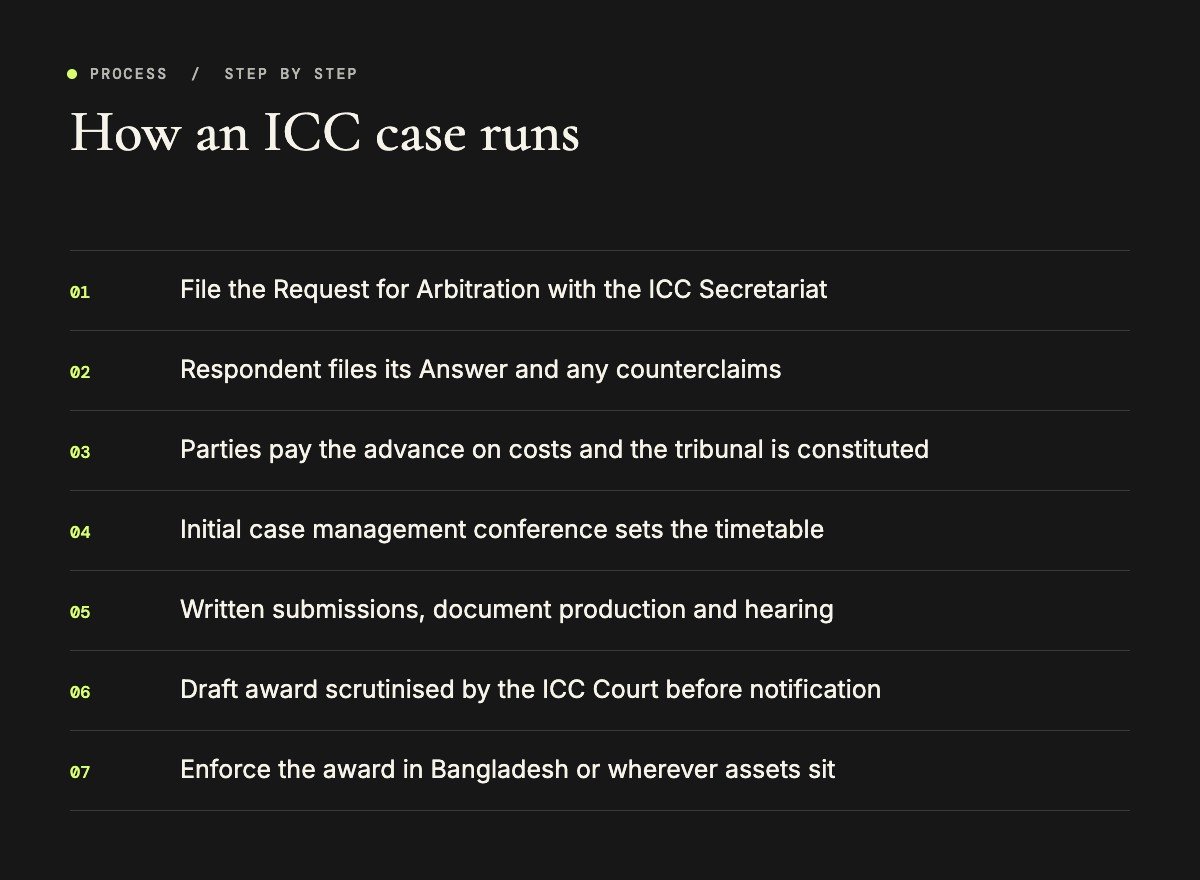
How an ICC arbitration runs, step by step
The procedure for ICC arbitration in Bangladesh-related disputes is broadly the same whatever the seat. The steps below reflect the 2026 Rules.
- Request for Arbitration. The claimant files a Request with the ICC Secretariat, describing the dispute, the relief sought and the arbitration agreement, and pays the filing fee.
- Answer. The respondent normally has 30 days to file an Answer, raise jurisdictional objections, nominate an arbitrator if required and bring counterclaims.
- Advance on costs. The ICC Court fixes an advance covering arbitrators' fees and administrative expenses, usually shared equally. If one side does not pay, the other may have to pay its share to keep the case moving.
- Constitution of the tribunal. Arbitrators are nominated and confirmed, or appointed by the ICC Court, after disclosure checks on independence and impartiality.
- Case management conference. The tribunal and parties agree a procedural timetable, including any early determination application and whether Terms of Reference will be used.
- Written phase and hearing. Statements of case, witness statements, expert reports, document production and an evidentiary hearing, in person or remote.
- Scrutiny and award. The tribunal submits a draft award to the ICC Court, which may modify its form and draw attention to points of substance, before the award is notified to the parties.
Costs are calculated on the ICC scales by reference to the amount in dispute; use the cost calculator on the ICC website for an estimate rather than relying on rules of thumb.
Practical issues for Bangladeshi parties
Beyond the Rules themselves, ICC arbitration in Bangladesh raises practical questions that foreign counsel often overlook and local teams often underestimate.
Paying fees and costs abroad
Payments to the ICC and to foreign counsel and arbitrators are outward remittances from Bangladesh. Authorised dealer banks process them under Bangladesh Bank's foreign exchange rules, and some payments may need supporting documents or approval. Plan this early so that a Bangladeshi party is not defaulted on the advance on costs because of a remittance delay.
Evidence and documents
Many records of Bangladeshi companies and agencies are in Bangla. Budget for certified translation, and keep originals of board approvals, correspondence and site records. Tribunals give weight to contemporaneous documents over later witness recollection.
Interim relief and emergency arbitrators
The ICC Rules allow a party to seek urgent measures from an emergency arbitrator before the tribunal is constituted, and the tribunal itself can order interim measures. Neither is automatically enforceable in Bangladesh. For a Dhaka-seated case, a party can ask the court for interim measures under section 7A of the Arbitration Act 2001. For a foreign-seated case, Bangladeshi courts have read their powers narrowly before the enforcement stage, so a party planning ICC arbitration in Bangladesh-related disputes should consider where urgent relief would actually be obtained and draft the seat accordingly.
Hearings in Dhaka with a foreign seat
The seat is a legal concept, not a physical place. Parties can choose Singapore as the seat and still hold hearings in Dhaka, or fully online, which saves travel costs for local witnesses. The award remains a Singapore award for setting-aside and enforcement purposes. Make the distinction clear in the clause by naming the seat separately from the hearing venue.
Parallel court proceedings
Where a party sues in Bangladesh despite an arbitration clause, the other can apply under section 10 of the Arbitration Act 2001 for the suit to be stayed and referred to arbitration, if the seat is in Bangladesh. For a foreign-seated ICC case, Bangladeshi courts have relied on their inherent powers under the Code of Civil Procedure rather than section 10. Move quickly, before filing a written statement on the merits.
Costs, funding and timing
An ICC case is a significant investment. The main cost items are the ICC administrative expenses, the arbitrators' fees, counsel and expert fees, translation and hearing costs. Under the ICC Rules the tribunal decides who bears the costs in its final award, and it often takes into account how each party conducted the case. A Bangladeshi party that drags out document production or raises late objections may find that reflected in the costs order.
Bangladesh has no specific legislation on third-party funding of arbitration. Foreign funders are increasingly active in disputes involving South Asian parties, but anyone considering funding for ICC arbitration in Bangladesh-related claims should take advice on disclosure obligations under the Rules and on how a funding agreement may be viewed in any Bangladeshi enforcement proceedings.
Timing depends on complexity, the number of parties and the tribunal's availability. The 2026 Rules aim to shorten the early stages, and the expedited and highly expedited procedures offer faster routes for smaller or simpler disputes. Build realistic time for enforcement into any business plan; for an award against a Bangladeshi party, enforcement can take as long as the arbitration itself.
Common mistakes in ICC arbitration in Bangladesh
- No seat named. A clause naming only "ICC, Dhaka or Singapore" invites a preliminary fight.
- Unchecked authority. A public body signs without the approvals needed to arbitrate.
- Ignoring the advance on costs. Failure to pay can leave a party without a voice in key decisions.
- Late jurisdiction objections. Objections not raised in the Answer may be treated as waived.
- No enforcement plan. Winning without knowing where the debtor's assets are wastes the award.
Frequently asked questions about ICC arbitration in Bangladesh
Can an ICC arbitration be seated in Dhaka?
Yes. Parties can agree to the ICC Rules with a Dhaka seat. The Arbitration Act 2001 then governs the arbitration, and any challenge to an award in an international commercial arbitration goes to the High Court Division within 60 days.
Do the 2026 ICC Rules apply to my existing contract?
Generally, an ICC case follows the Rules in force when it is commenced, so a case started after 1 June 2026 will usually use the 2026 Rules. The higher expedited threshold applies only to agreements concluded on or after that date.
How is an ICC award enforced in Bangladesh?
A foreign-seated award is enforced by the Court of the District Judge, Dhaka, under section 45 of the Arbitration Act 2001, subject only to the grounds in section 46. A Dhaka-seated award is enforced as a decree under section 44.
Can a Bangladeshi state entity refuse to take part?
It can refuse to participate, but the ICC case continues and the tribunal can issue a binding award in its absence. Non-participation usually makes enforcement objections harder, not easier.
Are emergency arbitrator orders enforceable in Bangladesh?
The Arbitration Act 2001 does not provide for emergency arbitrators, and an emergency order is not an award. Direct enforcement in Bangladesh is doubtful, so parties usually seek interim relief from the courts as well.
How we can help
We act for Bangladeshi and foreign parties in ICC arbitration in Bangladesh and abroad, from drafting and reviewing arbitration clauses to preparing requests, running hearings with international co-counsel and enforcing or resisting awards in Dhaka. Learn more about our ICC and LCIA arbitration practice, our wider international arbitration work and our guide to the arbitration process.
Facing an ICC claim or planning one?
We review your clause, assess jurisdiction and enforcement risk, and build a strategy that works under the 2026 Rules and Bangladeshi law.
Book a consultationICC and LCIA arbitrationPrimary sources: the ICC Arbitration Rules from the International Chamber of Commerce; the Arbitration Act 2001 on the Laws of Bangladesh portal; contracting states from the New York Convention site; standard contract forms from FIDIC.
This article is general information about Bangladeshi law and ICC practice as of 2026 and is not legal advice. Institutional rules, fees and court practice change; confirm the current position with a qualified lawyer before acting.



0 Comments