
The Bank Company Act 1991 is the main statute governing every scheduled bank in Bangladesh, from licensing and ownership to board composition, lending and Bangladesh Bank's power to intervene. The 2023 amendments and the 2025 to 2026 bank resolution reforms have changed how sponsors, directors and investors must approach it.
- The Act applies to all bank companies in Bangladesh, including private commercial banks, Islamic banks, foreign bank branches and, with some differences, state-owned banks.
- The Bank Company (Amendment) Act 2023 extended director tenure to 12 consecutive years, cut family directors to a maximum of three, and created a statutory wilful defaulter regime.
- Bangladesh Bank can issue directions, remove directors and senior managers, supersede boards and, under the new bank resolution law, transfer or merge failing banks.
- Loans to directors, their families and related companies are tightly controlled and must now be properly secured.
- Further amendments on independent directors and family control were proposed in 2025; check whether any have been enacted before relying on the current text.
Non-bank financial institutions are now governed by the Finance Company Act 2023, which replaced the Financial Institutions Act 1993; such institutions are now called finance companies. References below to the 1993 Act should be read accordingly.
What the Bank Company Act 1991 covers
The Bank Company Act 1991 (Act No. 14 of 1991) regulates the business of banking in Bangladesh. It replaced the earlier Banking Companies Ordinance 1962 and works alongside the Bangladesh Bank Order 1972, which constitutes the central bank, and the Companies Act 1994, which governs banks as companies.
The scope of the Bank Company Act 1991 is wide. It controls who may carry on banking business, how much capital a bank must hold, who may own and direct it, what it may and may not do with depositors' money, how it reports and how the regulator may step in when things go wrong. Non-bank financial institutions are regulated separately under the Financial Institutions Act 2023.
How the Act fits with other laws
The Bank Company Act 1991 does not stand alone. The Companies Act 1994 applies to banks as companies except where the banking law provides otherwise. Cash reserve requirements flow from the Bangladesh Bank Order 1972. Loan recovery runs through the Artha Rin Adalat Ain 2003, anti-money laundering duties through the Money Laundering Prevention Act 2012, and failing banks are now handled under the bank resolution law. Listed banks must also follow securities regulation and the corporate governance code of the Bangladesh Securities and Exchange Commission.
Who must comply
The Bank Company Act 1991 binds bank companies, their directors, chief executive officers, senior managers, sponsor shareholders and, in many respects, borrowers. Foreign banks operating branches in Bangladesh are also subject to it. State-owned commercial banks are covered too, although the government's role in appointing their boards creates some practical differences in supervision.
For investors, the Act matters before money is committed: buying a significant stake in a bank, joining its board or borrowing from a bank where you are connected to a director all trigger specific rules.
Licensing, capital and permitted business
No company may carry on banking business in Bangladesh without a licence from Bangladesh Bank under section 31 of the Act. The central bank examines the applicant's capital, the sponsors' financial strength and integrity, the business plan and whether the new bank serves the public interest. Licences can be cancelled for serious breaches.
Minimum paid-up capital and capital adequacy are set by Bangladesh Bank under the Act and its Basel-based capital framework. These figures are revised from time to time by circular, so check the current Bangladesh Bank requirements on the Bangladesh Bank website before planning a new bank or a capital raise.
Foreign bank branches
Foreign banks operate in Bangladesh through licensed branches rather than local subsidiaries. They need a licence under the same section, must keep capital in Bangladesh as Bangladesh Bank requires, and are supervised like local banks for most purposes. The board composition rules of the Bank Company Act 1991 are designed for locally incorporated banks, so a branch's governance is driven largely by its head office and Bangladesh Bank's directions.
What banks may and may not do
The Act lists the forms of business a bank company may undertake, such as taking deposits, lending, guarantees, trade finance and remittance, and restricts others. In general a bank may not engage directly in trading goods, and holdings of shares and immovable property beyond what the business needs are restricted. Islamic banks operate under the same Act, with Shariah-based products governed by Bangladesh Bank guidelines.
Ownership and shareholding limits
The Bank Company Act 1991 limits concentrated ownership so that no single person or family can treat a bank as its own. The Act caps the shares any one person, family or company may hold in a bank, and Bangladesh Bank's approval is needed for significant acquisitions and changes in sponsor shareholding.
"Family" is defined broadly to include spouses, parents, children, siblings and other dependants, so shares held through relatives and connected companies are aggregated. Sponsors who structure holdings through multiple group companies should expect Bangladesh Bank to look through the structure.
Foreign strategic investors interested in Bangladeshi banks should map the existing family and group holdings before signing anything. The aggregation rules and the need for regulatory approval often decide the deal structure more than price does.
Board of directors under the Bank Company Act 1991
Board composition has been the most contested part of the Act for two decades, and the 2023 amendment changed it again. The current position, as amended, is summarised below.
| Rule | Current position | Comment |
|---|---|---|
| Board size | Maximum of 20 directors | Includes independent directors |
| Family members | No more than three from one family | Reduced from four by the 2023 amendment |
| Tenure | Up to 12 consecutive years | Then a gap of three years before reappointment |
| Independent directors | Required by the Act and Bangladesh Bank rules | Further increases were proposed in 2025 |
| Fit and proper test | Bangladesh Bank criteria | Defaulters and certain disqualified persons barred |
| Chief executive | Appointment and removal need Bangladesh Bank approval | Fit and proper criteria apply |
Directors' duties and conflicts
Directors of a bank owe the same duties as other company directors, plus specific statutory duties under the banking law. They must not interfere in day-to-day management beyond the board's role, must disclose interests in transactions, and must not take part in decisions on loans to themselves or connected parties. Bangladesh Bank's corporate governance guidelines set out board committees, including audit and risk management committees.
Defaulters cannot sit on the board
A person who is a defaulter, or who is a director of a company in default, faces disqualification. Section 27KaKa deals with defaulting borrowers, who are barred from fresh credit and must be reported, and the Act provides for the office of a defaulting director to be vacated. The 2023 amendment strengthened this link by bringing wilful defaulters into the statute.
Lending restrictions and related-party loans
Insider lending has been at the heart of Bangladesh's banking crises, and the Bank Company Act 1991 addresses it directly. Loans to a bank's own directors, their family members and companies in which they have an interest are restricted, require board approval without the interested director, and are subject to limits set by Bangladesh Bank.
The 2023 amendment requires directors and their families who borrow from banks to provide proper security, and allows banks to realise that security through the Artha Rin Adalat Ain 2003 if loans are not repaid. Large loan and single-borrower exposure limits are set by Bangladesh Bank circular and apply across the banking sector.
Cross-lending between bank directors
Arrangements where the directors of one bank borrow from another bank in return for reciprocal lending have long been a concern. Banks should treat any loan request connected to directors of other banks with caution, document the credit assessment fully and report as Bangladesh Bank requires.
Wilful defaulters: the 2023 regime
The most significant change made in 2023 was the statutory definition of a wilful defaulter. In broad terms, a wilful defaulter is a borrower who has the means to repay but does not, who obtains a loan by fraud or false information, who uses a loan for a purpose other than the one approved, or who transfers mortgaged property without the bank's consent.
Banks must identify wilful defaulters through a defined process with a right to be heard, report them to Bangladesh Bank and publish lists. Bangladesh Bank may then ask the authorities to impose restrictions such as a ban on foreign travel, refusal of a trade licence and a bar on registering new companies with the RJSC. A wilful defaulter also cannot serve as a bank director.
Practical consequences for borrowers
For a borrower, a wilful defaulter classification is far more damaging than an ordinary default. It affects the ability to do business, raise new credit and travel. Borrowers facing classification should engage early, use the hearing process and, where the classification is unjustified, consider challenge, including by writ petition in the High Court Division where the process was unfair.
Bangladesh Bank's supervisory powers
The Bank Company Act 1991 gives Bangladesh Bank extensive powers. It may inspect any bank, call for information, issue binding directions in the interests of depositors or the banking system, and impose penalties for breaches.
Where a bank is run in a manner harmful to depositors, Bangladesh Bank may remove a director, chief executive or other officer, appoint observers or additional directors and, in serious cases, supersede the board and appoint an administrator. In 2024 and 2025 these powers were used to reconstitute the boards of a number of troubled banks.
The new bank resolution framework
The Bank Resolution Ordinance 2025, issued on 9 May 2025, gave Bangladesh Bank a dedicated toolkit for failing banks, including temporary public ownership, transfer to a bridge bank, mergers with stronger banks and a resolution fund. Parliament passed a Bank Resolution Bill on 10 April 2026, retaining the framework with amendments. Read the resolution law together with the Bank Company Act 1991, and check the final enacted text and any implementing rules.

The 2023 amendments at a glance
The Bank Company (Amendment) Act 2023, passed in June 2023, made changes across the Act. The main points are summarised here.
| Area | Change made in 2023 |
|---|---|
| Director tenure | Extended from 9 to 12 consecutive years, followed by a three-year gap |
| Family directors | Reduced from four to three per family |
| Wilful defaulters | Statutory definition, listing and publication, with travel, trade licence and company registration restrictions |
| Director borrowing | Security required for loans to directors and their families |
| Group defaults | Related group companies not automatically treated as defaulters where a default is not wilful |
| Restructuring | Provisions supporting bank mergers and restructuring |
Critics argued that extending tenure entrenched family control, while supporters pointed to the new tools against wilful default. Both arguments shaped the reform proposals that followed in 2025.
Reform proposals since 2025
In 2025 Bangladesh Bank prepared a draft amendment to the Bank Company Act 1991. Reported proposals included requiring at least half of each board to be independent directors drawn from a panel approved by the central bank, reducing the number of directors from one family, shortening the continuous tenure of directors, reducing the maximum board size and barring politicians from bank boards.
As of our last review, we could not confirm that these proposals had been enacted, and the position may have changed after the new Parliament began work in 2026. Treat the 2023 text as the current baseline, and check for any later amendment ordinance or Act before advising a board or completing an acquisition.
Compliance checklist for bank boards and sponsors
Boards, company secretaries and compliance heads can use the routine below to stay within the Act. It is not exhaustive, but it covers the areas Bangladesh Bank inspections focus on most.
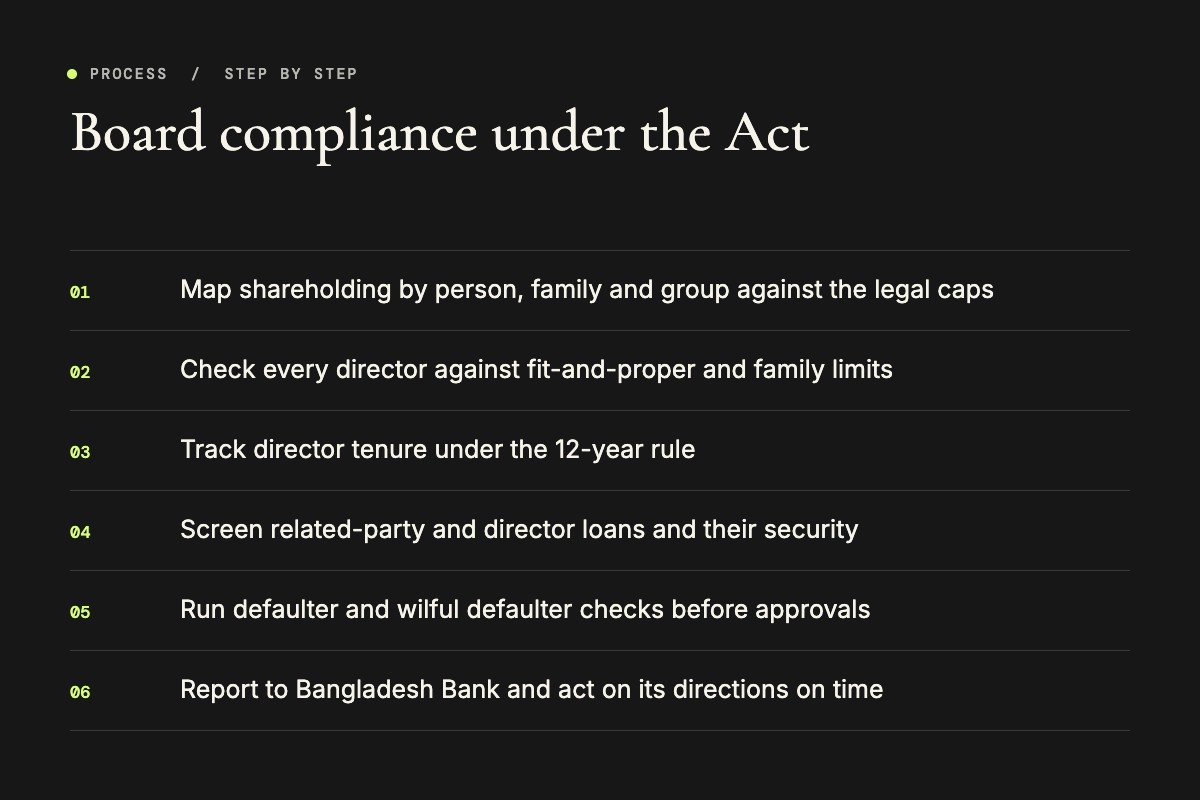
- Map ownership. Keep an up-to-date map of shareholdings aggregated by person, family and group, and test it against the statutory caps before any transfer.
- Vet directors. Check each director and nominee against the fit and proper criteria, family limits and defaulter databases before appointment and annually.
- Track tenure. Record each director's start date and plan successions well before the 12-year limit.
- Control insider lending. Route every loan to a director, relative or connected company through the required approval and security process, with the interested director absent.
- Run defaulter checks. Use the credit information bureau and wilful defaulter lists before approving credit or appointing directors.
- Report and respond. File returns on time and act on Bangladesh Bank directions within the deadlines set.
Banks also have obligations under the Money Laundering Prevention Act 2012, reported to the Bangladesh Financial Intelligence Unit (BFIU), which sit alongside the Act.
Penalties and enforcement
Breaches of the Bank Company Act 1991 can lead to monetary penalties on the bank and on individual directors and officers, removal from office, restrictions on business and, for certain offences, criminal prosecution. Bangladesh Bank may also impose daily fines for continuing breaches. Penalty amounts are set in the Act as amended and in later laws, and several were increased over the years, so check the current figures before advising on exposure.
Personal liability of directors and officers
Directors and senior officers are increasingly exposed personally. Beyond the penalties in the Bank Company Act 1991, the bank resolution law passed in April 2026 was reported to allow individuals to be held liable for a bank's failure, with fines of up to Tk 50 lakh plus daily fines for continuing breaches. Directors who approved irregular loans may also face investigation by the Anti-Corruption Commission and recovery suits. Good minutes recording dissent and the information relied on are a director's best protection.
Decisions of Bangladesh Bank affecting a bank or an individual can be challenged, usually by writ petition in the High Court Division on grounds such as lack of authority, procedural unfairness or unreasonableness. Our guide to writ petitions in Bangladesh explains how these challenges work.
Frequently asked questions about bank company act 1991
Does the Act apply to non-bank financial institutions?
No. Non-bank financial institutions are regulated under the Financial Institutions Act 2023, which replaced the 1993 Act. The Bank Company Act applies to bank companies.
How many members of one family can sit on a bank board?
Under the 2023 amendment, no more than three members of one family may be directors of the same bank at the same time. Proposals to reduce this further were discussed in 2025, so confirm the current position.
How long can a person remain a bank director?
Up to 12 consecutive years under the 2023 amendment, after which a gap of three years is required before reappointment.
What happens to a wilful defaulter?
After a hearing, the bank reports the borrower to Bangladesh Bank and publishes the name. Restrictions can follow, including bans on foreign travel, trade licences and registering companies, and the person cannot be a bank director.
Can Bangladesh Bank dissolve a bank board?
Yes. Where a bank is run against depositors' interests, Bangladesh Bank can supersede the board and appoint an administrator, and the bank resolution law gives it further powers to transfer or merge failing banks.
How we can help
We advise banks, sponsors, directors, foreign investors and borrowers on the Bank Company Act 1991 and Bangladesh Bank regulation, including acquisitions of bank shares, board appointments, insider lending questions, wilful defaulter proceedings and challenges to regulatory decisions. Learn more about our banking and financial services practice and our corporate governance work.
Need advice on bank regulation?
We review ownership structures, board compliance and Bangladesh Bank directions, and act in regulatory and defaulter disputes.
Book a consultationBanking and financial servicesPrimary sources: the Bank Company Act 1991 and its amendments on the Laws of Bangladesh portal; circulars and guidelines from Bangladesh Bank; anti-money laundering guidance from the Bangladesh Financial Intelligence Unit.
This article is general information about Bangladeshi law as of 2026 and is not legal advice. Banking laws, Bangladesh Bank circulars and penalties change frequently; confirm the current position with a qualified lawyer before acting.


0 Comments