
A power generation licence in Bangladesh is issued by the Bangladesh Energy Regulatory Commission (BERC), and without it a plant cannot lawfully generate electricity for sale or, in most cases, for its own industrial use. This guide explains who needs one, how the approval process runs and what changed in 2024 to 2026.
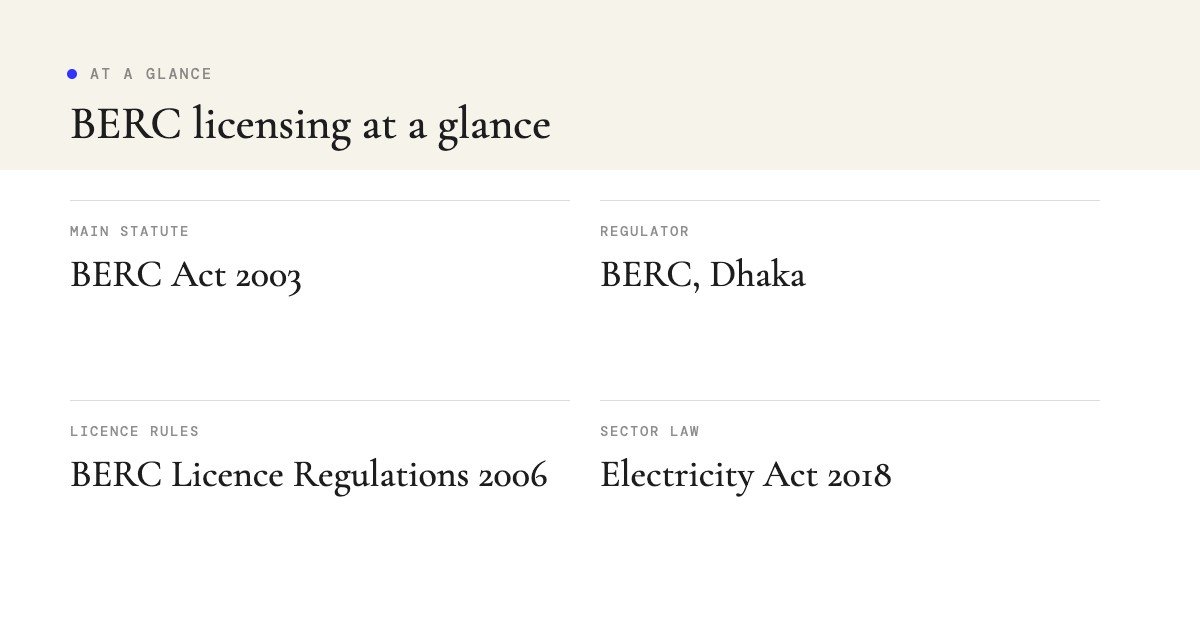
- BERC licenses electricity generation under the Bangladesh Energy Regulatory Commission Act 2003 and its Licence Regulations 2006; the Electricity Act 2018 sets the wider sector framework.
- The licence is only one approval. Projects also need a route to market (a government tender, a captive or merchant model, or net metering), land, fuel or resource rights, environmental clearance and grid consent.
- The Quick Enhancement of Electricity and Energy Supply (Special Provisions) Act 2010 was repealed in late 2024, so new projects can no longer be awarded without competition under that Act.
- In August 2024 an ordinance removed the government's power to change electricity tariffs without a BERC public hearing, returning tariff-setting to the Commission.
- The 2025 private participation and renewable energy policies move new private generation towards renewables, direct sales to large consumers and energy-only payments.
Under the Invest Bangladesh Act 2026, effective 23 August 2026, the Bangladesh Investment Development Authority (BIDA), the Bangladesh Economic Zones Authority (BEZA) and the PPP Authority were merged into a single body, Invest Bangladesh. References below to BIDA, BEZA or the PPP Authority should be read as references to Invest Bangladesh. BEPZA continues as a separate authority.
What a power generation licence in Bangladesh covers
The Bangladesh Energy Regulatory Commission Act 2003 created BERC as an independent regulator for electricity, gas and petroleum. One of its core functions is licensing: BERC issues, renews, varies and cancels licences for generation, transmission, distribution and supply. Carrying on a licensable activity without a licence is an offence under the Act.
The detailed procedure sits in the Bangladesh Energy Regulatory Commission Licence Regulations 2006, which set out who must apply, what the application must contain, how BERC reviews it and the conditions that attach to a licence. Fees and some forms have been revised since 2006, so always work from the version currently published by the Commission.
A generation licence authorises a named person to build and operate a named plant, of a stated capacity and technology, at a stated site. It is not a general permission to generate anywhere. If you change the capacity, fuel, site or owner, you usually need BERC's consent or a new licence.
How the licence fits with the Electricity Act 2018
The Electricity Act 2018 replaced the colonial Electricity Act 1910. It sets the structure of the sector, keeps transmission and distribution largely in state hands, deals with safety and inspection, and treats land and rights of way for generation and transmission as a public purpose.
In practice, the BERC Act decides whether you may generate, while the Electricity Act and the Power Division's policies decide how your plant connects to the grid and who may buy its output.
Who regulates power generation in Bangladesh
Several bodies touch every generation project. Knowing which one decides what saves months of misdirected correspondence.
| Body | Role in a generation project |
|---|---|
| BERC | Issues the generation licence, approves tariffs and certain power sale agreements, hears disputes between licensees and consumers |
| Power Division, Ministry of Power, Energy and Mineral Resources | Sets policy, runs or approves procurement of IPPs, approves gas connections for larger captive plants |
| Bangladesh Power Development Board (BPDB) | Single buyer for most grid-connected generation; signs power purchase agreements |
| Power Grid Bangladesh (PGCB) and distribution companies | Grid connection, interconnection studies, wheeling and metering |
| SREDA | Sustainable and renewable energy agency; registers smaller renewable projects and runs efficiency programmes |
| Department of Environment | Site and environmental clearance under the Environment Conservation Rules 2023 |
| BIDA | Investment registration, foreign loan and work permit processes for foreign-owned project companies |
Before August 2024, the government could also adjust electricity prices by executive order without a BERC hearing, under section 34A of the BERC Act inserted in 2023. An ordinance published on 27 August 2024 removed that power. Because many interim-government ordinances were re-enacted, amended or allowed to lapse by the new Parliament in April 2026, check the current text of the BERC Act before relying on the position.
Who needs a power generation licence in Bangladesh
As a working rule, anyone generating electricity beyond small household or backup use should assume a power generation licence in Bangladesh is required until advised otherwise. The main categories we see are set out below.
Independent power producers (IPPs)
IPPs build plants under a long-term power purchase agreement with BPDB, usually after a government tender or a public-private partnership process. The project company applies for its power generation licence in Bangladesh once it has the award and is moving to construction, and holds it through commissioning and operation.
Captive power plants
A captive plant generates mainly for the owner's own factory or industrial park. BERC data reported in 2026 showed captive capacity of about 6,085 MW by June 2024, with captive licences rising sharply in recent years. Captive plants need a power generation licence in Bangladesh just as IPPs do, and a captive plant that wants to sell surplus electricity to a distribution company needs a BERC-approved tariff and agreement under the Policy Guidelines for Power Purchase from Captive Power Plant 2007.
Gas is the pressure point. Captive plants seeking gas connections above 10 MW currently need prior Power Division approval, and in 2026 BPDB urged BERC to restrict gas supply to captive generation. A gas-fired captive project should treat fuel supply as the main legal risk, not the licence itself.
Renewable and merchant plants
The 2025 Policy for Renewable Energy-Based Commercial Electricity Generation with Private Participation allows private renewable producers to sell electricity, capacity or storage-backed capacity to large consumers through open access and wheeling, with energy-only payments rather than capacity payments. Reported commentary in 2026 indicates that the open access and wheeling framework is still being implemented, so confirm the current position before building a business case on direct sales.
Small and rooftop systems
Rooftop solar and smaller distributed systems are handled mainly through SREDA registration and the Net-Metering Guidelines 2025, rather than a full generation licence. The exact capacity thresholds for simplified treatment differ between instruments, so confirm with BERC and SREDA which applies to your system size.
Routes to market for a new plant
A power generation licence in Bangladesh lets you generate. It does not give you a buyer. Every plant needs one of the following routes, and each affects the licence application.
- Public tender. The Power Division or BPDB runs a competitive process under the Public Procurement Act 2006 or the Public-Private Partnership Act 2015. Award is followed by the implementation agreement, the PPA and, often, a land lease.
- Unsolicited proposal. Under the PPP Act 2015 and its guidelines, an unsolicited proposal is screened and then put to competitive tender, with possible bonus marks for the originator.
- Government-to-government. The Policy for G2G Partnership 2017 lets a foreign government nominate a sponsor, subject to PPP screening and cabinet committee approval.
- Captive or merchant sale. Electricity is used on site or sold to a large consumer, with BERC approving tariffs and wheeling charges.
- Net metering. Rooftop and small systems export surplus to the local distributor and offset it against imports.
The QEEES Act 2010 allowed power projects to be awarded without tender and shielded those decisions from court challenge. It was repealed by ordinance in late November 2024. Contracts already made under it remain valid subject to government review, and several have since been renegotiated. New projects must go through a competitive or PPP route.
How to apply for a power generation licence in Bangladesh
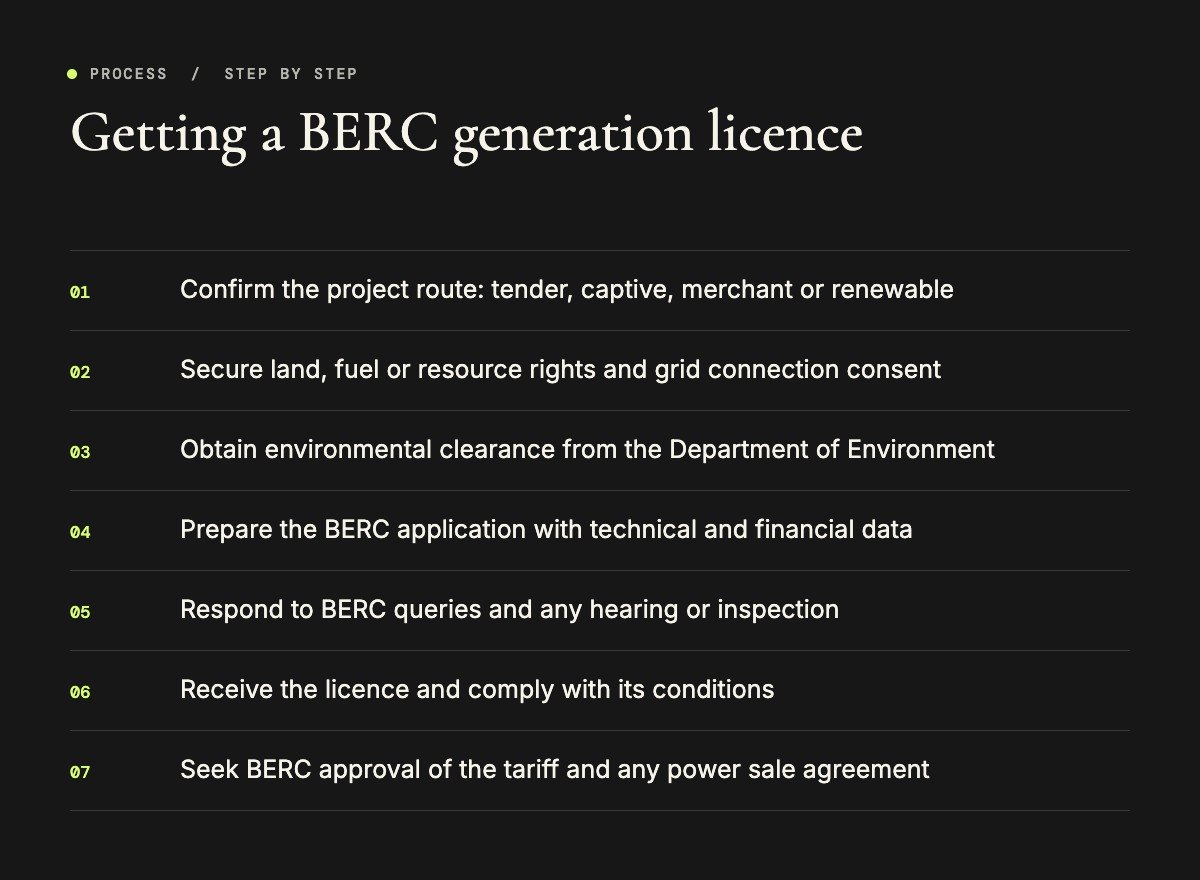
The process varies with the size and type of plant, but a typical application follows the sequence below. The steps assume a project company has already been incorporated with RJSC.
- Fix the project route. Decide whether the plant is a tendered IPP, a captive plant, a merchant renewable plant or a net-metered system. The route determines the buyer, the tariff process and which documents BERC will expect.
- Secure site and resource rights. Obtain title, a registered lease or a government land allotment, plus a gas allocation, fuel supply arrangement or solar or wind resource assessment.
- Obtain grid consent. Apply to PGCB or the relevant distribution company for connection and complete any interconnection or load-flow study.
- Get environmental clearance. Apply to the Department of Environment for site and environmental clearance in the category that fits the plant, with an initial environmental examination or full environmental impact assessment as required.
- File the BERC application. Submit the prescribed form, corporate documents, technical design, financial capacity evidence, approvals obtained so far and the application fee set by the current BERC schedule.
- Answer queries. BERC may ask for clarifications, inspect the site or, for some matters, hold a hearing. Respond fully and in writing.
- Receive and register the licence. Record the licence conditions, reporting dates and renewal date in a compliance calendar.
- Approve tariff and sale agreement. Where electricity is sold, obtain BERC approval of the tariff and, where required, the power sale agreement before commercial operation.
The order is not rigid. Tendered IPPs often apply for the licence after signing the PPA, while captive plants usually need the licence before the gas or distribution company will finalise connection.
Documents BERC usually expects
Incomplete files are the main cause of delay. A strong application for a power generation licence in Bangladesh normally includes the following.
- Certificate of incorporation, memorandum and articles, and a board resolution authorising the application.
- Shareholding details, including ultimate owners and any foreign shareholders.
- Plant description: capacity, technology, fuel, efficiency, single-line diagram and site layout.
- Land documents: title, khatian and mutation records, or the registered lease or allotment letter.
- Fuel or resource evidence: gas allocation letter, fuel supply contract or resource study.
- Grid connection consent and interconnection arrangements.
- Environmental clearance or evidence that it is in process.
- Financial statements and evidence of equity and debt funding.
- For sale projects, the draft or signed PPA, or the proposed buyer agreement.
Land documents deserve special care
Many applications stall on land. Where private land is bought, the seller must be recorded in the latest khatian before the sale deed can be registered, because of section 52A of the Registration Act 1908. Our guide to land registration in Bangladesh explains the checks to run before acquiring a site.
Environmental and other permits alongside the licence
A power generation licence in Bangladesh sits alongside a cluster of other permits. Treat them as one programme rather than separate tasks.
Environmental clearance
The Environment Conservation Rules 2023 (SRO 53, 5 March 2023) replaced the 1997 Rules and classify projects as green, yellow, orange or red. Thermal power plants fall in the higher-risk categories and need a site clearance followed by an environmental clearance, supported by an environmental impact assessment. The category for solar and other renewable plants depends on size and description in the current schedule, so check it at the outset. We explain the process in our guide to the environment clearance certificate.
Other common approvals
- Investment registration with BIDA, especially for foreign-owned companies.
- Department of Explosives licences for storing fuel oil or gas above set limits.
- Fire service and building approvals for the plant buildings.
- Import permits and customs treatment for equipment.
- Electrical inspection and safety certificates before energisation.
Tariffs and BERC approval
Tariff regulation is where a power generation licence in Bangladesh meets commercial value. BERC sets generation tariffs under its Power Generation Tariff Regulations 2008, together with separate regulations for transmission and retail tariffs.
For tendered IPPs, the tariff comes from the competitive bid and is written into the PPA with BPDB. Recent open tenders for solar have produced much lower tariffs than earlier negotiated deals, which has raised the bar for new bidders.
For captive surplus sales and merchant plants, BERC approves the tariff and any wheeling charge. Under the captive guidelines, the purchase price cannot exceed the published BPDB tariff for the relevant bulk category. The removal of the government's executive tariff power in August 2024 means retail price changes are again meant to follow a public hearing before BERC.
Net metering tariffs
The Net-Metering Guidelines 2025 let eligible systems offset exports against imports over a 12-month period, with net excess settled in cash. The government's rooftop solar programme has offered a fixed export rate for installations completed by a set date in 2027. Rates and deadlines in this programme have changed several times, so confirm the current figure with your distribution company.
Ongoing compliance for licensed generators
Holding a power generation licence in Bangladesh creates continuing obligations. Breach can lead to penalties, suspension or cancellation.
- Licence conditions. Operate within the licensed capacity and technology, and follow technical, safety and grid codes.
- Reporting. File periodic operational and financial information that BERC requires, and report major incidents.
- Annual fees. Pay the annual licence fee by the due date under the current schedule.
- Changes. Obtain BERC consent before transferring the licence, changing control of the licensee, expanding capacity or changing fuel.
- Renewal. Apply to renew well before expiry; operating on a lapsed licence is a breach.
Share sales of project companies often overlook the consents attached to a power generation licence in Bangladesh. A change of control can require prior consent under the licence, and lenders will ask for it as a condition precedent. Build the BERC step into the share purchase timetable from day one.
Disputes with BERC or a buyer
BERC can hear disputes between licensees, and between licensees and consumers. PPA disputes with BPDB usually go to arbitration under the contract, often with a foreign seat. Decisions of BERC can be challenged as the Act allows, and in some cases by writ in the High Court Division.
Foreign investors and project finance
Most large generation projects are foreign-owned or foreign-financed. A few points recur.
The project company should be registered with BIDA, and equity should come in through banking channels so that dividends and capital can later be repatriated. Long-term foreign loans go through BIDA and Bangladesh Bank scrutiny under the foreign borrowing rules, which Bangladesh Bank consolidated in a 2025 foreign exchange circular.
Lenders treat the power generation licence in Bangladesh as a core project document and review it closely: its term, conditions, transfer restrictions and the risk of cancellation. They usually require direct agreements and step-in rights in the PPA and implementation agreement. Our project finance practice works with sponsors and lenders on these structures.
Tax incentives depend on the policy that applies. The Renewable Energy Policy 2025 provides a ten-year corporate income tax exemption for qualifying renewable producers, but the exemption must also be reflected in the Income Tax Act 2023 and current SROs, so verify the exact conditions with your tax adviser.
Five questions we ask before any filing
Before we file for a power generation licence in Bangladesh, we ask the sponsor five things. Who will buy the electricity, and under what signed or draft agreement? Is the fuel or resource secured in writing? Does the company hold clean title or a registered lease to the site? Has the grid operator confirmed capacity at the connection point? And who owns the project company, directly and ultimately?
If any answer is uncertain, the licence application will usually stall at that point. It is cheaper to resolve the gap first than to argue it with the Commission later.
Common mistakes with a power generation licence in Bangladesh
- Licence before route. Applying before a buyer, fuel or grid connection is in place, so the application stalls.
- Wrong environmental category. Assuming a solar or small plant needs no clearance.
- Weak land title. Leases that are not registered, or sites with unresolved mutation or inheritance issues.
- Ignoring change-of-control consent. Selling or restructuring the project company without BERC approval.
- Relying on old policy. Building a model on QEEES-era negotiated tariffs or capacity payments that new policies no longer offer.
Frequently asked questions about power generation licence in Bangladesh
Does a captive power plant need a BERC licence?
Yes. Captive plants that generate for an owner's industrial use need a BERC generation licence, and a captive plant selling surplus electricity also needs a BERC-approved tariff and sale agreement. Larger gas-fired captive plants also need Power Division approval for the gas connection.
How long does BERC take to issue a licence?
There is no single fixed timeline that applies in practice. A complete application for a power generation licence in Bangladesh moves far faster than one filed before land, fuel and grid consent are settled. Plan the licence as part of the wider permitting timetable rather than as a standalone step.
Can a foreign company hold the licence directly?
In practice, BERC grants a power generation licence in Bangladesh to a locally incorporated company. Foreign sponsors normally set up a local project company, register it with BIDA and apply in its name.
Do rooftop solar systems need a generation licence?
Rooftop and smaller systems are usually handled through SREDA registration and the Net-Metering Guidelines 2025 rather than a full licence. Capacity thresholds differ between instruments, so check which applies to your system.
Can the government still set tariffs without a hearing?
An ordinance of 27 August 2024 removed the government's executive power to adjust electricity prices without a BERC hearing. Check the current BERC Act text, because Parliament reviewed many ordinances in April 2026.
Can the licence be transferred on a share sale?
The licence itself cannot simply be assigned, and a change of control of the licensee often needs BERC's prior consent under the licence conditions. Factor this into any acquisition timetable.
How we can help
We advise sponsors, industrial groups, lenders and foreign investors on BERC licensing, captive and renewable projects, PPAs, environmental clearance and change-of-control approvals. We can review your route to market, prepare the BERC application and manage the related permits. Learn more about our energy and natural resources practice.
Planning a new plant or acquiring one?
We map the approvals, prepare the BERC application and coordinate land, environmental and grid consents so your project reaches commercial operation on time.
Book a consultationEnergy practicePrimary sources: the Bangladesh Energy Regulatory Commission Act 2003 and Electricity Act 2018 on the Laws of Bangladesh portal; licensing and tariff regulations from the Bangladesh Energy Regulatory Commission; procurement information from the Bangladesh Power Development Board; environmental clearance from the Department of Environment.
This article is general information about Bangladeshi law as of 2026 and is not legal advice. Fees, forms, policies and procedures change; confirm current requirements with BERC or a qualified lawyer before acting.

0 Comments