
A construction contract in Bangladesh decides who carries the cost when a project runs late, the ground turns out worse than expected or the employer changes the design. Most building disputes we see trace back to a handful of clauses that were left vague, copied from another project or never negotiated at all.

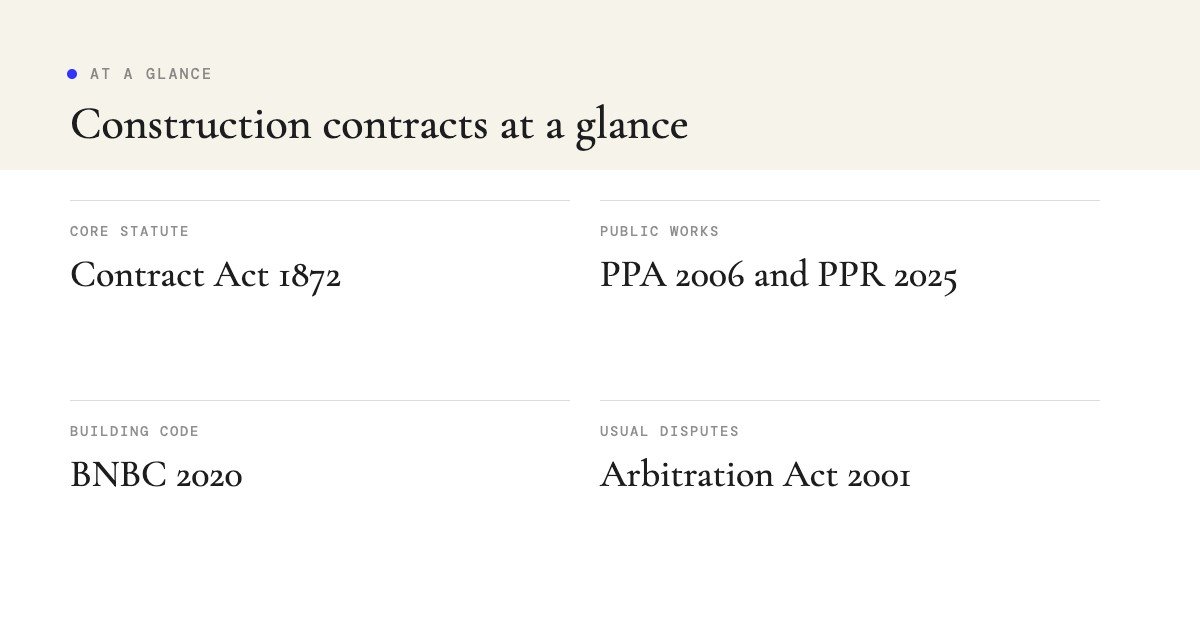
- The Contract Act 1872 governs private building contracts; public works also follow the Public Procurement Act 2006 and the Public Procurement Rules 2025, which replaced the 2008 Rules from 28 September 2025.
- FIDIC forms are common on international and donor-funded projects, while many private projects still use short bespoke agreements that leave key risks unallocated.
- Liquidated damages clauses are enforceable, but under section 74 of the Contract Act the employer recovers only reasonable compensation up to the stated amount, whether the sum is labelled damages or a penalty.
- Payment, variations, extensions of time and notice clauses cause the majority of disputes; precise drafting and disciplined contract administration prevent most of them.
- Arbitration under the Arbitration Act 2001 is the usual final dispute route, ideally preceded by a dispute board or structured negotiation.
The legal framework for a construction contract in Bangladesh
There is no single construction statute in Bangladesh. A construction contract in Bangladesh is an ordinary commercial contract governed by the Contract Act 1872, supplemented by sector rules that depend on who the employer is and what is being built.
The Contract Act supplies the basics: offer and acceptance, consideration, free consent, the effect of breach, compensation for loss under section 73, liquidated damages and penalties under section 74, and frustration under section 56. Courts and arbitrators read every construction contract in Bangladesh against those general principles.
Public works
Where the employer is a government ministry, agency, statutory body or state-owned company, procurement follows the Public Procurement Act 2006. The Act was substantially amended by the Public Procurement (Amendment) Ordinance 2025, which Parliament approved as an Act on 9 April 2026. The new Public Procurement Rules 2025, issued on 28 September 2025, replaced the 2008 Rules.
The reforms make the e-GP portal mandatory for public procurement unless the Bangladesh Public Procurement Authority approves an exception, remove the old plus-or-minus ten per cent price band for works, require disclosure of beneficial owners on contract award and introduce sustainable procurement, reverse auctions and expanded framework agreements.
Building approvals and technical standards
Design and construction must comply with the Bangladesh National Building Code 2020 and the planning and building approval rules applied by RAJUK in Dhaka, or by the relevant development authority or local government body elsewhere. Approvals sit with the owner, but the contract should say who obtains which permit and who bears the cost of a refusal or delay.
Other laws touch most sites: the Bangladesh Labour Act 2006 and its rules on worker safety, the Environment Conservation Act 1995 and Rules 2023 for clearance, and fire safety rules for larger buildings.
Common types of construction contract
Choosing the pricing and delivery model is the first real decision in any construction contract in Bangladesh. It drives how risk is shared and how the rest of the contract should be drafted.
| Model | How it works | Who carries most risk |
|---|---|---|
| Lump sum (fixed price) | One price for a defined scope, paid by milestones | Contractor, for quantities and cost overruns within the scope |
| Re-measurement (bill of quantities) | Rates fixed, quantities measured as work is done | Employer, for quantity growth |
| Cost-plus | Actual cost plus an agreed fee or percentage | Employer, unless a guaranteed maximum price is added |
| Design and build | Contractor designs and builds to the employer's requirements | Contractor, for design and buildability |
| EPC or turnkey | Single point responsibility for engineering, procurement and construction | Contractor, for performance and completion |
Developer and landowner agreements
Apartment projects in Dhaka and Chattogram often begin with a joint venture between a landowner and a real estate developer, under which the developer builds and the parties share the finished flats. These agreements are regulated by the Real Estate Development and Management Act 2010 as well as the Contract Act. The developer then usually signs a separate construction contract with its own contractor, so the two documents must line up on timing, specification and handover.
Standard forms or bespoke drafting
Public bodies use the standard tender documents issued under the procurement rules. Donor-funded and international projects usually adopt a FIDIC form, such as the Red Book for employer-designed works or the Yellow and Silver Books for design-build and EPC work, with particular conditions tailored to Bangladeshi law.
Private employers often sign short agreements prepared in-house. These are quicker to agree but frequently omit variation procedures, time-bar notices and dispute steps. If you use a standard form, the particular conditions are where Bangladesh-specific points belong: tax deduction at source, governing law, language, currency and the seat of arbitration.
Ten clauses every construction contract in Bangladesh needs
Whatever form you start from, these are the clauses that decide outcomes when something goes wrong. Employers and contractors look at them from opposite sides, so we flag both perspectives.
1. Scope, specifications and design responsibility
Describe the works precisely, attach drawings and specifications, and state the order of precedence between documents. Say clearly who is responsible for design and who takes the risk of errors in employer-supplied information. Ambiguity here becomes a variation claim later.
2. Contract price and payment
Set out the price, the measurement or milestone basis, the interim payment cycle, the certification process and the time for payment after certification. Contractors should insist on a fixed payment period and a right to interest or suspension for late payment. Employers should link payments to certified progress, not invoices alone.
3. Advance payment and retention
Advance payments help contractors mobilise but should be secured by an advance payment guarantee and recovered through deductions from interim payments. Retention, commonly a percentage of each payment, is held until completion and the end of the defects period. State when each half is released.
4. Time, programme and extensions
Fix the commencement date, completion date and key milestones, and require a programme that is updated regularly. List the events that entitle the contractor to an extension of time, such as employer delay, variations, exceptional weather or force majeure, and the notice the contractor must give.
5. Liquidated damages for delay
A daily or weekly rate of delay damages, usually capped as a percentage of the contract price, gives both sides certainty. Under section 74 of the Contract Act, an employer recovers reasonable compensation not exceeding the stated amount, so the rate should reflect a genuine estimate of loss and be supported by a short calculation kept on file.
6. Variations
The employer needs the right to change the works; the contractor needs to be paid fairly for it. Require variations to be instructed in writing by an authorised person, set the valuation method by reference to contract rates, and allow the time effect to be assessed at the same time as the cost.
7. Performance security and guarantees
A performance guarantee from a scheduled bank, commonly a set percentage of the contract price, protects the employer against default. Specify whether it is on-demand or conditional, its expiry date and the circumstances in which it may be called. Contractors should resist open-ended expiry.
8. Defects liability and warranties
Set a defects notification period after completion, often twelve months, during which the contractor must return to fix defects at its own cost. Longer warranties may apply to structural work, waterproofing or equipment. Remember that general limitation periods under the Limitation Act 1908 still apply to latent defects outside the contractual period.
9. Insurance, indemnity and limits of liability
Require contractor's all risks insurance, third-party liability cover and workmen's injury cover, naming both parties where appropriate. Cross-indemnities should be balanced, and a cap on total liability, with standard carve-outs for fraud and wilful misconduct, is normal on larger projects.
10. Termination, suspension and disputes
List the grounds for termination by each side, the notice and cure periods, and what happens to materials, payment and securities on termination. Then set a tiered dispute clause, discussed below. A termination clause that does not say how the final account is valued is an invitation to litigate.
Also worth covering: subcontracting, assignment and site access
Decide whether the contractor may subcontract without consent, and whether the employer may approve or nominate key subcontractors and suppliers. Restrict assignment of the contract and of payment rights, while allowing assignment to lenders by way of security where financing requires it. State when the site will be handed over, who controls access and who is responsible for security, utilities and neighbouring properties during the works.
Force majeure, frustration and price escalation
Recent years tested these clauses hard in almost every construction contract in Bangladesh. Political unrest, fuel shortages, currency depreciation and sharp rises in steel and cement prices have all affected Bangladeshi projects.
Force majeure relief is only as wide as the clause. Define qualifying events, require prompt notice and say whether the contractor gets time only, or time and money. If the clause is silent, a party must rely on frustration under section 56 of the Contract Act, which is narrow and rarely succeeds merely because performance has become more expensive.
Price adjustment
A long construction contract in Bangladesh should include a price adjustment formula tied to published indices for key materials and labour, or a clear statement that the price is fixed. The removal of the old price band for public works under the 2025 reforms makes realistic pricing and adjustment provisions even more important on government projects.
Exchange rate risk is often forgotten. If equipment is imported and the price is fixed in taka, a large depreciation can wipe out the contractor's margin. Agree in the contract which currency each part of the price is paid in, and whether any foreign exchange adjustment applies.
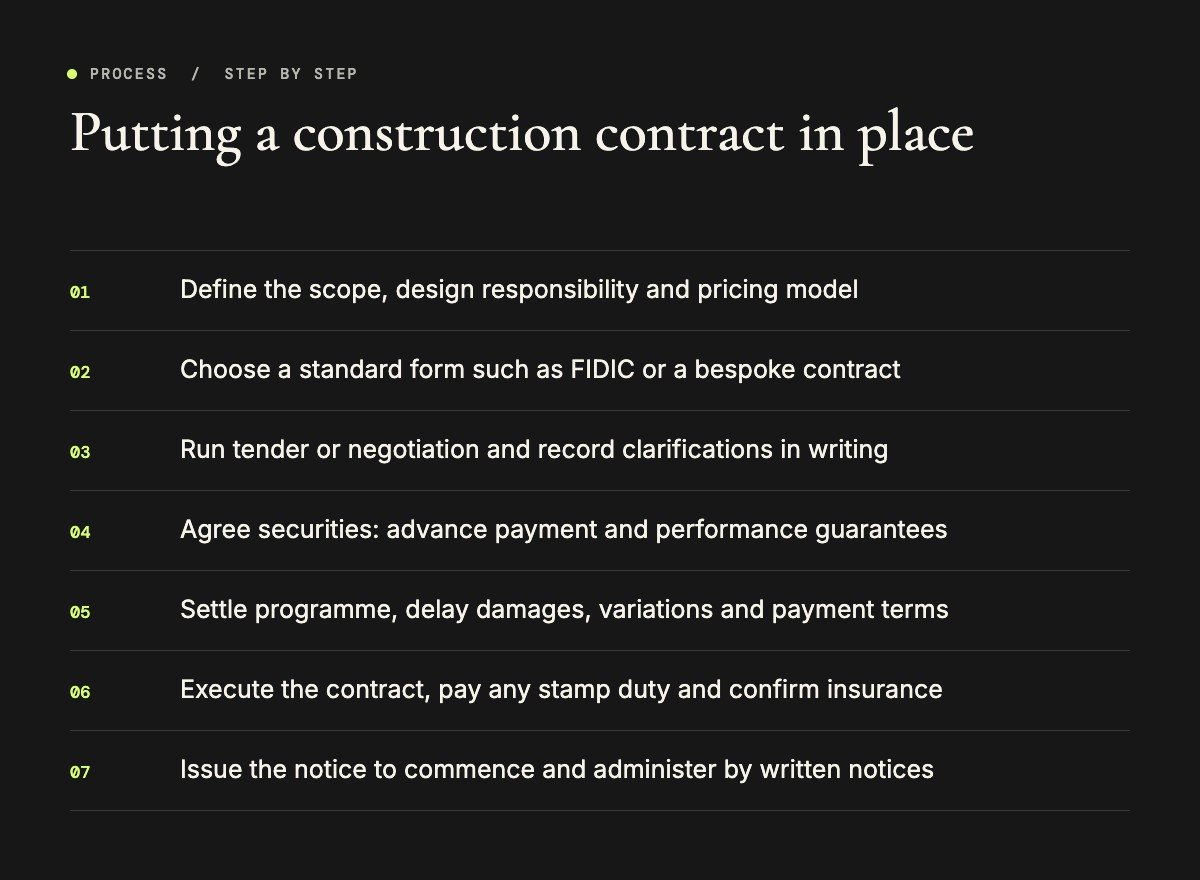
How to put a construction contract in Bangladesh in place
Good contracts come from a disciplined process, not from editing a template the night before signing. This sequence works for most private projects and mirrors the logic of public tenders.
- Define the project. Fix the scope, design responsibility, budget and target dates, and decide the pricing model that suits the risk profile.
- Choose the form. Select a standard form, such as a FIDIC book, or instruct a bespoke draft, and prepare particular conditions for Bangladeshi law and tax.
- Tender or negotiate. Issue clear tender documents, answer queries in writing to all bidders and keep a record of clarifications that will form part of the contract.
- Agree securities. Settle the advance payment guarantee, performance guarantee and retention, and check the issuing bank and wording.
- Settle the commercial terms. Confirm the programme, delay damages, variations, payment cycle and dispute clause, and resolve any qualifications in the winning bid.
- Execute properly. Sign through authorised signatories under board resolutions, pay any stamp duty due under the Stamp Act 1899 as currently amended and confirm the insurance is in place.
- Commence and administer. Issue the notice to commence, hand over the site and run the contract through written instructions, notices and minutes from day one.
For public procurement, the steps are fixed by the rules and run through the e-GP system, with evaluation committees, notification of award and set times for signing and providing the performance security.
Tax and regulatory points in building contracts
Tax is frequently overlooked in a construction contract in Bangladesh until the first payment certificate. Payments to contractors are generally subject to VAT under the VAT and Supplementary Duty Act 2012 and to advance income tax deducted at source under the Income Tax Act 2023. The employer, as the paying party, is usually the withholding agent.
Rates change with each Finance Act and differ by type of service, so the contract should say whether the price is inclusive or exclusive of VAT and how deductions at source are shown on certificates. Foreign contractors also need to consider permanent establishment, work permits for expatriate staff through the investment authorities and remittance rules for profits.
Licences and registrations
Contractors bidding for public works need the registrations and enlistment required by the procuring entity, and every contractor needs a trade licence, tax registration and VAT registration. Employers should verify these before signing. Our guide to the trade licence process covers the basics.
Contract administration: where projects are won or lost
Even the best drafted construction contract in Bangladesh fails if no one administers it. Claims are decided on records.
- Notices. Give every notice the contract requires, in the stated form and within the stated time. FIDIC forms bar late claims.
- Records. Keep daily site diaries, labour and plant returns, photographs and correspondence registers.
- Instructions. Do not carry out verbal instructions for extra work without written confirmation.
- Programme. Update the programme regularly and show the effect of each delay event.
- Payments. Track certificates, deductions and late payments against the contract dates.
The role of the engineer or consultant
Under a larger construction contract in Bangladesh, an engineer or project manager is usually appointed to certify payments, assess claims and issue instructions. The engineer acts for the employer but must make certain determinations fairly. The contract should state the limits of the engineer's authority, especially on variations above a set value.
Resolving disputes under a construction contract in Bangladesh
In a construction contract in Bangladesh, a tiered dispute clause gives the best chance of resolving disagreements quickly and cheaply before positions harden.
A typical structure starts with negotiation between senior representatives, moves to a dispute board or adjudicator where the project is large enough, and ends in arbitration. FIDIC forms build this in through the Dispute Avoidance and Adjudication Board. Mediation can be added at any stage, and courts may also refer civil suits to mediation under the Code of Civil Procedure 1908.
Arbitration in Bangladesh is governed by the Arbitration Act 2001. Parties may choose Dhaka as the seat or, in international contracts, a foreign seat such as Singapore or London, with Bangladesh law governing the contract. A Dhaka-seated award is enforced as a decree of the court; a foreign award is enforced under the Act's provisions on foreign awards. We explain the process in our guide to the arbitration process in Bangladesh.
Calling a performance guarantee during a live dispute is a common flashpoint. On-demand guarantees are hard to stop, but courts may intervene in cases of clear fraud or special equities. Draft the call conditions carefully and keep the paper trail clean.
For contentious matters, our construction disputes practice handles claims, adjudication and arbitration for employers and contractors.
Common mistakes we see
These are the problems we find most often when reviewing a construction contract in Bangladesh after a dispute has already started.
- Undefined scope. Drawings and specifications that conflict, with no order of precedence.
- Penalty-style delay damages. Rates far above any real loss, which invite challenge under section 74.
- No variation procedure. Extra work instructed by phone and disputed months later.
- Silent on escalation. Long fixed-price contracts with no adjustment for material or currency shocks.
- Weak dispute clause. A one-line reference to arbitration with no seat, rules or number of arbitrators.
- Unchecked guarantees. Bank guarantees with wrong beneficiaries, short expiry or wording that does not match the contract.
Frequently asked questions about construction contract in Bangladesh
Is a written contract legally required for building work?
The Contract Act 1872 does not require most building contracts to be in writing, and oral contracts can be enforced. In practice, a written construction contract in Bangladesh is essential: it is the only reliable way to prove scope, price, time and variations.
Are liquidated damages enforceable in Bangladesh?
Yes. Under section 74 of the Contract Act, the injured party may recover reasonable compensation up to the stated amount. A rate that reflects a genuine estimate of loss is far more likely to be upheld in full.
Can we use FIDIC for a private project in Bangladesh?
Yes. FIDIC forms work well as the basis of a private construction contract in Bangladesh, provided the particular conditions deal with local tax, governing law, language, currency and the arbitration seat.
What changed for government construction contracts in 2025?
The Public Procurement (Amendment) Ordinance 2025, approved by Parliament in April 2026, and the Public Procurement Rules 2025 made e-GP mandatory, removed the old price band for works and added beneficial ownership disclosure and sustainable procurement.
What happens if the employer does not pay on time?
That depends on the contract. Well-drafted terms give the contractor interest on late payment and a right to suspend after notice, and ultimately to terminate. Without those terms, the contractor must rely on general damages for breach.
Should disputes go to court or arbitration?
Most commercial construction contracts choose arbitration because it is private, allows technical arbitrators and is easier to enforce abroad. Courts remain available for urgent interim relief and for enforcing awards.
How we can help
We draft, review and negotiate every type of construction contract in Bangladesh for employers, developers, contractors and lenders, from short private agreements to FIDIC and EPC packages, and we support contract administration and claims when projects come under pressure. Learn more about our infrastructure and construction practice.
Starting a project or facing a claim?
We review the risk allocation, draft the particular conditions and help you administer the contract so disputes are avoided or won on the record.
Book a consultationConstruction practicePrimary sources: the Contract Act 1872, Public Procurement Act 2006 and Arbitration Act 2001 on the Laws of Bangladesh portal; procurement rules and standard documents from the Bangladesh Public Procurement Authority; standard contract forms from FIDIC; building approvals from RAJUK.
This article is general information about Bangladeshi law as of 2026 and is not legal advice. Rules, tax rates and procedures change; confirm current requirements with the relevant authority or a qualified lawyer before acting.


0 Comments