
The Arbitration Act 2001 in Bangladesh is the single statute that governs domestic arbitration, international commercial arbitration seated in the country and the enforcement of foreign awards. Knowing its key sections tells you how much a court can interfere, how fast you must act and what an award is worth in practice.
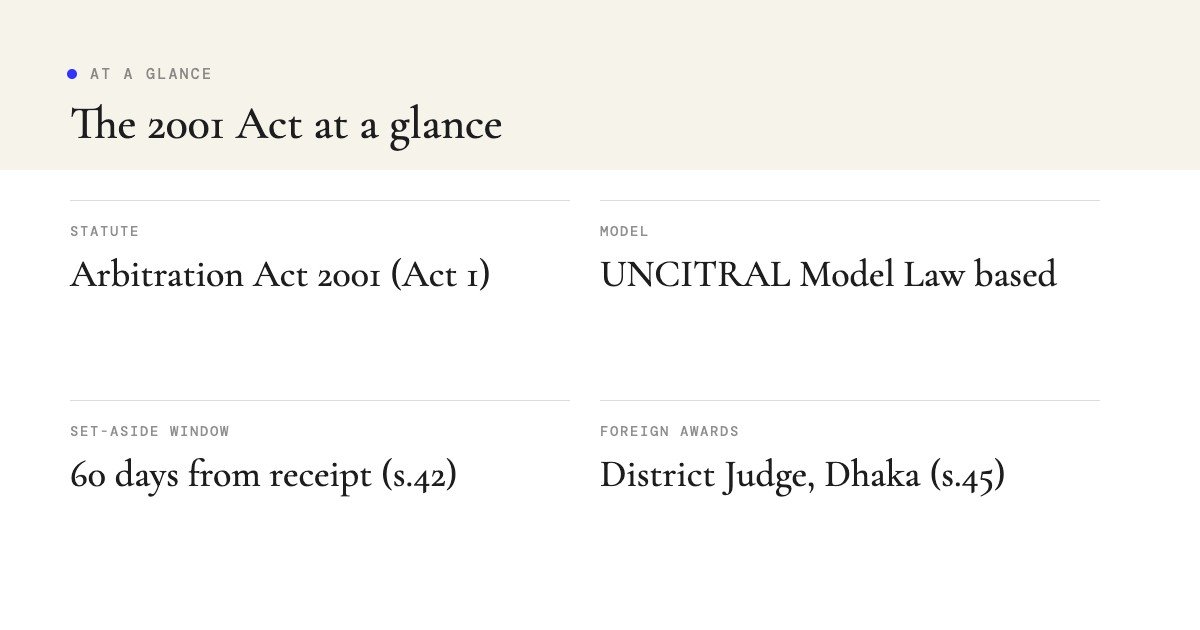
- The Act (Act No. 1 of 2001) replaced the Arbitration Act 1940 and is modelled on the UNCITRAL Model Law, with Bangladesh-specific changes.
- Courts must refer a dispute to arbitration if a party applies under section 10 before filing its written statement and the agreement is valid.
- Whether Bangladeshi courts can grant interim relief under section 7A in support of an arbitration seated abroad is still unsettled.
- An application to set aside an award must be made within 60 days of receiving it; late challenges fail.
- Foreign awards from New York Convention states are enforced through the District Judge's court in Dhaka under sections 45 and 46.
What the Arbitration Act 2001 in Bangladesh covers
Before the Arbitration Act 2001 in Bangladesh, arbitration in the country ran on the Arbitration Act 1940 and, for foreign awards, the Arbitration (Protocol and Convention) Act 1937. Both were court-heavy. Parties could be pulled back into litigation at almost every stage, and enforcement of foreign awards was slow and uncertain.
Parliament replaced them with a single code, the Arbitration Act 2001 (Act No. 1 of 2001). It follows the structure of the UNCITRAL Model Law on International Commercial Arbitration: party autonomy, a limited role for courts, a tribunal that can decide its own jurisdiction and narrow grounds for challenging an award.
The Act was amended by the Arbitration (Amendment) Act 2004, which inserted section 7A on interim measures by courts. We have not found any later amendment to the Act itself as of October 2026, although commentators have called for reform for years. Check the current text on the official laws portal before relying on any section.
Domestic and international commercial arbitration
The Arbitration Act 2001 in Bangladesh draws one key distinction. Under section 2(c), an arbitration is an international commercial arbitration if at least one party is a foreign national or habitually resident abroad, a company incorporated outside Bangladesh, a company whose central management is exercised abroad, or a foreign government. Everything else is domestic.
The label matters because it decides which court acts. In a domestic arbitration, court functions usually sit with the District Judge. In an international commercial arbitration, appointments go to the Chief Justice or a judge he designates, and challenges to the award go to the High Court Division.
Why the seat decides which sections apply
Section 3 sets the scope of the Arbitration Act 2001 in Bangladesh. As a rule, the Act applies where the place of arbitration is in Bangladesh. A limited set of provisions, chiefly those on recognising and enforcing foreign awards, applies where the seat is abroad. Choosing the seat in your contract is therefore the single most important drafting decision: it fixes which courts supervise the process and which law governs a challenge to the award.
Key sections at a glance
The table below maps the sections of the Arbitration Act 2001 in Bangladesh that come up most often in practice. Section numbers follow the Act as amended in 2004.
| Section | Subject | What it means in practice |
|---|---|---|
| 2(c) | International commercial arbitration | Decides whether the District Judge or the High Court Division and Chief Justice exercise court functions |
| 3 | Scope | Act applies mainly to Bangladesh-seated arbitrations; enforcement provisions reach foreign awards |
| 7A | Interim measures by court | Injunctions, attachment and other protective orders in support of arbitration |
| 9 | Arbitration agreement | Must be in writing; clause or separate agreement |
| 10 | Reference by court | Court must send the dispute to arbitration if asked before the written statement is filed |
| 11 to 16 | Tribunal | Number, appointment, disclosure, challenge and replacement of arbitrators |
| 17 and 18 | Jurisdiction | Tribunal rules on its own jurisdiction; arbitration clause treated as a separate agreement |
| 21 | Interim measures by tribunal | Tribunal orders that a court can be asked to enforce |
| 36 | Applicable law | Parties choose the law governing the substance of the dispute |
| 38 and 40 | Award | Form of the award; correction and interpretation within 14 days |
| 42 and 43 | Setting aside | 60-day window and exhaustive grounds for challenge |
| 44 to 46 | Enforcement | Domestic awards enforced as decrees; foreign awards enforced in Dhaka subject to limited refusal grounds |
The arbitration agreement under the Act
Under the Arbitration Act 2001 in Bangladesh, section 9 allows an arbitration agreement to take the form of a clause in a contract or a separate agreement. Either way it must be in writing. Writing is satisfied by a document signed by the parties, an exchange of letters, emails or other communications that record the agreement, or an exchange of pleadings in which one side alleges the agreement and the other does not deny it.
Separability
Section 18 treats an arbitration clause as an agreement independent of the main contract. A finding that the main contract is void, voidable or terminated does not automatically destroy the clause. This lets a tribunal decide claims that the contract was induced by misrepresentation, for example, without its own authority falling away.
What cannot go to arbitration
Section 3 preserves other laws that keep certain disputes out of arbitration. Criminal liability, matrimonial and guardianship status, insolvency and winding-up orders, and matters reserved to statutory tribunals are generally treated as non-arbitrable. At the other end, some statutes make arbitration compulsory; the Real Estate Development and Management Act 2010, for example, sends certain developer and buyer disputes to arbitration.
Name the seat, the number of arbitrators, the language, the governing law and any institutional rules in one clause. A clause that says only "disputes shall be settled by arbitration" works under the Act, but every missing choice becomes an early fight in court.
How courts interact with the Arbitration Act 2001 in Bangladesh
Section 7 of the Arbitration Act 2001 in Bangladesh limits court intervention: where parties have agreed to arbitrate, courts should not hear the dispute except as the Act allows. The two practical tools are a stay of court proceedings and court-ordered interim measures.
Stay of court proceedings under section 10
If a party sues despite an arbitration agreement, the defendant can apply under section 10 for the matter to be referred to arbitration. The application must be made before the defendant files its written statement on the substance. Taking a step on the merits first risks waiving the right to arbitrate.
The court must refer the parties unless the agreement is void, inoperative or incapable of being performed. Section 10 does not stop criminal proceedings; complaints under the Negotiable Instruments Act 1881 over a dishonoured cheque, for instance, continue alongside an arbitration.
Interim measures under section 7A
Section 7A lets the court grant interim orders such as injunctions, attachment of property, appointment of a receiver and orders preserving evidence. For a Bangladesh-seated arbitration, the power is settled and used regularly.
For arbitrations seated abroad, the position is genuinely unsettled. High Court Division benches have taken opposing views over the years on whether section 7A reaches a foreign-seated arbitration, and we are not aware of a definitive Appellate Division ruling resolving the point. A party with assets at risk in Bangladesh should take local advice early and consider protective steps in parallel.
Constituting the tribunal
The Arbitration Act 2001 in Bangladesh leaves parties free to agree the number of arbitrators under section 11. If they agree an even number, the appointed arbitrators must appoint an additional arbitrator to act as chairman, so the tribunal always has an odd number of members.
Appointment and default
Section 12 lets the parties agree the appointment procedure. If a party fails to appoint within the agreed time, or within 30 days of a request where there is no agreed time, the other party can apply to court. In a domestic arbitration that is the District Judge; in an international commercial arbitration it is the Chief Justice or a Supreme Court judge he designates.
Disclosure and challenge
Under section 13, an arbitrator must disclose any circumstances likely to raise justifiable doubts about independence or impartiality, and the duty continues throughout the case. A party may challenge an arbitrator on those grounds or because the arbitrator lacks qualifications the parties agreed.
Section 14 sets a tight timetable. A challenge is raised with the tribunal within 30 days of learning the grounds, the tribunal decides within 30 days, and an unsuccessful challenger may appeal to the High Court Division within 30 days. The High Court Division is directed to decide within 90 days, and the arbitration may continue in the meantime. Sections 15 and 16 deal with the end of an arbitrator's mandate and the appointment of a substitute.
Tribunal powers: jurisdiction and interim measures
Section 17 of the Arbitration Act 2001 in Bangladesh gives the tribunal power to rule on its own jurisdiction, including whether a valid arbitration agreement exists, whether the tribunal is properly constituted and whether the dispute is arbitrable. Objections should be raised promptly, normally no later than the statement of defence.
Under section 21, unless the parties agree otherwise, the tribunal may order a party to take interim measures, such as preserving goods, keeping funds in a designated account or maintaining the status quo. A tribunal order does not enforce itself; the beneficiary may apply to court to enforce it.
Running the proceedings
The Arbitration Act 2001 in Bangladesh gives the parties wide freedom to agree procedure under section 25, including by adopting institutional rules. If they do not agree, the tribunal can conduct the case as it considers appropriate, including deciding on the admissibility and weight of evidence.
Section 23 requires the tribunal to act fairly and impartially, give each party a reasonable opportunity to present its case, and deal with the dispute as quickly as possible. If a party fails without sufficient cause to file a defence or attend a hearing, section 35 allows the tribunal to continue and make an award on the evidence before it.
Applicable law and institutional rules
Section 36 lets the parties choose the law that governs the substance of the dispute. Without a choice, the tribunal applies the rules of law it considers appropriate, taking account of the contract terms and trade usages.
Many parties choose institutional rules. Locally, the Bangladesh International Arbitration Centre (BIAC) administers cases under its Arbitration Rules 2019, which include an expedited procedure for lower-value claims. International contracts often choose ICC, SIAC or LCIA rules. Institutional rules sit on top of the Arbitration Act 2001 in Bangladesh; they cannot override its mandatory provisions, such as the setting-aside grounds.
The award and its correction
Section 38 of the Arbitration Act 2001 in Bangladesh requires the award to be in writing, signed by the arbitrators, stating its date and place, and delivered to each party. A majority signature is sufficient if the reason for any missing signature is stated. The Act fixes no general deadline for making the award, so time limits come from the contract or the institutional rules.
Under section 40, a party may within 14 days of receiving the award ask the tribunal to correct clerical or arithmetical errors, or, if the parties agree, to interpret a specific point. Requests for an additional award on claims that were presented but not decided are also possible. These steps matter because they can affect when the setting-aside clock starts.
Setting aside an award
A party dissatisfied with an award made under the Arbitration Act 2001 in Bangladesh can apply to set it aside under section 42. The deadline is 60 days from the date the applicant received the award. Courts treat the period strictly, and a late application will generally be dismissed regardless of merit.
For a domestic award, the application goes to the District Judge's court. For an award made in an international commercial arbitration seated in Bangladesh, it goes to the High Court Division.
Grounds under section 43
The grounds are limited. The applicant must show, broadly, that a party was under incapacity, the arbitration agreement was invalid, the applicant was not given proper notice or was unable to present its case, the award deals with matters beyond the reference, or the tribunal's composition or procedure departed from the agreement. The court may also set aside an award if the dispute is not arbitrable, the award conflicts with the public policy of Bangladesh or the laws in force, or the award was induced by fraud or corruption.
Courts do not rehear the merits. A wrong finding of fact or a debatable reading of the contract is not, on its own, a ground. Parties cannot contract out of the right to apply.
Enforcing awards under the Arbitration Act 2001 in Bangladesh
Once the setting-aside period expires, or a challenge is refused, section 44 allows a domestic award to be enforced under the Code of Civil Procedure 1908 as if it were a decree of the court. Execution tools include attachment and sale of property and garnishee-style orders against bank accounts.
Foreign awards
Bangladesh acceded to the New York Convention in 1992 without reservations. Under section 45, a foreign award is enforced on application to the District Judge's court in Dhaka, as if it were a decree of that court. The applicant files the original or a duly authenticated copy of the award, the original agreement or a certified copy, and evidence that the award is a foreign award. Documents not in Bangla or English need a certified translation.
Section 46 of the Arbitration Act 2001 in Bangladesh lists the only grounds for refusal, which mirror the New York Convention: incapacity, invalid agreement, lack of notice, excess of jurisdiction, irregular composition or procedure, an award not yet binding or set aside at the seat, non-arbitrability and conflict with public policy. Enforcement in practice often takes one to two years, depending on objections and appeals. Our guide to the enforcement of arbitral awards covers the procedure in detail.
The Commercial Court Ordinance 2026 (Ordinance No. 1 of 2026), gazetted in January 2026, created specialised commercial courts with appellate benches in the High Court Division, and 75 courts were notified in February 2026. Commentary suggests arbitration-related applications in commercial matters may be heard there. It was made by ordinance, and we could not confirm whether Parliament has since re-enacted it; check the current forum before filing.
A practical roadmap through an arbitration
The sequence below reflects how a typical commercial arbitration unfolds under the Arbitration Act 2001 in Bangladesh and institutional rules. Each stage has its own deadline risk.
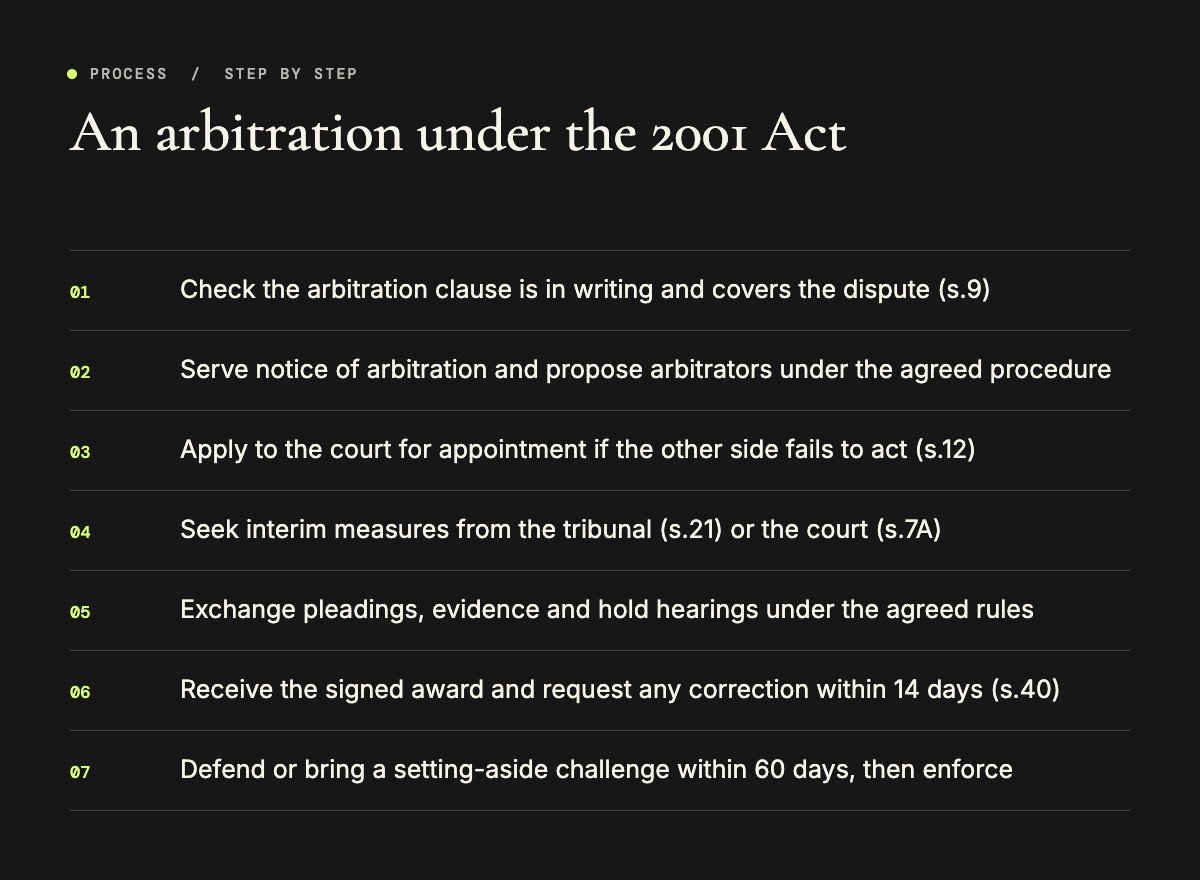
- Review the clause. Confirm the agreement is in writing, covers the dispute, and identifies the seat, rules and number of arbitrators.
- Preserve your position. If you have been sued, apply under section 10 before filing a written statement on the merits.
- Commence the arbitration. Serve a notice of arbitration that identifies the dispute, the relief sought and your proposed arbitrator.
- Secure the tribunal. If the other side does not appoint, apply to the District Judge or the Chief Justice under section 12.
- Protect assets. Seek interim measures from the tribunal under section 21 or from the court under section 7A where urgency demands.
- Present the case. Exchange statements of claim and defence, documents, witness statements and expert reports, then attend the hearing.
- Act on the award. Diary the 14-day correction period and the 60-day setting-aside window, then move to enforcement.
For a narrative walk-through of the same process with practical timings, see our guide to the arbitration process in Bangladesh.
Common mistakes under the Act
- Pathological clauses. Clauses naming a non-existent institution or mixing two sets of rules invite jurisdiction fights.
- No seat. Without a clear seat, parties argue about whether the Act applies at all and which court supervises.
- Filing a defence first. A written statement on the merits before a section 10 application can waive the right to arbitrate.
- Missing the 60 days. Settlement talks do not pause the setting-aside clock.
- Weak records. Failure to keep proof of service of notices makes awards vulnerable on due-process grounds.
- Ignoring assets. An award is only as good as the assets it can reach; trace assets before you start.
Frequently asked questions about the Arbitration Act 2001 in Bangladesh
Does the Act apply to arbitrations held outside Bangladesh?
Mostly no. The Arbitration Act 2001 in Bangladesh applies mainly where the seat is in the country. Its enforcement provisions in sections 45 and 46 apply to foreign awards, and whether section 7A interim relief extends to foreign-seated arbitrations is unsettled.
How long do I have to challenge an award?
Sixty days from the date you received the award, under section 42. File well before the deadline, as courts apply it strictly.
Can a court review the merits of an award?
No. The grounds in section 43 concern capacity, validity, due process, jurisdiction, arbitrability, public policy and fraud or corruption. An error of fact or contract interpretation is not enough by itself.
Which court enforces a foreign award?
The District Judge's court in Dhaka under section 45. Check whether the Commercial Court Ordinance 2026 has changed the forum for commercial matters at the time you file.
Is there a time limit for the tribunal to make an award?
The Act fixes no general time limit; the tribunal must act as quickly as possible. Time limits usually come from the contract or institutional rules.
How we can help
We advise on clauses and proceedings under the Arbitration Act 2001 in Bangladesh, act for claimants and respondents in domestic and international arbitrations, and handle court applications for stays, interim measures, setting aside and enforcement. Learn more about our international arbitration practice.
Facing an arbitration in Bangladesh?
We review your clause, map the deadlines under the 2001 Act and plan the steps from notice to enforcement.
Book a consultationArbitration practicePrimary sources: the Arbitration Act 2001 on the Laws of Bangladesh portal; decisions of the Supreme Court of Bangladesh; the New York Convention; and the UNCITRAL Model Law.
This article is general information about Bangladeshi law as of 2026 and is not legal advice. Statutes, court practice and forums change; confirm the current position with the official texts or a qualified lawyer before acting.


0 Comments