
A letter of credit in Bangladesh is still the backbone of import and export trade. It replaces trust between buyer and seller with a bank undertaking under UCP 600, but disputes are common: refused documents, late payment of accepted bills, fraud allegations and court injunctions that freeze payment.
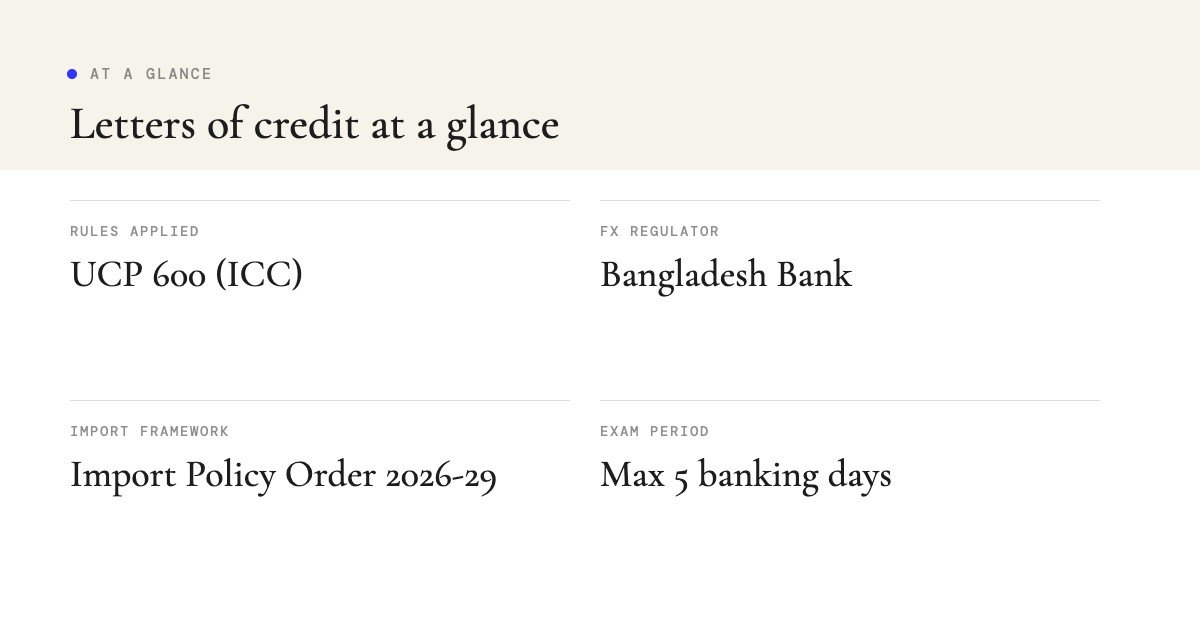
- Almost every LC issued or advised in Bangladesh incorporates the ICC's UCP 600, which binds the parties as contract terms.
- Under UCP 600, banks deal only with documents; the LC is independent of the sale contract, which is why payment disputes turn on document compliance.
- A bank has at most five banking days after presentation to decide whether documents comply, and must send a single refusal notice listing all discrepancies.
- Bangladesh Bank FE Circular No. 33 of 14 August 2025 tightened import payment timelines and makes delays beyond four months an FE offence.
- The Import Policy Order 2026-29 removed the value cap on imports under sales contracts without an LC, but LCs remain the main tool for secured trade.
How a letter of credit in Bangladesh works
A documentary credit is a bank's undertaking to pay the seller (the beneficiary) if the seller presents documents that comply with the credit's terms. The buyer (the applicant) asks its bank (the issuing bank) to open the credit. A bank in the seller's country usually advises it and may confirm it, adding its own undertaking.
When the goods ship, the seller presents the documents, typically a commercial invoice, bill of lading, packing list, certificate of origin and insurance documents. If they comply, the issuing bank must pay, or accept a draft and pay at maturity. The buyer then reimburses its bank and receives the documents needed to clear the goods.
In Bangladesh, every import LC is opened through an authorised dealer bank under the foreign exchange rules. That means a letter of credit in Bangladesh sits at the meeting point of three bodies of rules: the ICC's private rules, Bangladesh Bank's foreign exchange regulation and the import and export control regime.
Sight, usance and UPAS credits
A sight LC is paid when compliant documents are presented. A usance (deferred payment or acceptance) LC is paid at a later date, often 90 to 180 days after shipment or acceptance. Bangladesh also uses usance payable at sight (UPAS) credits, where the seller is paid at sight by a financing bank while the importer pays later. Back-to-back LCs are central to the garment sector, where an exporter opens an import LC for raw materials against its export LC.
The legal framework for letters of credit
There is no Bangladeshi statute that codifies the letter of credit in Bangladesh. The rules come from several sources, and understanding which one governs a question is the first step in any dispute.
UCP 600 and related ICC rules
The Uniform Customs and Practice for Documentary Credits, 2007 revision (UCP 600), published by the International Chamber of Commerce, apply when the credit expressly says so, which almost every SWIFT MT700 does. They are not law in themselves; they bind because the parties incorporate them. Related ICC rules include ISBP 821 (international standard banking practice for examining documents, 2023), eUCP for electronic presentations, URR 725 for bank-to-bank reimbursement and URDG 758 for demand guarantees.
Bangladeshi law
- Contract Act 1872. Governs the LC and related contracts where UCP 600 is silent.
- Foreign Exchange Regulation Act 1947 and GFET 2018. Govern opening, payment and reporting of import and export LCs through authorised dealers.
- Imports and Exports (Control) Act 1950 and the Import Policy Order 2026-29. Set who may import what, the need for import registration, and permitted payment methods.
- Bank Company Act 1991. Governs the banks and gives Bangladesh Bank supervisory powers.
- Artha Rin Adalat Ain 2003. The recovery route for banks when an importer fails to repay a forced loan created by an LC payment.
- Code of Civil Procedure 1908 and Specific Relief Act 1877. Govern suits and injunctions, including attempts to stop payment.
The 2025–2026 regulatory changes
Recent changes affect how a letter of credit in Bangladesh is used and enforced. Two are especially important for importers and foreign suppliers.
Import Policy Order 2026-29
The Ministry of Commerce gazetted the Import Policy Order 2026-29 on 24 August 2026, replacing the 2021-24 order. The previous order allowed imports under sales contracts without an LC, but capped commercial importers at USD 500,000 a year. The new order removes that value limit, and Bangladesh Bank's implementation circular of September 2026 recognises open account payment. In practice, more trade may now move outside LCs, which shifts payment risk back onto sellers unless they obtain other security.
Payment discipline: FE Circular No. 33
Overdue payment of accepted import bills in 2022–2024 damaged confidence in the letter of credit in Bangladesh. Bangladesh Bank's FE Circular No. 33 of 14 August 2025 responded with strict timelines.
As reported, payment delayed beyond four months from the bill of lading date is treated as a foreign exchange offence; importers with payments pending beyond four months cannot open new imports; banks must track maturity dates, alert importers before maturity and report overdue bills through the Online Import Monitoring System. Officials can face personal accountability, and authorised dealer licences are at risk.
Margins and essential goods
Cash margin requirements on LCs have been used as a policy tool and changed several times, often to ease imports of essential goods before Ramadan or to cool demand for non-essentials. Check the current Bangladesh Bank instructions and your bank's credit terms before assuming any margin rate.
Foreign suppliers often ask us whether a Bangladeshi bank's acceptance is "as good as cash". Legally, an accepted draft or deferred payment undertaking is a firm bank obligation under UCP 600. Practically, ask for confirmation by a bank you trust when country or bank risk is a concern; confirmation is still the most reliable protection.
Core UCP 600 rules behind most disputes
Most disputes about a letter of credit in Bangladesh turn on a handful of UCP 600 articles. Knowing them lets you judge quickly whether a refusal or delay is justified.
| UCP 600 rule | What it says | Why it matters |
|---|---|---|
| Articles 4 and 5 | The credit is separate from the sale contract; banks deal with documents, not goods | Quality complaints about goods are not a ground to refuse compliant documents |
| Article 7 | The issuing bank must honour a complying presentation | The core payment obligation, independent of the applicant's instructions |
| Article 8 | A confirming bank adds its own undertaking | Gives the beneficiary a second, often local, payer |
| Article 14 | Banks have a maximum of five banking days after presentation to examine documents | Sets the clock for refusal; late refusal can lose the right to refuse |
| Article 14(c) | Original transport documents must be presented no later than 21 days after shipment, within expiry | A common cause of "late presentation" discrepancies |
| Article 16 | A refusing bank must give a single notice stating every discrepancy and what it is doing with the documents | A defective notice can preclude the bank from claiming non-compliance |
| Article 36 | Banks are not liable for interruptions caused by force majeure events | Relevant to strikes, disasters and shutdowns |
Strict compliance, sensibly applied
For a letter of credit in Bangladesh, as elsewhere, documents must comply on their face, but they need not mirror each other word for word. Under UCP 600, data in a document need not be identical to other documents or the credit, but must not conflict. ISBP 821 gives detailed guidance, for example on typographical errors that do not affect meaning. Many refusals we review cite discrepancies that ISBP would treat as immaterial.
Discrepancies under a letter of credit in Bangladesh
A refusal under a letter of credit in Bangladesh is not the end of the road. Under UCP 600 it is a formal step with strict requirements, and a bank that gets the procedure wrong may be precluded from relying on the discrepancies.
For beneficiaries and their banks
- Timing. Was the refusal sent within five banking days following the day of presentation?
- Single notice. Did the notice list every discrepancy at once? A bank cannot add new discrepancies later.
- Disposal of documents. Did the notice say whether the bank is holding documents, returning them, or holding them pending a waiver from the applicant?
- Substance. Are the stated discrepancies real under UCP 600 and ISBP 821, or are they trivial?
Waivers and their risk
Issuing banks often seek the applicant's waiver of discrepancies. In a falling market, importers sometimes use minor discrepancies to delay or renegotiate. The bank still decides independently whether to honour, and a waiver obtained after the five-day period does not cure a defective refusal. Sellers should respond quickly, in writing and through their bank, pointing to the relevant UCP 600 and ISBP provisions.
Fraud and court injunctions in LC disputes
The autonomy principle has one widely recognised exception: fraud. If the beneficiary presents documents it knows to be false, courts in common law jurisdictions, including Bangladesh, may restrain payment. This is the most litigated area for a letter of credit in Bangladesh.
Bangladeshi courts generally apply the exception narrowly, consistent with international practice. An applicant must usually show clear evidence of fraud by the beneficiary, not merely a dispute about the quality or quantity of the goods. Injunctions against banks paying under a credit, especially an accepted or confirmed credit with third-party rights, are treated with caution, because they damage confidence in Bangladeshi bank undertakings.
Practical points
- Applicants should gather documentary evidence of fraud, such as false shipment dates or non-existent shipments, before filing.
- Banks served with an interim order should comply, notify the counterparty bank immediately through SWIFT, and seek legal advice on varying the order.
- Beneficiaries and confirming banks abroad should engage local counsel early, because orders are often obtained ex parte and must be challenged quickly in the High Court Division.
An injunction obtained by an applicant does not erase the issuing bank's obligation under UCP 600 to other banks. Where a negotiating or confirming bank has already paid in good faith, the issuing bank may still face a claim abroad. Both banks and applicants should weigh this before going to court.
Recovery, remedies and forums
The right forum depends on who is in dispute with whom, because every letter of credit in Bangladesh involves several parties. Claims can run in several directions.
Beneficiary against issuing or confirming bank
A seller that presented compliant documents and was wrongly refused may claim the credit amount, with interest, against the issuing bank and any confirming bank. Where the issuing bank is in Bangladesh, the claim may be brought in the Bangladeshi courts, and, for commercial matters, the Commercial Court Ordinance 2026 may affect the forum; we have not confirmed whether Parliament has re-enacted it. Escalation to Bangladesh Bank is also useful where an accepted bill is overdue, given FE Circular No. 33.
Expert determination: ICC DOCDEX
For disputes about whether documents comply, the ICC's DOCDEX rules offer a quick, expert decision by trade finance specialists. A DOCDEX decision is not binding unless the parties agree, but it carries weight with banks and courts.
Bank against importer
If the issuing bank pays and the importer does not reimburse, the payment becomes a forced loan, often recorded as a payment against documents (PAD) or loan against trust receipt (LTR). Banks recover through the Artha Rin Adalat under the Artha Rin Adalat Ain 2003. Our commercial litigation team acts for both banks and borrowers in these cases.
Buyer against seller
Claims about defective goods belong under the sale contract, often in arbitration if the contract has an arbitration clause. See our guide to the arbitration process in Bangladesh.
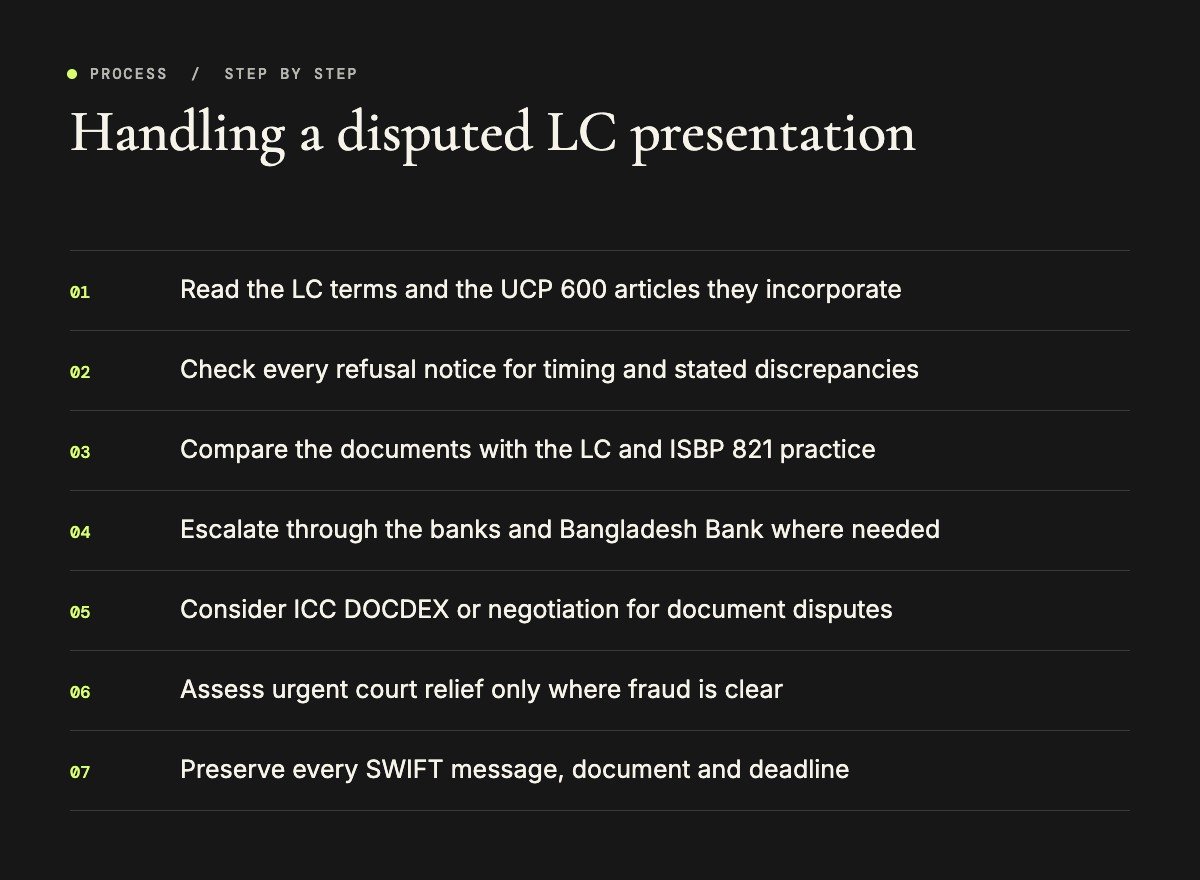
Responding to an LC dispute, step by step
Speed matters when a letter of credit in Bangladesh is disputed. UCP 600 deadlines run in banking days, and court orders are often obtained without notice. This is the sequence we follow.
- Collect the record. Gather the MT700 and amendments, the presented documents, covering schedule and every SWIFT message.
- Check the refusal. Test the notice against UCP 600 articles 14 and 16 for timing, completeness and disposal of documents.
- Assess the discrepancies. Compare each one with the credit terms and ISBP 821, and note which are curable by re-presentation within validity.
- Escalate through the banks. Have the presenting or confirming bank dispute the refusal formally, citing the rules.
- Use regulatory channels. For overdue accepted bills, raise the matter with the issuing bank's senior management and, if needed, Bangladesh Bank.
- Choose the forum. Decide between negotiation, DOCDEX, arbitration under the sale contract or court proceedings.
- Protect your position. Diary every deadline, keep originals safe and avoid statements that could be read as a waiver.
Drafting a letter of credit in Bangladesh to prevent disputes
Most LC disputes we see could have been avoided at the drafting stage. A well-drafted credit asks only for documents the seller can realistically produce, on deadlines it can meet.
- Avoid non-documentary conditions. UCP 600 tells banks to disregard conditions without a stated document, which only creates confusion.
- Match the credit to the contract. Shipment dates, partial shipment, transhipment and Incoterms should line up with the sale contract.
- Be realistic about documents. Requiring certificates from bodies that issue them slowly is a recipe for late presentation.
- Check expiry and place of presentation. An LC expiring at the issuing bank's counters in Dhaka gives the seller less time than one expiring in the seller's country.
- Address sanctions and AML clauses. Broad sanctions clauses can allow banks to refuse payment; negotiate their wording.
Compliance: AML and trade-based money laundering
Banks screen every letter of credit in Bangladesh for trade-based money laundering under the Money Laundering Prevention Act 2012 and guidance from the Bangladesh Financial Intelligence Unit. Over- and under-invoicing, unusual routing and mismatched goods descriptions trigger enhanced checks and can delay payment.
With imports now permitted under sales contracts without value limits, regulators have flagged the need for closer price monitoring. Importers should expect banks to ask for price evidence and supplier information, and should keep complete records. A clean compliance file is one of the best ways to avoid delays on a letter of credit in Bangladesh.
Frequently asked questions about letter of credit in Bangladesh
Is UCP 600 law in Bangladesh?
No. UCP 600 is a set of ICC rules that applies because the credit incorporates it. Bangladeshi law, especially contract and foreign exchange law, applies alongside it and fills gaps.
How long does a bank have to refuse documents?
Under UCP 600 article 14, a maximum of five banking days following the day of presentation. The refusal must be a single notice listing all discrepancies, as article 16 requires.
Can a buyer stop payment because the goods are defective?
Not under the credit itself. The LC is independent of the sale contract. A court may restrain payment only in narrow cases, usually clear fraud by the beneficiary. Quality claims go under the sale contract.
What happens if an importer does not pay an accepted bill?
The issuing bank remains liable to pay at maturity. Under FE Circular No. 33 of August 2025, delays beyond four months are treated as a foreign exchange offence, and the importer is barred from new imports while payment is pending.
Do imports still need an LC?
No. The Import Policy Order 2026-29 allows imports under sales contracts without an LC and without the former value cap. Many traders still use LCs because they secure payment.
What is DOCDEX?
DOCDEX is an ICC expert-determination service for documentary credit disputes. Specialists decide whether documents comply, quickly and at modest cost, though the decision is not binding unless agreed.
How we can help
We advise banks, importers, exporters and foreign suppliers on every stage of a letter of credit in Bangladesh: drafting and reviewing credits, challenging refusals, recovering overdue accepted bills, defending or seeking injunctions, and Artha Rin recovery. Learn more about our trade finance practice.
Facing a refused or unpaid LC?
We review the documents against UCP 600 and ISBP 821, escalate through the banks and Bangladesh Bank, and act fast in court where needed.
Book a consultationTrade finance practicePrimary sources: UCP 600, ISBP 821 and DOCDEX rules from the International Chamber of Commerce; GFET 2018 and FE circulars from Bangladesh Bank; import policy from the Office of the Chief Controller of Imports and Exports; statutes on the Laws of Bangladesh portal.
This article is general information about Bangladeshi law as of 2026 and is not legal advice. Circulars, margins and procedures change; confirm current requirements with Bangladesh Bank, your bank or a qualified lawyer before acting.


0 Comments