
India Bangladesh cross border trade law changed sharply in 2025. Both governments now restrict which goods may cross at which land ports, on top of customs, origin and foreign exchange rules that already applied. This guide explains the current framework, the port restrictions still in force in 2026 and how traders can keep consignments moving.
- Since May 2025, India allows Bangladeshi ready-made garments only through the Kolkata and Nhava Sheva seaports, and has barred several other product groups from land ports in its north-east.
- Since June 2025, Bangladeshi jute products and certain woven jute fabrics may enter India only through Nhava Sheva; land routes are closed to them.
- Bangladesh barred yarn imports through its main land ports in April 2025 and closed three smaller land ports in August 2025.
- Bangladesh's duty-free access to India under SAFTA is tied to its least developed country status; a three-year deferral of graduation to November 2029 was recommended by ECOSOC in July 2026.
- Most delays come from documents: origin certificates, LC discrepancies and goods sent to a port that is not permitted for them.
The legal framework for India Bangladesh cross border trade law
There is no single statute governing trade between the two countries. India Bangladesh cross border trade law is a combination of each country's domestic customs and trade control laws, bilateral agreements, and regional trade agreements under which Bangladesh enjoys tariff preferences.
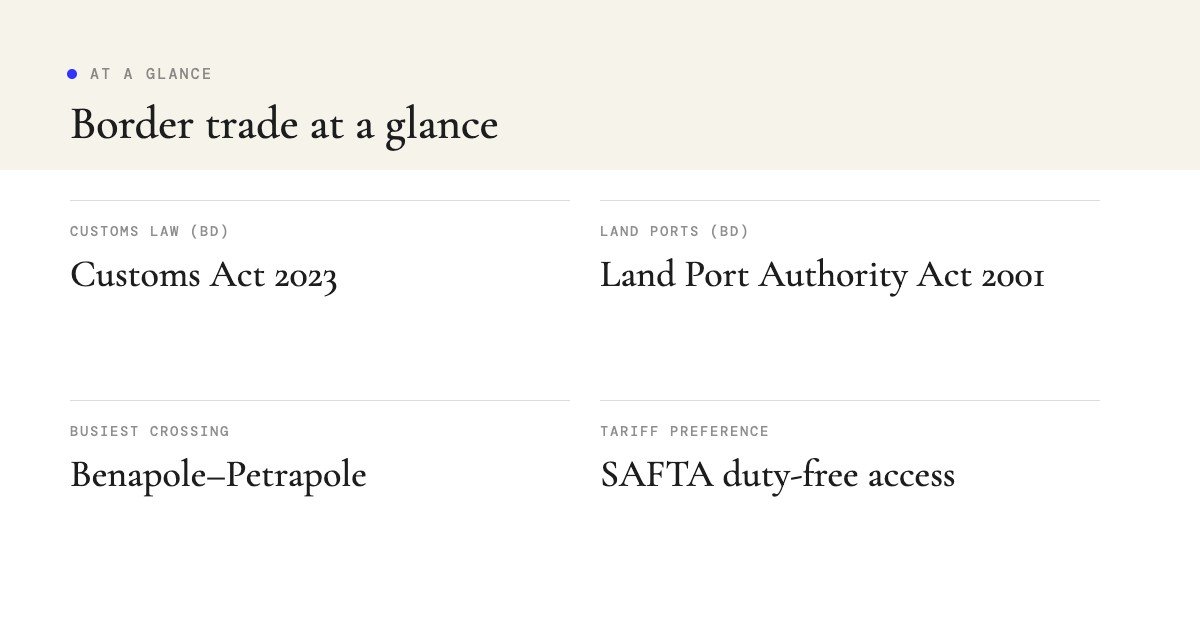
On the Bangladeshi side, the main laws are the Customs Act 2023, which replaced the Customs Act 1969, the Imports and Exports (Control) Act 1950 under which the Import Policy Order and Export Policy are issued, the VAT and Supplementary Duty Act 2012, and the Foreign Exchange Regulation Act 1947 for payments. Land ports are run by the Bangladesh Land Port Authority under the Bangladesh Land Port Authority Act 2001.
On the Indian side, the key instruments are the Customs Act 1962, the Foreign Trade (Development and Regulation) Act 1992 under which the Directorate General of Foreign Trade issues port restriction notifications, and the Land Ports Authority of India Act 2010, which governs integrated check posts such as Petrapole.
Bilateral and regional agreements
The bilateral Trade Agreement between the two countries, first signed in 1972 and renewed several times since, provides for trade through agreed land customs stations, rail and inland waterways. The Protocol on Inland Water Transit and Trade allows cargo on designated river routes. Under the South Asian Free Trade Area (SAFTA), India has given Bangladesh duty-free, quota-free access since 2011 for all goods except a short list of tobacco and alcohol lines.
Land ports and crossing points
Most road trade covered by India Bangladesh cross border trade law passes through a handful of crossings. Benapole in Jashore, opposite Petrapole in West Bengal, carries the largest share and has a rail link. Other significant crossings include Bhomra (Satkhira), Sonamasjid (Chapainawabganj), Hili (Dinajpur), Burimari (Lalmonirhat), Banglabandha (Panchagarh), Akhaura (Brahmanbaria) towards Tripura, and Tamabil (Sylhet) towards Meghalaya.
In India Bangladesh cross border trade law, a land port is not the same as a customs station. A land port has warehouses, weighbridges and yard facilities managed by the Land Port Authority, while customs clearance is handled by the National Board of Revenue's customs house or station at the border. Some crossings are customs stations only, with limited facilities and limited product lists.
Closures announced in 2025
In late August 2025 the interim government announced the closure of Chilahati (Nilphamari), Daulatganj (Chuadanga) and Tegamukh (Rangamati) land ports and suspended operations at Balla (Habiganj), citing low traffic. Traders who used those routes must now plan for a different crossing. Always check the Land Port Authority's current list before agreeing delivery terms.
Before signing a sales contract, confirm that both the Indian and the Bangladeshi customs station at your chosen crossing are notified for the specific goods. Under India Bangladesh cross border trade law a station can be open for trade generally yet closed for your product.
India's port restrictions on Bangladeshi goods
The biggest change to India Bangladesh cross border trade law in recent years came from a series of Indian notifications in 2025. They do not ban Bangladeshi goods outright; they control where those goods may enter India.
| Date | Measure | Practical effect |
|---|---|---|
| April 2025 | India withdrew the 2020 facility for transhipping Bangladeshi export cargo through Indian land customs stations to third countries (Nepal and Bhutan transit excepted) | Exports to third countries can no longer be trucked to Indian airports or seaports for onward shipment |
| 17 May 2025 | Ready-made garments from Bangladesh allowed only through Kolkata and Nhava Sheva seaports | Garments cannot enter India by land |
| 17 May 2025 | Processed food, fruit-flavoured and carbonated drinks, plastic and PVC goods, wooden furniture, cotton and cotton yarn waste barred from land customs stations in Assam, Meghalaya, Tripura and Mizoram and at Changrabandha and Fulbari | North-east trade in these goods must reroute |
| 27 June 2025 | Jute products, jute yarn and certain woven jute and flax fabrics allowed only through Nhava Sheva | Land routes closed for these goods |
The May 2025 restrictions did not apply to certain goods, including fish, LPG, edible oil and crushed stone, or to Bangladeshi goods transiting India to Nepal and Bhutan. Indian commentary in mid-2026 estimated that the measures cover a large share of Bangladesh's exports to India by value.
Are the restrictions still in force?
As of October 2026 we are not aware of any notification withdrawing these restrictions. Exports through Benapole were reported to have fallen sharply in the 2025-26 fiscal year. Because the measures are made by notification, they can be changed overnight. Check the latest DGFT notifications before each new contract.
Bangladesh's own measures
Bangladesh has also used port restrictions. In April 2025 the National Board of Revenue barred imports of yarn from India through the Benapole, Bhomra, Sonamasjid, Banglabandha and Burimari land ports, leaving the Chattogram seaport and other sea and air routes open. Consignments under letters of credit opened before the order were later allowed through the land ports.
According to NBR data reported in August 2026, Bangladesh's imports from India rose to about USD 10.96 billion in fiscal year 2025-26, while exports to India stayed flat at about USD 1.75 billion. The imbalance helps explain why both sides now use port rules, rather than tariffs, as the main lever in India Bangladesh cross border trade law.
Imports must also comply with the Import Policy Order in force, which lists banned and restricted items and conditions such as BSTI certification, plant quarantine certificates under the Plant Quarantine Act 2011, and radioactivity tests for some food items. These requirements apply whichever border crossing is used.
Customs clearance under India Bangladesh cross border trade law
Clearance at a land border follows the same legal steps as at a seaport, compressed into a busier space. Bangladeshi customs operate on the ASYCUDA World system, and goods are declared on a bill of entry or bill of export lodged by a licensed customs agent.
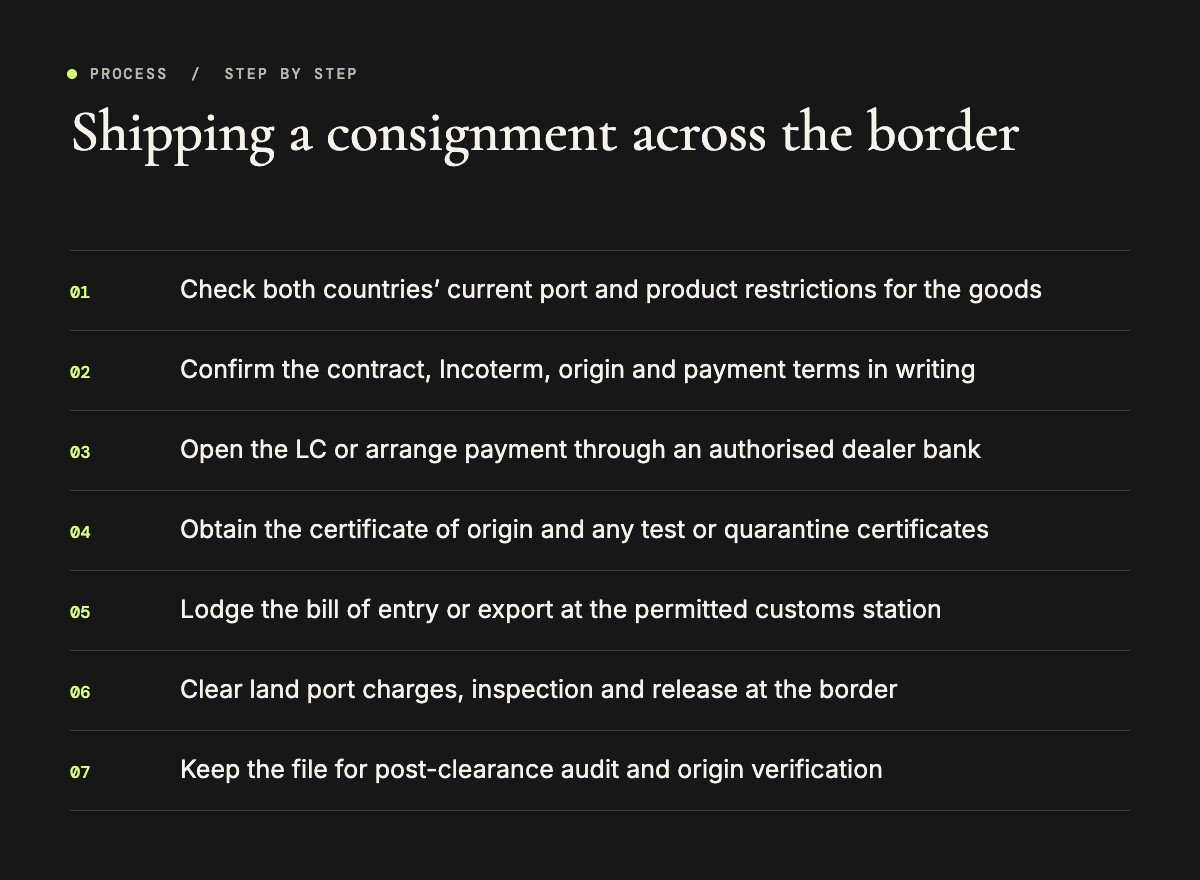
- Check the restrictions. Confirm both countries permit your goods at the chosen crossing, and that the goods are not banned or restricted under the current Import Policy Order or Export Policy.
- Fix the contract terms. Agree the Incoterm, place of delivery, origin requirements and who bears border charges and delay costs.
- Arrange payment. Open the letter of credit or other payment arrangement through an authorised dealer bank, with an import registration certificate or export registration certificate in place.
- Prepare documents. Commercial invoice, packing list, certificate of origin, test or quarantine certificates and the transport documents must match the LC exactly.
- Lodge the declaration. Your customs agent lodges the bill of entry or export and pays duties, VAT and advance tax where applicable.
- Clear the port. Pay Land Port Authority charges, complete examination and obtain release. Demurrage starts quickly, so do not let trucks wait.
- Keep the file. Customs can audit after clearance and Indian customs can ask for origin verification, so keep records for several years.
Valuation and classification disputes
Most customs disputes under India Bangladesh cross border trade law concern the value declared or the tariff heading chosen. Customs may reassess the value using the methods in the Customs Act 2023, which follow the WTO Customs Valuation Agreement. Assessments can be appealed internally and then to the Customs, Excise and VAT Appellate Tribunal, with further appeal on points of law to the High Court Division. Strict time limits apply, so act on any demand promptly.
Rules of origin and tariff preferences
Duty-free entry into India depends on the goods qualifying as Bangladeshi under the SAFTA rules of origin. A certificate of origin issued in Bangladesh, by the Export Promotion Bureau for SAFTA purposes, must accompany the shipment.
India's Customs (Administration of Rules of Origin under Trade Agreements) Rules 2020 put the burden on the Indian importer to hold information proving origin. Indian customs can deny the preference and demand full duty if the importer cannot answer a verification request. Bangladeshi exporters should therefore be ready to share costing and sourcing data with their buyers.
LDC graduation and India Bangladesh cross border trade law
Bangladesh was scheduled to graduate from least developed country status on 24 November 2026. The government requested a three-year extension in February 2026; the UN Committee for Development Policy endorsed it, and ECOSOC recommended on 21 July 2026 that graduation move to 24 November 2029, subject to final approval by the UN General Assembly. Check the current position, because the end of LDC status would affect the basis of Bangladesh's preferential access.
Talks on a Comprehensive Economic Partnership Agreement with India have been discussed for years but no agreement has been concluded.
Payments, letters of credit and foreign exchange
Every import and export payment made under India Bangladesh cross border trade law must go through an authorised dealer bank under the Foreign Exchange Regulation Act 1947 and Bangladesh Bank's Guidelines for Foreign Exchange Transactions. Importers need an import registration certificate and exporters an export registration certificate from the Office of the Chief Controller of Imports and Exports.
Letters of credit remain the usual method for cross-border trade. Discrepancies between the LC and the documents, such as a different crossing named on the truck receipt, are a frequent reason for delayed payment. Bangladesh Bank has also allowed settlement of trade with India in Indian rupees through designated banks since 2023, alongside US dollars.
For exports, the proceeds must be repatriated within the period set by Bangladesh Bank, and the bank tracks each export against its declaration. For structuring LCs, guarantees and supplier credit, see our trade finance practice.
Contracts that name a land port for delivery become impossible to perform when a port restriction is imposed. Include a clause allowing the seller to switch to a permitted route and stating who pays the extra freight.
Transit, rail and inland waterways
Not all trade governed by India Bangladesh cross border trade law goes by road. Rail freight crosses at Benapole–Petrapole, Darshana–Gede and other points, and is often cheaper for bulk goods such as stone, grain and fertiliser. Inland waterway cargo moves under the Protocol on Inland Water Transit and Trade.
Under the 2018 agreement on the use of Chattogram and Mongla ports, Indian goods can move through Bangladesh between mainland India and the north-eastern states, subject to Bangladeshi customs transit procedures and charges. Bangladeshi goods bound for Nepal and Bhutan can transit India, which the 2025 Indian restrictions expressly preserved.
When disruptions hit a land crossing, as with the scheduled suspension at Benapole–Petrapole around Durga Puja each year, rail and water alternatives can keep contracts on schedule.
Contracts and disputes in cross-border trade
A well-drafted contract is the best protection against the uncertainty of India Bangladesh cross border trade law. It should state the governing law, the Incoterm (with the named place), the permitted routes, origin obligations, inspection rights, force majeure and change-in-law clauses, and a dispute resolution mechanism.
Both countries are parties to the New York Convention, so an arbitration award made in one can generally be enforced in the other. Bangladesh's Arbitration Act 2001 and India's Arbitration and Conciliation Act 1996 both follow the UNCITRAL Model Law in broad terms. A clause providing for institutional arbitration in a neutral seat, or in Dhaka or Kolkata under agreed rules, is usually more practical than court litigation. Our guide to the arbitration process in Bangladesh explains the procedure.
Change-in-law clauses
Given the frequency of port notifications, a change-in-law clause is no longer optional. It should say whether a new restriction suspends the contract, allows rerouting at the buyer's cost, or allows termination after a set period.
Penalties under India Bangladesh cross border trade law
Enforcement at the border is strict, and the consequences of a mistake are often out of proportion to the error. The Customs Act 2023 allows Bangladeshi customs to impose penalties for misdeclaration of description, quantity or value, to confiscate prohibited or restricted goods, and in many cases to release confiscated goods on payment of a redemption fine. Repeated or deliberate evasion can lead to criminal prosecution, and smuggling is also punishable under special criminal legislation.
On the Indian side, the Customs Act 1962 gives similar powers of seizure and penalty, and India's Directorate of Revenue Intelligence investigates origin fraud and undervaluation. A consignment that enters India through a port not permitted for it can be refused entry or seized, even if the paperwork is otherwise in order.
Under India Bangladesh cross border trade law the exporter or importer, not the customs agent or transporter, normally bears the penalty. Contracts with agents and transporters should therefore include indemnities and clear instructions on routes and declarations.
Border haats and informal trade
Border haats, set up under a 2010 memorandum of understanding, allow residents living near the border to trade local produce in small quantities without the full customs process. They are not a channel for commercial consignments. Goods moved outside the official crossings are treated as smuggled, whatever their value.
If customs detains your goods, respond in writing within the time given and ask for the reasons. Early, documented engagement often avoids confiscation and narrows any appeal.
Compliance checklist for traders
Businesses that trade regularly across the border should build compliance with India Bangladesh cross border trade law into their routine. The following checks prevent most problems we see:
- Restriction check. Before each new contract, check DGFT notifications in India and NBR orders in Bangladesh for the goods and crossing.
- Licences current. Keep the import or export registration certificate, trade licence and any product licence renewed.
- Origin file. Keep cost sheets and supplier invoices supporting each certificate of origin.
- Product standards. Confirm BSTI, quarantine or Indian BIS and FSSAI requirements for the product.
- Bank alignment. Make sure the LC allows the actual route, partial shipments and transhipment where needed.
- Agent oversight. Review your customs agent's declarations; misdeclaration penalties fall on the importer or exporter.
Our regulatory compliance team can build this into a written procedure for your logistics staff.
Frequently asked questions about india bangladesh cross border trade law
Can Bangladeshi garments be exported to India by road?
Not at present. Since 17 May 2025 India allows Bangladeshi ready-made garments only through the Kolkata and Nhava Sheva seaports. Check whether the notification has changed before each shipment.
Can I import Indian yarn through Benapole?
Not under the NBR order of April 2025, which barred yarn imports through Benapole and four other land ports. Yarn can still come through Chattogram and other sea or air routes.
Do Bangladeshi goods still enter India duty free?
Yes, if they qualify under SAFTA rules of origin and carry a valid certificate of origin, but only through ports permitted for those goods. The long-term position depends on the LDC graduation timetable.
Which law governs customs disputes at a land port?
The Customs Act 2023 governs assessment, penalties and appeals in Bangladesh. Disputes go first to the customs authorities, then to the Appellate Tribunal and, on points of law, to the High Court Division.
What happens to a contract if a new port restriction is imposed?
That depends on the contract. Without a change-in-law or rerouting clause, the parties may argue about frustration and costs. Draft for this risk at the outset.
How we can help
We advise Bangladeshi and Indian businesses on cross-border supply contracts, customs disputes, LC and payment problems, and the changes in India Bangladesh cross border trade law that affect your goods, and we act in arbitration when deals go wrong. Learn more about our India desk.
Trading across the Indian border?
We review your contracts, routes and documents against the current port restrictions and customs rules, and help resolve disputes quickly.
Book a consultationIndia deskPrimary sources: the Customs Act 2023 and NBR orders via the National Board of Revenue; trade policy from the Ministry of Commerce; certificates of origin from the Export Promotion Bureau; foreign exchange rules from Bangladesh Bank; Indian DGFT notifications of April–June 2025 as reported by Indian and Bangladeshi media.
This article is general information about Bangladeshi law and trade rules as of October 2026 and is not legal advice. Port restrictions and trade rules change by notification; confirm the current position with the NBR, the Land Port Authority, your bank or a qualified lawyer before acting.


0 Comments