
Winning in London, Singapore or New York is only half the battle if the debtor’s assets are in Dhaka. Enforcing a foreign judgment in Bangladesh depends on where the judgment was given. Decrees from reciprocating territories can be executed directly under section 44A of the Code of Civil Procedure 1908; judgments from other countries must be sued upon as a fresh cause of action.
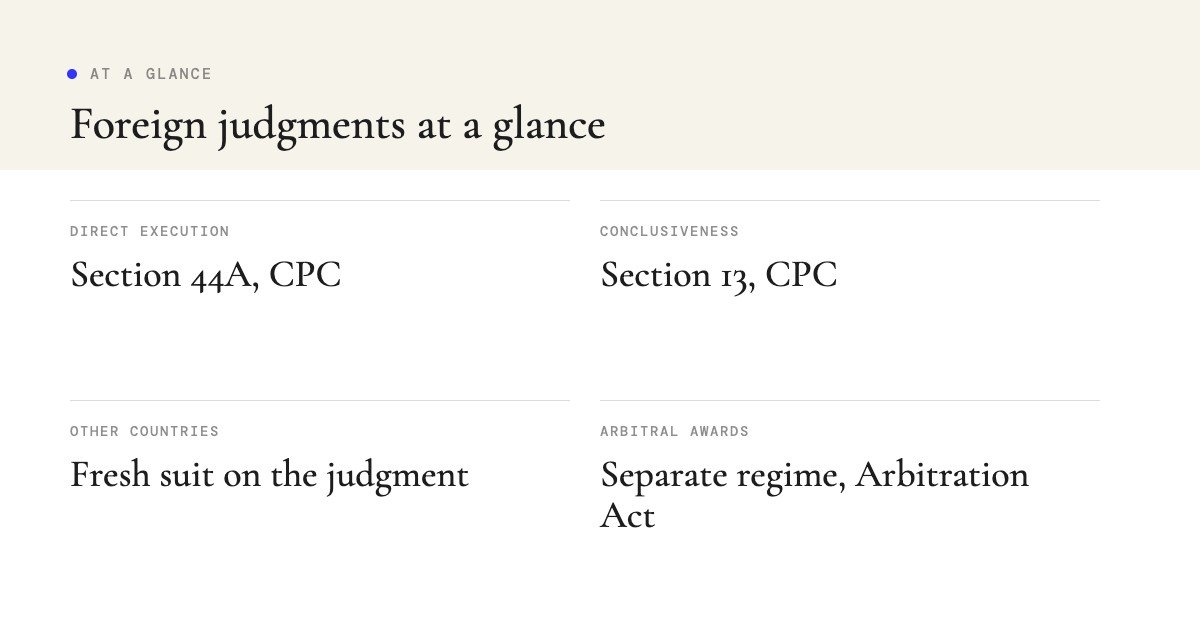
- Section 44A CPC allows money decrees of superior courts in reciprocating territories to be executed in Bangladesh as if passed by a District Court.
- Reciprocating territories are those declared by government notification; the current list should always be checked.
- Judgments from non-reciprocating countries can be enforced only by filing a suit on the foreign judgment.
- Under section 13 CPC, a foreign judgment is conclusive except on six grounds, including fraud, lack of jurisdiction and breach of natural justice.
- Arbitral awards follow a different and often easier route under the Arbitration Act 2001 and the New York Convention.
Two routes to enforce a foreign judgment in Bangladesh
Bangladesh is not party to any multilateral convention on the recognition of foreign court judgments. Instead, the Code of Civil Procedure 1908 provides two routes. The first, under section 44A, is direct execution for decrees from reciprocating territories. The second is a common law style suit on the foreign judgment, available for judgments from anywhere.
Which route applies to a foreign judgment in Bangladesh shapes the timetable, cost and risk. Our enforcement practice advises judgment creditors from many jurisdictions on recovering against assets here.
Section 44A: direct execution of a foreign judgment in Bangladesh
Section 44A provides that where a certified copy of a decree of a superior court of a reciprocating territory is filed in a District Court, the decree may be executed in Bangladesh as if it had been passed by that District Court. The creditor must file, together with the certified copy, a certificate from the superior court stating the extent, if any, to which the decree has been satisfied or adjusted.
The decree must be a money decree. Section 44A does not cover sums payable in respect of taxes or similar charges, fines or other penalties, and it does not cover arbitral awards even if they have been entered as judgments abroad.
The executing court can refuse execution if the judgment debtor shows that the decree falls within any of the exceptions in section 13. In practice, a foreign judgment in Bangladesh under section 44A is therefore subject to the same core defences as one sued upon.
Which countries are reciprocating territories
A reciprocating territory is a country or territory outside Bangladesh that the government declares, by notification in the official Gazette, to be a reciprocating territory for the purposes of section 44A, together with its superior courts. Historically, notifications have covered the United Kingdom and certain Commonwealth jurisdictions.
Because notifications can be old and the political map has changed, creditors should verify the current position before relying on section 44A. If the country is not notified, the creditor must use the suit route. Getting this question wrong at the start can waste months.
Section 13: when a foreign judgment is not conclusive
Section 13 CPC makes a foreign judgment conclusive as to any matter directly adjudicated between the same parties, except in six situations:
| Exception | What it means in practice |
|---|---|
| Not pronounced by a court of competent jurisdiction | The foreign court lacked international jurisdiction over the defendant |
| Not given on the merits | For example, some default judgments without consideration of evidence |
| Founded on an incorrect view of international law or refusal to recognise Bangladeshi law where applicable | The foreign court ignored governing Bangladeshi law |
| Proceedings opposed to natural justice | No proper notice or opportunity to be heard |
| Obtained by fraud | Fraud on the court or the parties |
| Sustains a claim founded on a breach of any law in force in Bangladesh | The underlying claim offends Bangladeshi law |
Section 14 adds a presumption: on production of a certified copy, the court presumes the foreign judgment was pronounced by a court of competent jurisdiction unless the contrary appears on the record, although that presumption can be displaced by proof.
Default judgments and jurisdiction
Default judgments cause the most disputes when a creditor seeks to enforce a foreign judgment in Bangladesh. Courts in the subcontinent have held that a judgment entered merely because the defendant did not appear, without any consideration of evidence, may not be "on the merits". If the foreign court considered the claim and evidence before entering judgment, the position is stronger.
Jurisdiction is the other common battleground. A foreign judgment in Bangladesh is more likely to be recognised where the defendant submitted to the foreign court by appearing, agreed to its jurisdiction in a contract, or was resident or carrying on business there when proceedings began.
The suit route for non-reciprocating countries
For judgments from countries that are not reciprocating territories, including many major trading partners, the creditor files an ordinary money suit in Bangladesh based on the foreign judgment. The judgment is treated as creating an obligation to pay, and section 13 governs whether it is conclusive.
The creditor does not usually need to re-prove the original claim, unless the defendant establishes a section 13 exception. Once the Bangladeshi court passes its own decree, that decree is executed in the normal way under Order 21. Limitation applies: the Limitation Act 1908 prescribes a period for suits on foreign judgments, generally six years from the date of the judgment, so creditors should not delay.
Step by step
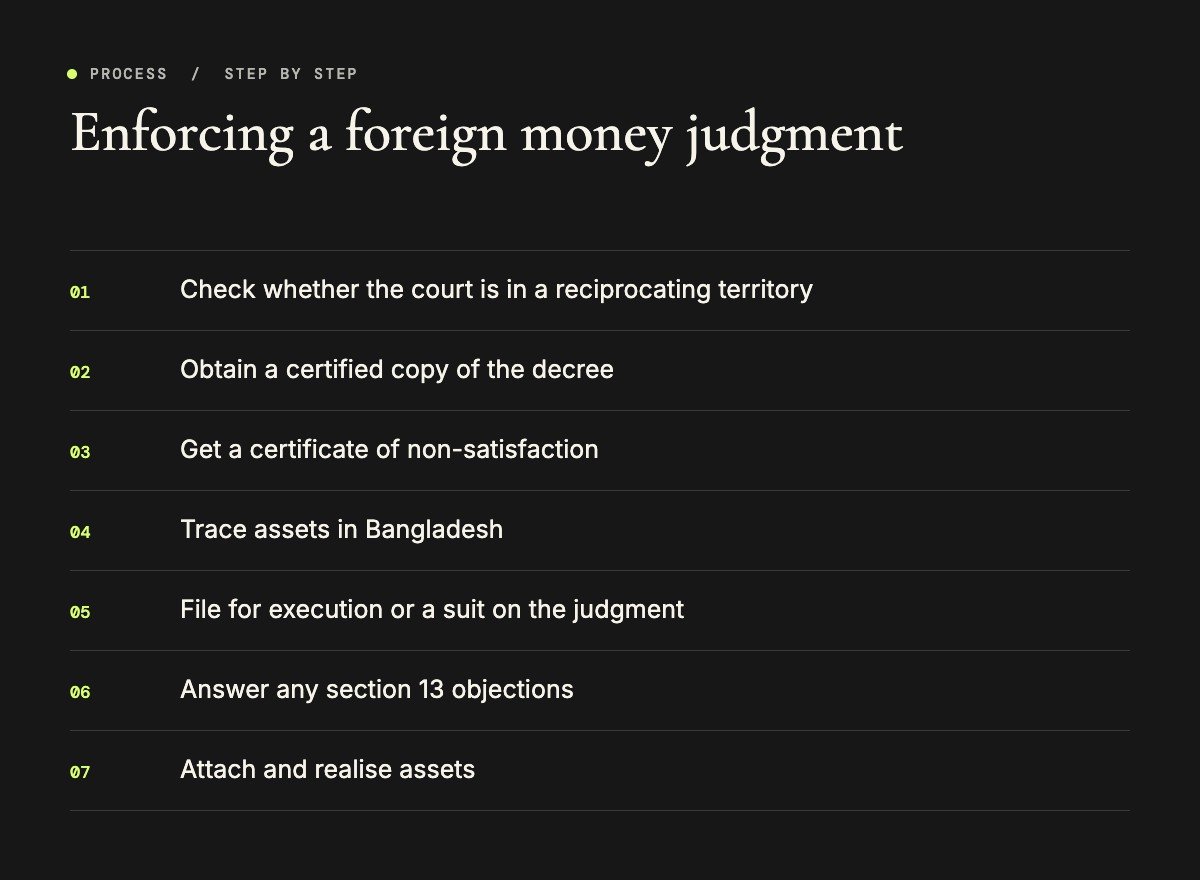
- Check reciprocity. Confirm whether the foreign court is a superior court of a notified reciprocating territory.
- Obtain certified copies. Get a certified copy of the judgment and decree from the foreign court.
- Get a satisfaction certificate. For section 44A, obtain a certificate of the amount unsatisfied.
- Authenticate documents. Arrange notarisation and apostille or consular legalisation as appropriate.
- Trace assets. Identify bank accounts, land, shares and receivables in Bangladesh.
- File proceedings. File an execution application in the District Court, or a suit on the judgment.
- Enforce. Seek attachment, sale or garnishee orders once the court allows execution.
Since Bangladesh joined the Apostille Convention, documents from other contracting states can be authenticated by apostille rather than full consular legalisation. Translate any non-English documents and have translations certified to avoid objections at the filing stage.
Interim protection while enforcement is pending
A creditor worried that assets will disappear can seek attachment before judgment under Order 38 CPC in a suit on the foreign judgment, or temporary injunctions under Order 39. Strong evidence of the risk of dissipation is required.
Where the underlying dispute is still being litigated abroad, interim relief in Bangladesh is harder to obtain, because there is not yet a foreign judgment in Bangladesh to enforce and no local suit on the merits. Early advice on asset protection is important.
Foreign judgments compared with arbitral awards
| Issue | Foreign court judgment | Foreign arbitral award |
|---|---|---|
| Legal basis | Sections 13, 14 and 44A CPC | Sections 45 to 47, Arbitration Act 2001 |
| International treaty | None | New York Convention |
| Countries covered | Reciprocating territories only for direct execution | All Convention states |
| Forum | District Court | District Judge's court for foreign awards |
For contracts with Bangladeshi parties, this comparison is a strong argument for choosing arbitration over foreign court jurisdiction. See our guide to arbitration in Bangladesh.
Currency, interest and remittance
Foreign judgments are often expressed in foreign currency. Bangladeshi courts may convert the amount into taka at an appropriate date, and the creditor should address the conversion date in its application. Post-judgment interest awarded by the foreign court may be recoverable, subject to the court's view.
Once money is recovered, remittance abroad must comply with foreign exchange regulations administered by Bangladesh Bank. A certified copy of the Bangladeshi execution order or decree usually supports the remittance.
Defending a foreign judgment in Bangladesh
A judgment debtor faced with a foreign judgment in Bangladesh should examine how it was served, whether it appeared or submitted to jurisdiction, whether the judgment was on the merits, and whether the claim breaches Bangladeshi law. Objections should be raised at the earliest stage, with documentary evidence.
Debtors should also check limitation and whether the judgment has been partly satisfied, set aside or stayed abroad, since these points can reduce or defeat enforcement.
Where the debtor has a genuine defence, it may also consider applying to set aside the judgment in the foreign court itself. A successful application abroad removes the basis for enforcement here and may be quicker than contesting each step locally, though the timing of both sets of proceedings needs careful coordination with foreign counsel.
Practical costs and timing
Enforcing a foreign judgment in Bangladesh involves court fees calculated on the value of the claim, translation and authentication costs, and lawyers' fees. A section 44A execution is generally faster than a suit, because the creditor goes straight to the executing court. A suit on a foreign judgment in Bangladesh involves pleadings, evidence and judgment before execution can begin, and contested cases may take years.
Creditors should weigh the value of identifiable assets against these costs. Where assets are modest, negotiating a settlement backed by the threat of enforcement may be the better commercial choice.
Asset tracing before you file
A foreign judgment in Bangladesh is only worth enforcing against reachable assets. Useful sources include the RJSC records of companies and directors, land records and mutation registers, court records of other litigation, and publicly available information on listed shareholdings.
Bank account information is confidential, but once execution is allowed, the court can issue attachment orders to banks. Precise asset information makes each step of enforcing a foreign judgment in Bangladesh faster.
Drafting contracts with enforcement in mind
Parties contracting with Bangladeshi companies can avoid many of these problems at the drafting stage. Choosing arbitration seated in a New York Convention state, rather than foreign court jurisdiction, gives a far more reliable route to enforcement. If court jurisdiction is preferred, selecting the courts of a reciprocating territory and requiring the Bangladeshi party to appoint a process agent help reduce the risk that a foreign judgment in Bangladesh will be challenged later.
Frequently asked questions about foreign judgment in bangladesh
Can a UK judgment be enforced in Bangladesh?
UK superior court money judgments have historically been covered by section 44A notifications; confirm the current notification before filing.
What if the country is not a reciprocating territory?
File a money suit in Bangladesh based on the foreign judgment.
Can a default judgment be enforced?
Possibly, but it may be challenged as not given on the merits under section 13(b).
Is there a time limit?
Yes. Suits on foreign judgments are subject to the Limitation Act 1908, generally six years.
Does section 44A cover arbitral awards?
No. Foreign awards are enforced under the Arbitration Act 2001.
Do documents need an apostille?
Documents from Apostille Convention states can be apostilled; others need consular legalisation.
How we can help
We act for creditors and debtors in enforcing or resisting a foreign judgment in Bangladesh, from reciprocity checks and asset tracing to execution and appeals. Learn more about our enforcement practice, our commercial litigation team and our England and Wales desk.
Holding an overseas judgment?
We assess enforceability and trace assets in Bangladesh.
Book a consultationEnforcement practicePrimary sources: the Code of Civil Procedure 1908 and the Limitation Act 1908 on the Laws of Bangladesh portal; decisions of the Supreme Court of Bangladesh.
This article is general information about Bangladeshi law as of October 2026 and is not legal advice. Reciprocity notifications and case law should be checked for each matter.


0 Comments