
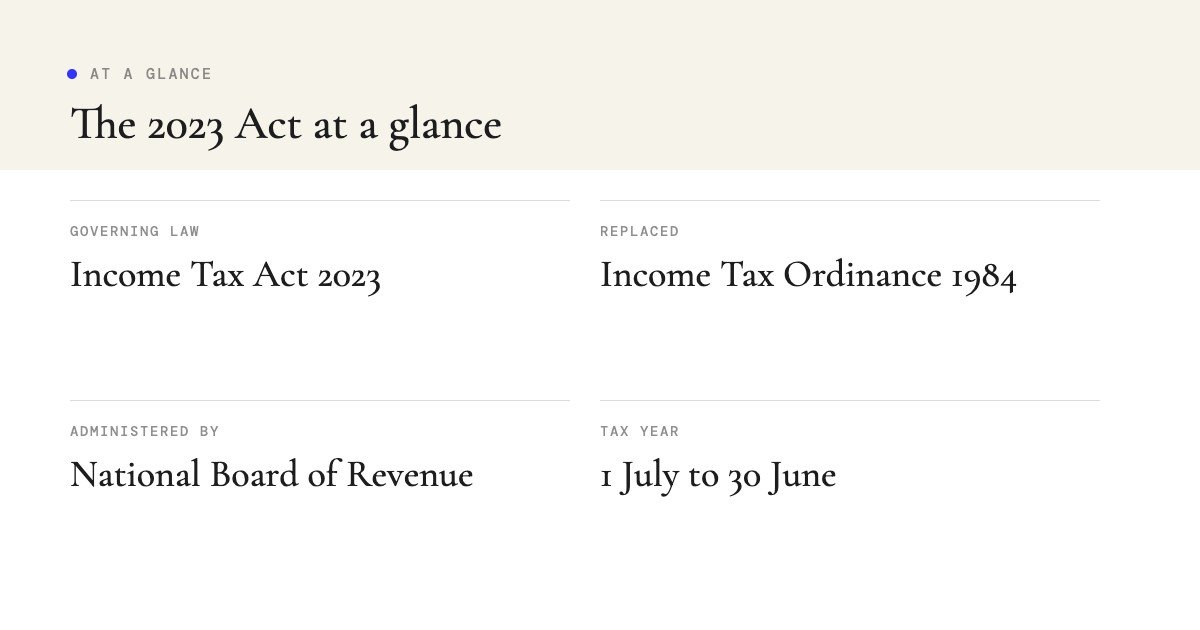
The income tax act 2023 in Bangladesh replaced the Income Tax Ordinance 1984 after almost four decades. It kept many familiar rules but rewrote the structure, narrowed official discretion, widened withholding and tightened deductions. Here is what changed, what stayed the same and what businesses and individuals should do about it.
- The Income Tax Act 2023 repealed the Income Tax Ordinance 1984 and applies from the 2023-24 tax year; it was enacted in Bangla, with an English translation published by the NBR.
- The Act reorganises the heads of income, uses the language of income year and tax year, and moves almost all taxpayers onto self-assessment.
- Withholding obligations, proof of return submission and bank-channel payment rules are wider, and failure to comply now often costs a deduction as well as a penalty.
- Rates, thresholds and caps have already been changed by the Finance Ordinance 2025 and the Finance Act 2026, so always read the Act as currently amended.
- Pending matters from the Ordinance years are generally preserved by the savings provisions, so old disputes still need careful handling.
Why the income tax act 2023 in Bangladesh was needed
For almost forty years, income tax in Bangladesh was governed by the Income Tax Ordinance 1984, itself a successor to the Income Tax Act 1922 of the British period. The Ordinance was made during a period of martial law and had been amended by nearly every Finance Act since. By the 2020s it was a patchwork of provisos, explanations and special regimes that even experienced practitioners found hard to navigate.
Parliament passed the Income Tax Act 2023 in June 2023. It repealed the Ordinance and applies to income from the 2023-24 tax year onward. The stated aims were simpler language, a logical structure, less discretion for tax officials, a broader tax base and closer alignment with modern accounting standards.
The income tax act 2023 in Bangladesh is not a complete break with the past. Many core concepts, such as residence, total income, the heads of income and withholding at source, survive in recognisable form. What changed is how those rules are organised, how much room officials have to interpret them, and how strictly documentation and payment conditions are enforced.
The first income tax law written in Bangla
The 2023 Act was enacted in Bangla. The National Board of Revenue (NBR) later published an English translation, which foreign investors and their advisers rely on heavily. Where the two versions differ, the Bangla text is the law. In close cases, especially on definitions and conditions for deductions, we always check the Bangla wording before giving advice.
Structure of the income tax act 2023 in Bangladesh
The Act runs to well over three hundred sections and eight schedules, grouped into chapters by subject. Related provisions that were scattered across the old Ordinance now sit together: all the withholding provisions in one part, all the assessment and return provisions in another, all the appeal provisions in a third.
The schedules carry much of the detail that used to be buried in sections and statutory regulatory orders. They deal with matters such as exempt income, tax rates and reduced rates, depreciation and amortisation, and the rules for amalgamations and other business restructurings.
Income year and tax year
The 1984 Ordinance taxed the income of an "income year" in the following "assessment year". The new law speaks of the income year and the tax year, and NBR forms now refer to the tax year. For most taxpayers the practical effect is the same: income earned in the twelve months from 1 July to 30 June is reported and taxed in the return for that tax year.
Reorganised heads of income
The Ordinance had seven heads, including salaries, interest on securities and income from house property. The income tax act 2023 in Bangladesh restates the heads in modern terms: employment income, rental income, agricultural income, income from business, capital gains, income from financial assets and income from other sources. Interest, dividends and similar returns are now grouped under financial assets rather than spread across several heads.
Business income is also split. Ordinary business income is taxed on the usual net basis, while certain items, such as proceeds from disposing of business assets, compensation and old liabilities written back, are treated as special business income without the usual set-off.
Key changes at a glance: 1984 Ordinance versus 2023 Act
The table below summarises the main structural differences. It is a guide to where to look, not a substitute for reading the current text, because rates and thresholds have already been amended more than once.
| Topic | Income Tax Ordinance 1984 | Income Tax Act 2023 |
|---|---|---|
| Language | English | Bangla, with an NBR English translation |
| Period terminology | Income year and assessment year | Income year and tax year |
| Heads of income | Seven heads including salaries and house property | Employment, rent, agriculture, business, capital gains, financial assets, other sources |
| Assessment model | Mix of normal, universal self and spot assessment | Self-assessment as the default for almost all taxpayers |
| Withholding | Many sections, frequent SRO changes | Consolidated in one part, withholder registration and returns |
| Disallowances | Spread through many provisos | Systematic rules on cash payments, perquisites and unwithheld payments |
| Restructuring | Limited guidance on amalgamation | A dedicated schedule for amalgamations, demergers and restructuring |
| Anti-avoidance | Specific rules only | General anti-avoidance and thin capitalisation rules added |
| Refunds | Often slow and paper-based | Electronic refund to the taxpayer's bank account |
Returns and self-assessment under the new law
The single biggest procedural change under the income tax act 2023 in Bangladesh is the move to self-assessment as the normal way of being taxed. The taxpayer computes the tax, pays it and files the return; the return is accepted on that basis, and only a selection of returns is later examined in audit.
Under the Ordinance, deputy commissioners had wide powers to reject accounts and estimate income, and "spot assessment" and negotiated assessments were common. The new framework is designed to reduce face-to-face contact and the room for arbitrary estimates, while giving the NBR stronger tools to select risky returns for audit.
Tax Day and filing deadlines
The concept of Tax Day continues under the income tax act 2023 in Bangladesh. For individuals it is 30 November following the end of the income year. Companies and other entities have a later Tax Day fixed by reference to the end of their income year, and that definition has been adjusted by later amendments, so confirm the current date for your entity each year.
The Act limits extensions more tightly than the Ordinance did, and late filing brings loss of certain benefits as well as penalties and delay interest. The 2025 amendments added specific rules for limited extensions and for individuals working or studying abroad. Plan to file on time and treat any extension as an exception.
Audited accounts with the return
Companies must file audited financial statements with their return, and other entities above prescribed turnover thresholds must do the same.
For a walk-through of the filing process for companies, see our company income tax return guide.
Self-assessment shifts risk onto the taxpayer. A return that is accepted today can still be selected for audit later within the statutory time limit. Keep the working papers, withholding certificates and bank evidence behind every figure, not just the return itself.
Withholding tax and proof of return under the 2023 Act
Withholding tax, also called tax deducted or collected at source, raises the largest share of income tax revenue in Bangladesh. The income tax act 2023 in Bangladesh keeps that model but organises it more tightly and puts more obligations on payers.
Withholders, registration and returns
Companies, firms, government bodies and many other specified persons are withholders. They must deduct tax at the prescribed rate when making specified payments, such as salaries, contract and supply payments, professional fees, rent, commissions and payments to non-residents, and deposit it with the government within the deadline.
The Act introduced a withholder identification number and a separate withholding tax return. As first enacted, withholding returns were monthly; the Finance Ordinance 2025 moved them to a quarterly cycle. Salary information and employee return information are reported through this system as well.
Proof of return submission
The Ordinance required a TIN for many services. The 2023 Act replaced much of that with a requirement to show proof of submission of return (PSR) before obtaining a long list of services, from large loans, credit cards and trade licences to property registration and certain contracts. Where a payee cannot show PSR, the withholding rate on payments to them is generally increased.
The cost of getting withholding wrong
Under the income tax act 2023 in Bangladesh, failure to withhold is expensive in three ways. The payer can be treated as the defaulting taxpayer for the tax not deducted. Interest and penalties apply. And in many cases the underlying expense is disallowed in the payer's own tax computation, so the business pays more tax on its profit as well.
For this reason, we advise clients to treat withholding as a payments-control issue, not an accounting afterthought. Every vendor payment workflow should check the category, the applicable rate, the payee's PSR status and the deposit deadline.
Minimum tax under the income tax act 2023 in Bangladesh
Minimum tax is one of the most commercially significant features of the income tax act 2023 in Bangladesh. The Act keeps and strengthens the rule that certain taxpayers must pay tax of at least a percentage of their gross receipts, whatever their profit. Loss-making or low-margin businesses therefore still pay income tax.
In addition, tax deducted at source on specified receipts, such as payments to contractors, suppliers and importers, is often treated as the minimum tax for those receipts. Under the Act as first enacted, any excess of minimum tax over regular tax could not be refunded or carried forward. The Finance Ordinance 2025 relaxed this in some cases, and the rates and thresholds have changed more than once.
Because the minimum tax interacts with withholding, turnover and sector-specific rates, we recommend modelling it at budget time each year. A business that expects to report low profits should know in advance whether its liability will be driven by profit or by turnover.
Deductions, disallowances and bank-channel rules
The income tax act 2023 in Bangladesh tightened the rules on what a business may deduct. Several of these changes catch companies that ran comfortably under the Ordinance.
- Cash payments. Salary and rent paid otherwise than through a bank channel, and other payments above prescribed limits made in cash, can be disallowed.
- Payments without withholding. Expenses on which tax should have been withheld but was not are generally disallowed.
- Perquisites. Benefits to employees above a statutory ceiling per employee are disallowed in the employer's hands.
- Royalties and technical fees. Payments for royalties, technical know-how and similar services, often paid to foreign group companies, are capped by reference to turnover or profit.
- Head office and group charges. Allocations from head office or associated companies are capped.
- Entertainment, travel and promotion. These are subject to percentage limits.
The caps themselves have been changed by the Finance Ordinance 2025 and may change again in any Finance Act, so do not rely on the original 2023 percentages. Read the schedule in force for the relevant income year.
Bank channel conditions for reduced rates
The reduced corporate tax rate under the income tax act 2023 in Bangladesh is conditional on receipts, and large expenses and investments, being made through bank transfer. A company that misses the condition pays a higher rate on its whole income, not just on the cash portion, so treasury policies should be aligned with the conditions in the current Finance Act.
Capital gains, share transfers and restructuring
The income tax act 2023 in Bangladesh modernised the treatment of capital transactions. Capital gains are measured with reference to fair market value where the stated consideration is lower, which limits under-reporting on related-party sales.
Valuation report for non-listed shares
A transfer of shares in a company that is not listed must be supported by a valuation report, and tax on the gain must be dealt with before the transfer is recorded. Without the report, the registering authority can refuse to register the transfer. This affects every share sale in a private company, including transfers between family members and intra-group reorganisations. See our guide to company share transfer in Bangladesh for the corporate side.
Amalgamations and demergers
The Ordinance gave little guidance on how mergers were taxed. The income tax act 2023 in Bangladesh added a schedule dealing with amalgamations, demergers and business restructurings, setting out when a reorganisation can proceed without immediate tax and how losses, depreciation and cost bases carry over. The conditions are strict, so restructuring should be designed with the schedule in hand.
General anti-avoidance and thin capitalisation
For the first time, the income tax act 2023 in Bangladesh includes a general anti-avoidance rule allowing the tax authority to disregard arrangements whose main purpose is to obtain a tax benefit. It also adds thin capitalisation rules that limit interest deductions on excessive borrowing from related parties. Groups financing Bangladeshi subsidiaries with shareholder loans should review their debt-equity mix.
Refunds, audit and appeals
The income tax act 2023 in Bangladesh promises electronic payment of refunds to the taxpayer's bank account within a fixed period after the return is processed, net of any outstanding demands.
The appeal ladder
The appeal structure under the income tax act 2023 in Bangladesh is familiar. An assessment can be challenged before the Commissioner of Taxes (Appeals), then the Taxes Appellate Tribunal, and then on questions of law before the High Court Division of the Supreme Court of Bangladesh.
Pre-deposit requirements at each level have been revised by recent Finance laws, generally downward, so check the current percentage before filing.
Transition from the Ordinance to the income tax act 2023 in Bangladesh
Repeal of the Ordinance did not wipe out old liabilities. The repeal and savings provisions generally preserve assessments, appeals, penalties and other proceedings relating to earlier years, which continue under the law that applied at the time. A dispute about the 2021-22 assessment year, for example, is still decided under the Ordinance.
Businesses now often run two regimes side by side: the Ordinance for legacy audits and appeals, and the income tax act 2023 in Bangladesh for current years. Keeping files separate and citing the correct law in every reply to the tax office avoids unnecessary confusion.
A transition plan for businesses
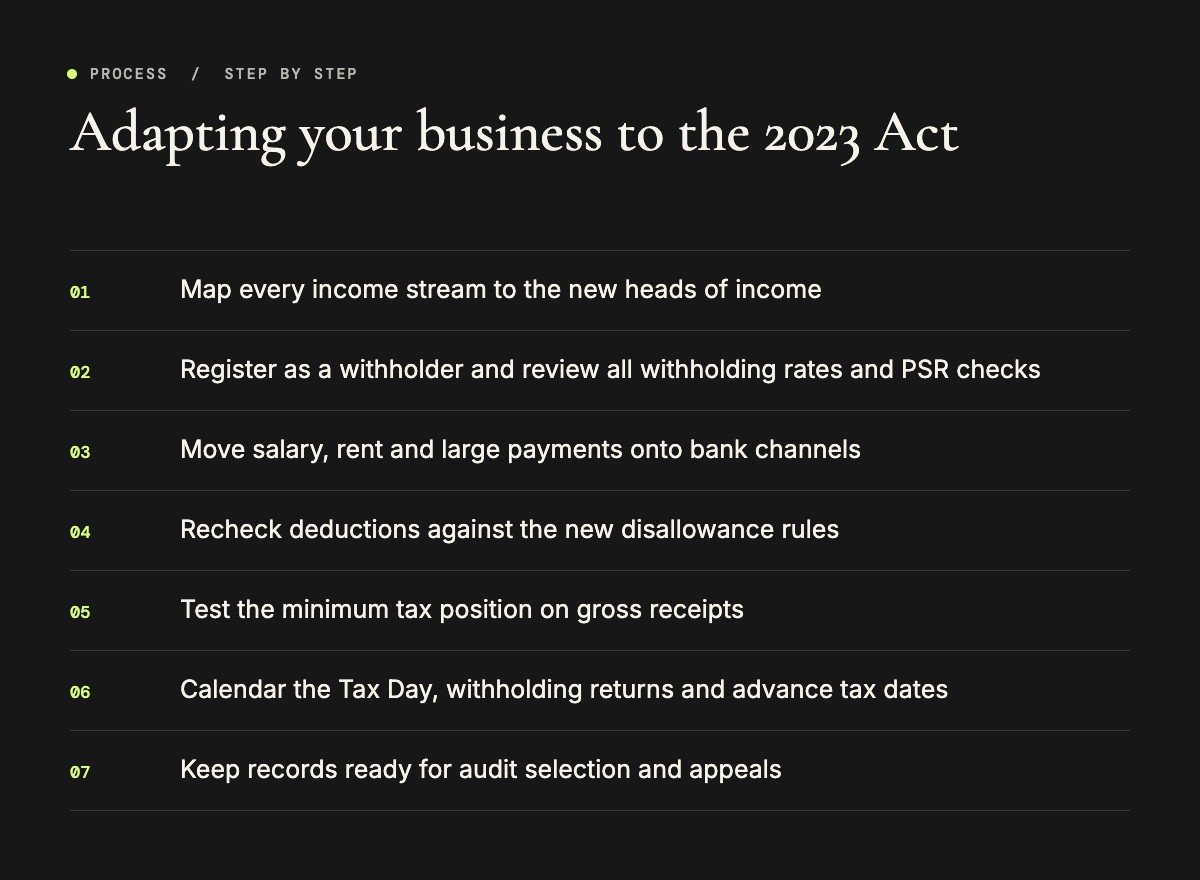
- Map income to the new heads. Review each revenue stream and investment return and classify it under the new heads, especially financial asset income and special business income.
- Fix withholding controls. Register as a withholder, update vendor master data with PSR status and load the current rates into the payment system.
- Move payments onto banks. Pay all salaries and rent through bank channels and set internal limits for other cash payments below the statutory thresholds.
- Re-test deductions. Check royalties, technical fees, group charges, perquisites and promotional spending against the current caps.
- Model minimum tax. Compare expected regular tax with minimum tax on gross receipts and withholding that counts as minimum tax.
- Build the calendar. Record the Tax Day, withholding return dates, advance tax instalments and audit deadlines in one compliance calendar.
- Prepare for audit. Keep an audit file for each year with reconciliations between accounts, VAT returns, withholding returns and bank statements.
What the 2023 Act means for individuals and expatriates
Individuals feel the income tax act 2023 in Bangladesh mainly through the employment income rules and the return form. Salary is now taxed as employment income, with a single exemption expressed as the lower of a fraction of income or a fixed amount, replacing the old list of separately exempt allowances. Perquisites such as company cars and accommodation are valued under specific rules.
Many individuals must file a statement of assets and liabilities and, above certain thresholds, a statement of lifestyle expenses. The thresholds for these statements, for the tax-free allowance and for the net-worth surcharge have been revised by later Finance laws, so check the figures for the relevant tax year rather than relying on 2023 commentary.
Foreign nationals working in Bangladesh
Residence is still decided mainly by days of presence in Bangladesh during the income year. A resident foreign employee is taxed on worldwide income in principle, while a non-resident is taxed on Bangladesh-source income, generally at a flat rate. Employers must withhold on salary paid to expatriates, including amounts paid offshore for work done in Bangladesh, and double taxation agreements may give relief.
Frequently asked questions about income tax act 2023 in Bangladesh
When did the Income Tax Act 2023 take effect?
Parliament passed it in June 2023 and it applies from the 2023-24 tax year. Income earned from 1 July 2023 onward is taxed under the new Act, while earlier years remain under the 1984 Ordinance.
Is there an official English version of the Act?
Yes, the NBR has published an English translation. The Act was enacted in Bangla, and the Bangla text prevails if there is any difference in meaning.
Do the 2023 tax rates still apply?
Not necessarily. The Finance Ordinance 2025 and the Finance Act 2026 changed several rates, thresholds and caps. Always check the Act as amended for the relevant tax year.
Can the tax office still estimate my income?
Self-assessment is the default, but a return selected for audit can be examined and income can be reassessed where the books are unreliable or income has been concealed, within the statutory time limits.
What happens to my old tax case under the Ordinance?
Pending assessments and appeals for years before the Act generally continue under the Ordinance by virtue of the savings provisions. Treat them as separate files governed by the old law.
Does the Act affect share transfers in private companies?
Yes. Transfers of non-listed shares need a valuation report and the capital gains tax position must be settled, or the transfer may not be registered.
How we can help
We advise companies, foreign investors and individuals on the income tax act 2023 in Bangladesh, from structuring and withholding reviews to returns, audits, appeals and restructurings under the new schedule. If you want your tax position checked against the current law, start with our tax law practice.
Need a review under the 2023 Act?
We review withholding, deductions and minimum tax exposure against the Income Tax Act 2023 as currently amended, and represent clients in audits and appeals.
Book a consultationTax law practicePrimary sources: the Income Tax Act 2023 and later Finance laws on the Laws of Bangladesh portal; the Act, translations and circulars from the National Board of Revenue; online returns through NBR e-return.
This article is general information about Bangladeshi law as of 2026 and is not legal advice. Tax rates, thresholds and procedures change with every Finance law; confirm current requirements with the NBR or a qualified adviser before acting.



0 Comments