
A government tender dispute in Bangladesh is won or lost on time limits. The Public Procurement Act 2006 gives aggrieved bidders a structured complaint route up to an independent Review Panel, but the windows are measured in days, and a bidder who misses them may find the courts unwilling to help.
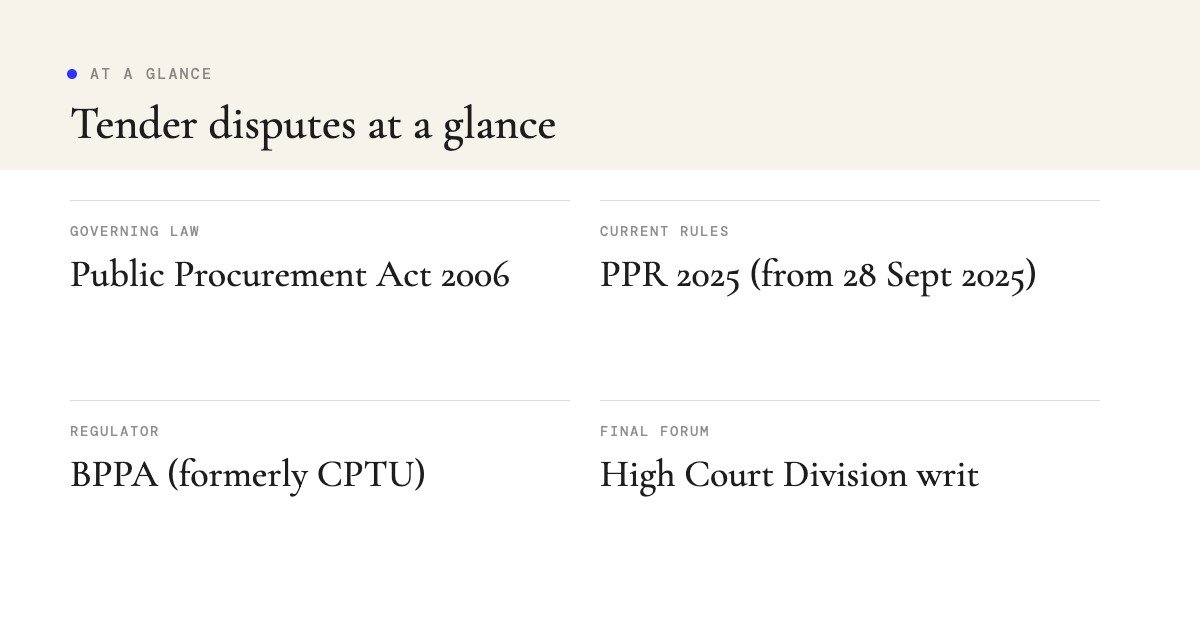
- Public procurement is governed by the Public Procurement Act 2006, as amended by the 2025 amendment ordinance that Parliament turned into an Act in April 2026, and by the Public Procurement Rules 2025, in force since 28 September 2025.
- Complaints climb a ladder: the procuring entity, the head of the procuring entity, the Secretary of the ministry or division, and then a Review Panel run by the Bangladesh Public Procurement Authority (BPPA).
- Each step has a short deadline counted in calendar or working days from awareness or from the previous decision.
- The Review Panel can have the award suspended and recommend remedial action, annulment or compensation.
- A writ petition is a last resort; the High Court Division usually expects the statutory remedies to be used first.
What a government tender dispute in Bangladesh usually involves
Most procurement disputes start with a letter or an e-GP notification that a bidder did not expect. The tender has been declared non-responsive, a competitor has been awarded the contract at a higher price, the whole process has been cancelled, or the bidder has been debarred. In each case the bidder has to decide quickly whether to bring a government tender dispute in Bangladesh and, if so, how.
In our experience, the common grounds fall into a few groups:
- Responsiveness. A bid rejected for a missing document, a minor deviation or a misread qualification requirement.
- Evaluation errors. Arithmetic mistakes, inconsistent scoring, or criteria applied that were not in the tender document.
- Tailored specifications. Requirements drafted so that only one brand or supplier can comply.
- Low-price rejection. A bid rejected as significantly low-priced without proper analysis.
- Cancellation and re-tender. A process scrapped after prices are known, often to favour a different bidder.
- Debarment. Exclusion from public procurement for alleged misconduct or contract default.
The legal framework for public procurement
The Public Procurement Act 2006 (PPA) applies to procurement of goods, works and services by government ministries, divisions, departments, statutory bodies, local government institutions and state-owned companies using public funds. It sets the principles, methods and institutions, and it creates the right to complain that underpins every government tender dispute in Bangladesh.
The Act was substantially amended by the Public Procurement (Amendment) Ordinance 2025, promulgated on 4 May 2025 and brought into force on 28 September 2025. Parliament passed a bill turning the ordinance into an Act in April 2026. The reforms made the e-GP system mandatory, introduced sustainable procurement, framework agreements and reverse auctions, and recognised BPPA as the primary procurement regulator.
The Public Procurement Rules 2025
The detailed procedure is in the Public Procurement Rules 2025, which replaced the Public Procurement Rules 2008 and came into force on 28 September 2025. They cover procurement planning, tender methods, evaluation, award notices, contract management through the e-GP contract management module, debarment, and complaints.
Among the changes most relevant to disputes: a three-step award process (a letter of acceptance to the winner, a notification of award to the other bidders, then a contract signing report with beneficial ownership information), a revised method for identifying significantly low-priced tenders, and a new debarment regime with its own appeal board.
Donor-funded projects
Where a project is financed by a development partner such as the World Bank or the Asian Development Bank, the loan agreement may require the partner's own procurement regulations to apply. In that case the complaint route may follow the partner's rules, and the partner itself may review the dispute. Check the loan agreement and tender document before choosing a forum for a government tender dispute in Bangladesh on a donor-funded project.
The right to complain in a government tender dispute in Bangladesh
Section 29 of the PPA gives a person who participates in a procurement process, and who claims to have suffered or to be likely to suffer loss because the procuring entity failed to comply with the Act or the Rules, the right to complain. Section 30 provides for Review Panels to hear appeals once administrative remedies are exhausted.
The right to bring a government tender dispute in Bangladesh belongs to tenderers, applicants and potential tenderers with a real interest. A complaint must identify the decision, the rule breached, and the loss or likely loss. General dissatisfaction with an outcome is not enough.
Time usually runs from when you became aware, or ought to have become aware, of the problem, not from when you finish reading the evaluation report. If a defect is visible in the tender document itself, such as a restrictive specification, raise it before the submission deadline. Bidders who wait until they lose are often told they accepted the terms by bidding.
The complaint ladder: step by step
The complaint system for a government tender dispute in Bangladesh is tiered so that most disputes are settled inside government before an independent body is involved. Each tier must be used, in order, within its deadline. Complaints for e-GP tenders are generally lodged through the e-GP system, which records the time of filing.
| Stage | Who decides | Time limits published by BPPA |
|---|---|---|
| 1. Complaint | Procuring entity (PE) | Within 7 calendar days of awareness; PE responds within 5 working days |
| 2. First escalation | Head of the procuring entity (HOPE) | Within 3 working days after the PE period ends; decision within 5 working days |
| 3. Second escalation | Secretary of the ministry or division | Within 7 working days after the HOPE period ends; decision within 5 working days |
| 4. Appeal | BPPA Review Panel | Within 7 working days of the Secretary's decision; panel decides within 12 working days |
These periods are those BPPA publishes for its complaint and appeal system, which were set under the 2008 Rules. The 2025 Rules keep a tiered system, but the rule numbers and schedules have changed, so confirm the exact periods in the current Rules and the tender data sheet for your procurement before relying on them.
Where the HOPE was on the evaluation committee
If the head of the procuring entity sat on the evaluation committee, they should not decide the complaint. Under the published procedure the HOPE forwards it to the Secretary within a short period and tells the complainant. Watch for this, because a decision by a conflicted HOPE is itself a ground of appeal.
What a strong complaint contains
- The tender reference, package number and procuring entity.
- The decision complained of and the date you became aware of it.
- The specific provision of the PPA, the Rules or the tender document that was breached.
- The evidence, such as e-GP screenshots, clarifications, the evaluation outcome and bank or document records.
- The remedy you want: re-evaluation, reinstatement, suspension of award or cancellation of a flawed decision.
The Review Panel and how appeals work
Review Panels are the independent tier in a government tender dispute in Bangladesh. They are constituted under the Act and administered by BPPA, the authority formerly known as the Central Procurement Technical Unit (CPTU). Panel members are drawn from lists of experienced professionals, such as retired senior officials and procurement, legal and technical experts.
In a government tender dispute in Bangladesh, an appeal is admissible only after the administrative stages are exhausted. It must be lodged with BPPA within the deadline, with the registration fee and a security deposit. The amounts are set by the Rules and BPPA; check the current figures before filing, because an appeal without them is not validly lodged.
Suspension of the award
Once a valid appeal is lodged, the panel may direct the procuring entity to keep the notification of award suspended until it decides. For most bidders this is the single most important protection, because once a contract is signed the practical value of a procurement remedy falls sharply.
What the panel can decide
Decisions are made by majority and are in writing. According to BPPA, the panel may reject the appeal, state the rules that govern the issue, recommend remedial measures, recommend annulment of a non-compliant act or decision, recommend that the procurement proceed, or recommend compensation, including the return of the security deposit. Decisions are copied to the Secretary, BPPA and the procuring entity, and are generally made public.
Many panel outcomes are framed as recommendations or directions to the procuring entity. If an entity ignores a decision in your favour, that refusal can itself become the basis of a writ petition. Keep a clean record of the panel decision and every follow-up letter.
Debarment disputes under the 2025 Rules
Debarment is one of the most serious outcomes in public procurement, and it is a distinct kind of government tender dispute in Bangladesh. Under the 2025 Rules, a procuring entity may debar a person or firm for up to two years for professional misconduct, or where a contract was terminated for fundamental breach. A debarment by one public-sector entity applies across the public sector.
While a debarment is under consideration, the entity may temporarily suspend the firm. The debarment decision must be finalised within 42 days, or the suspension lapses. Tenderers must also certify that they are not currently debarred by a development partner in Bangladesh for procurement reasons.
Appealing a debarment
A firm aggrieved by a debarment may appeal to a Debarment Review Board of three experts set up under the 2025 Rules. The grounds usually focus on procedure, such as whether the firm was told the allegations and given a chance to answer, and on proportionality. Because debarment can shut a business out of its main market, appeal promptly and in parallel consider whether interim relief from the High Court Division is needed.
Writ petitions in a government tender dispute in Bangladesh
Under Article 102 of the Constitution, the High Court Division can review the actions of public authorities. Procuring entities are public authorities, so their tender decisions are open to judicial review. Our guide to writs explains the different writs and how they work.
The court is, however, cautious about any government tender dispute in Bangladesh. It does not re-run the evaluation or substitute its own commercial judgement. It intervenes where a decision is illegal, mala fide, procedurally unfair or so unreasonable that no rational authority could make it.
The alternative remedy problem
Because the PPA provides its own complaint system, the High Court Division often declines a writ where the petitioner skipped the statutory route. Exceptions exist, for example where the procuring entity acted wholly without jurisdiction, where fundamental rights are engaged, or where the statutory remedy is not effective in the circumstances. Do not count on an exception; use the complaint ladder unless there is a strong reason not to.
Interim orders
A writ petition can be accompanied by an application to stay the award or the signing of the contract. Interim relief is discretionary. The court weighs the strength of the case, the public interest in the project proceeding, and whether the petitioner acted promptly.
When the dispute arises after contract signing
Once a contract is signed, a disagreement about payment, variations, delay or termination is usually a contract dispute rather than a procurement complaint. The remedy then lies in the contract's dispute clause, which for works contracts commonly provides for an engineer or adjudicator decision followed by arbitration under the Arbitration Act 2001.
The line matters. A government tender dispute in Bangladesh about award goes through the PPA ladder; a dispute about performance goes through the contract. For the latter, see our guide to arbitration in Bangladesh, and for building and infrastructure matters our construction disputes practice.
Evidence, records and access to information
Evidence decides most procurement complaints. The e-GP system is helpful here because it time-stamps submissions, clarifications and notifications, and it keeps the official record of what each bidder uploaded. In a government tender dispute in Bangladesh, that record is usually more persuasive than any affidavit.
Bidders do not normally see competitors' bids or the full evaluation report. The notification of award, however, should tell unsuccessful bidders the outcome, and a bidder may ask the procuring entity for a debriefing on why its own tender failed. Ask early and in writing; a refusal or a vague answer can support the complaint.
Using the Right to Information Act 2009
Where the procuring entity will not explain itself, a request under the Right to Information Act 2009 may produce documents such as approvals, minutes or notices. It is slower than the complaint deadlines, so it should run alongside the complaint, never instead of it. Some commercial information is exempt from disclosure, and the entity may refuse those parts.
Expert and technical evidence
Where the dispute turns on whether a product met a specification or whether a price was abnormally low, a short independent technical note can make the difference. Keep it factual and tied to the tender criteria. Review Panels are practical bodies, and a clear one-page comparison often does more than a long legal argument.
A practical action plan for bidders
Bidders who succeed in a government tender dispute in Bangladesh usually move fast and keep their arguments narrow and documented. These are the steps we follow.
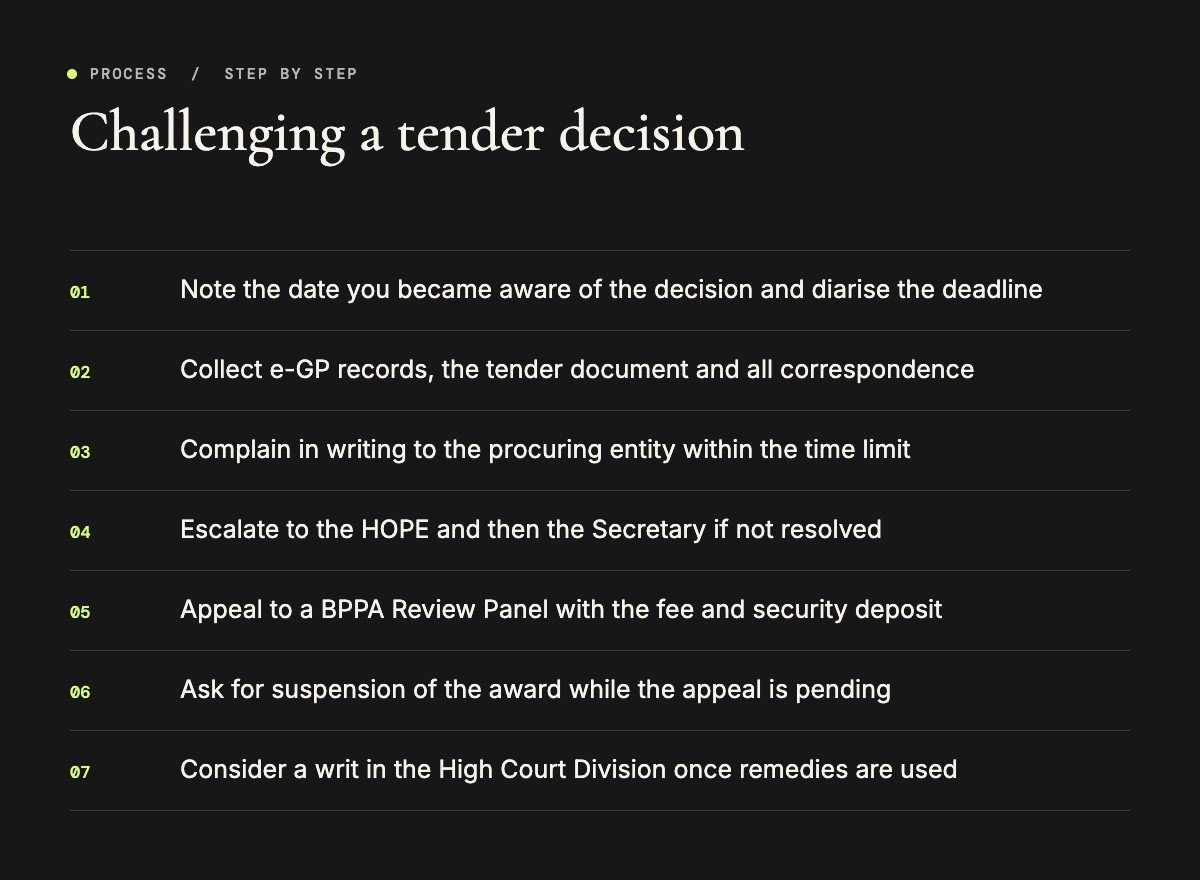
- Fix the deadline. Record the exact date and time you learned of the decision, and calculate each deadline in calendar or working days as the Rules require.
- Secure the record. Download everything from e-GP: the tender document, addenda, clarifications, your submission, and the notification. Screenshots with timestamps help.
- Identify the breach. Tie your complaint to a specific provision of the Act, the Rules or the tender document, not to fairness in general.
- File at the first tier. Lodge the complaint with the procuring entity within the period, and ask for the remedy you want in clear terms.
- Escalate on time. If there is no answer or an unsatisfactory one, move to the HOPE and then the Secretary within their windows. Silence does not stop the clock.
- Appeal to the Review Panel. File with BPPA with the fee and security deposit, and ask for the award to be suspended.
- Assess court action. If the panel route fails or is ignored, take advice promptly on a writ petition and interim relief.
Common mistakes that lose tender disputes
- Waiting for the evaluation report. In a government tender dispute in Bangladesh, the clock often starts earlier than bidders assume.
- Skipping a tier. Going straight to the Secretary or the Review Panel usually results in rejection for non-exhaustion.
- Arguing merits, not rules. Panels and courts respond to clear breaches, not to claims that your product is better.
- Challenging accepted terms too late. Restrictive specifications must be raised before bid submission.
- No suspension request. Without it, the contract may be signed and the dispute becomes academic.
- Inconsistent documents. A complaint that contradicts the bid on file damages credibility instantly.
Bidders should also remember that public procurement disputes sometimes involve allegations of collusion or corruption. Anything that suggests an offence under anti-corruption law should be handled with legal advice before it is put in writing.
Frequently asked questions about government tender dispute in Bangladesh
Can I go straight to the High Court Division?
Usually not. In a government tender dispute in Bangladesh, the court generally expects you to use the complaint and appeal route under the Public Procurement Act 2006 first. A writ without exhausting that route is often rejected unless the case falls within a recognised exception.
How quickly must I complain?
Very quickly. BPPA's published procedure allows 7 calendar days from awareness for the first complaint to the procuring entity, with short working-day windows for each later stage. Confirm the current periods in the Public Procurement Rules 2025.
Can the Review Panel stop the contract being signed?
Once a valid appeal is lodged, the panel can direct the procuring entity to keep the notification of award suspended until it decides. Ask for this expressly in your appeal.
Do I get my security deposit back?
The panel can recommend return of the security deposit, typically where the appeal succeeds. The deposit may be forfeited where the appeal is found frivolous or fails, depending on the Rules.
How long can a firm be debarred?
Under the Public Procurement Rules 2025, up to two years for professional misconduct or termination for fundamental breach, and the debarment applies across the public sector. An appeal lies to the Debarment Review Board.
Does the same process apply to World Bank or ADB funded tenders?
Not always. Where the financing agreement applies the development partner's procurement regulations, the complaint route may follow those regulations. Check the tender document and loan agreement first.
How we can help
We act for bidders, contractors and consultants at every stage of a government tender dispute in Bangladesh: reviewing tender documents before submission, drafting complaints and escalations, presenting appeals before BPPA Review Panels and Debarment Review Boards, and bringing writ petitions in the High Court Division. Learn more about our government and public sector practice.
Facing a tender rejection or debarment?
Send us the notification and tender document. We will map your deadlines and advise on the strongest route within days, not weeks.
Book a consultationPublic sector practicePrimary sources: the Public Procurement Act 2006 on the Laws of Bangladesh portal; the Public Procurement Rules 2025, complaint procedure and Review Panel decisions from the Bangladesh Public Procurement Authority; tender records on the e-GP portal; writ practice before the Supreme Court of Bangladesh.
This article is general information about Bangladeshi law as of October 2026 and is not legal advice. Procurement rules, time limits and fees change; confirm the current position with BPPA or a qualified lawyer before acting.


0 Comments