
The food safety law in Bangladesh changed sharply in 2026. The Food Safety Act 2013 has always set strict duties and criminal penalties, but new regulations gazetted on 16 July 2026 now require almost every food business, from street stalls to large importers, to register with or be licensed by the Bangladesh Food Safety Authority.
- The Food Safety Act 2013 repealed the Pure Food Ordinance 1959 and created the Bangladesh Food Safety Authority (BFSA) as the central food regulator.
- The Safe Food (Registration and Licensing) Regulations 2026 were gazetted on 16 July 2026, and BFSA has said businesses must apply from 1 November 2026.
- Sixteen categories of ordinary food business need registration only; four categories dealing with special and health-oriented foods need a full set of licences.
- Registrations and licences last three years. Operating without them is an offence under the 2013 Act.
- BFSA does not replace BSTI, the Department of National Consumer Rights Protection or sector regulators, so most businesses deal with more than one agency.
Why food safety law in Bangladesh matters more in 2026
For years, many food businesses treated food safety as an inspection risk: a mobile court might visit, a fine might follow, and life went on. That approach no longer works. Bangladesh now has a regulator with a growing field presence, detailed regulations on hygiene, labelling and contaminants, and since July 2026 a formal registration and licensing system that brings every operator into BFSA's records.
The practical effect is that the food safety law in Bangladesh now reaches the paperwork of a business, not only its kitchen or factory floor. A restaurant, bakery or importer that cannot show a BFSA registration number will find it harder to sell through supermarkets, win catering contracts or defend itself after a complaint.
BFSA enforcement drives are frequent and well publicised. Fines are imposed most months, and repeat offenders face criminal cases in the designated food courts. For a brand, the reputational cost of a reported adulteration case is often greater than the fine.
The Food Safety Act 2013: the legal foundation
The Food Safety Act 2013 (নিরাপদ খাদ্য আইন, ২০১৩) is the central statute. It repealed the Pure Food Ordinance 1959, whose small penalties had failed to deter adulteration, and replaced the scattered system with one regulator and one set of rules for the whole food chain.
The Act covers the production, import, processing, storage, distribution and sale of food. It applies to farmers selling processed products, factories, importers, wholesalers, retailers, restaurants, caterers and online sellers alike. If you handle food that reaches a consumer, the Act applies to you.
Core prohibitions
The Act prohibits producing, importing, storing or selling food that contains poisonous or harmful substances, radioactive material or heavy metals above permitted limits. It also bans unauthorised additives and processing aids, growth promoters, pesticide and veterinary drug residues above limits, and harmful micro-organisms.
Separately, it prohibits adulterated food, substandard food, food from diseased or dead animals, misleading labels and false or misleading advertisements. Chemicals such as calcium carbide, formalin and textile dyes, which have featured in high-profile prosecutions, fall squarely within these prohibitions.
Duties of food business operators
Beyond prohibitions, the Act places positive duties on food business operators. They must keep food safe at every stage under their control, follow hygiene rules, keep records, cooperate with inspectors, and withdraw unsafe food when they learn of a problem. Producers, packers, distributors and sellers each carry responsibility for the stage they control.
These duties matter in litigation under the food safety law in Bangladesh. When unsafe food is traced back, the question is often not who added the contaminant but who failed to take reasonable steps to prevent it reaching the shelf.
The Bangladesh Food Safety Authority and its powers
The Act established the Bangladesh Food Safety Authority, headquartered in Dhaka, to administer the food safety law in Bangladesh. It has a chairman and members appointed by the government. BFSA operates under the Ministry of Food and has offices at district level, staffed by food safety officers.
BFSA's main functions are to set and enforce food standards, coordinate the many agencies involved in food, run inspections and sampling, issue regulations with government approval, and bring cases for offences. A Central Food Safety Management Coordination Committee coordinates the ministries and agencies that touch food.
Inspection, sampling and seizure
Food safety inspectors may enter premises, inspect food and records, take samples for laboratory analysis, and seize or detain unsafe food. Samples are tested in designated laboratories, and under the food safety law in Bangladesh the analyst's report is usually the central evidence in any case.
Many BFSA enforcement drives are run with an executive magistrate under the Mobile Court Act 2009, which allows summary fines on the spot when an offence is admitted. Contested or serious matters go to the designated food courts.
When inspectors take a sample, ask for a portion of it sealed and labelled in your presence, and keep it under proper storage. If the official result is disputed, a properly preserved counter-sample and chain-of-custody record are often the strongest defence evidence you will have.
Food safety law in Bangladesh: the 2026 registration and licensing regulations
The biggest recent change to the food safety law in Bangladesh is the Safe Food (Registration and Licensing) Regulations 2026, published in the official gazette on 16 July 2026. According to BFSA's media statement reported in October 2026, food businesses must apply for the required registration or licences from 1 November 2026. The regulations replace the relevant parts of the old Pure Food Rules 1967.
The new regime under the food safety law in Bangladesh has two tiers. Ordinary food businesses need registration. Businesses dealing with special and health-oriented foods need a fuller set of licences covering the business, the premises, the product and its registration.
| Tier | Who it covers | What is required |
|---|---|---|
| Registration (16 categories) | Restaurants, bakeries, sweet shops, juice and pastry shops, caterers, street and temporary stalls, packaged food makers, dairy manufacturers, wholesale grocers, cold storage, edible oil and salt producers, and food importers | Registration with BFSA using the prescribed form; first registration for existing businesses is free according to BFSA |
| Licensing (4 categories) | Producers, processors, importers, storers and marketers of infant formula, foods for older people and patients, special dietary and medical foods, supplementary and health foods, probiotic and prebiotic foods and nutraceuticals | Business licence, premises licence, production or import licence, and product registration |
Both registrations and licences are valid for three years and must then be renewed. Each packaged product must carry its BFSA registration number, so that buyers can check it and complain if something is wrong.
Forms, fees and where to apply
The regulations prescribe separate forms for registration and for each type of licence, and set fees in a schedule. Premises licence fees for licensed special-food manufacturers rise with floor area. Because the fee schedule is new and may be adjusted, check the current figures with your BFSA district office before applying.
BFSA has said applications will first be accepted at its district offices, with a gradual move to online filing. Keep stamped copies of everything you submit; the receipt is your evidence of compliance while an application is pending.
Special foods and claims
Foods that are genetically modified, organic, irradiated, novel, functional or fortified, and any food sold with a health or disease-risk claim, are subject to additional requirements under the Safe Food (Advertisement and Claims) Regulations 2025. A product can be lawfully registered and still breach the law because of what its label or advertisement says.
Other regulations every operator should know
The Act is supplemented by a series of BFSA regulations that give the food safety law in Bangladesh its technical detail. The ones that most often matter in practice are those on packaged food labelling, food hygiene, food additives, and chemical contaminants and residues. Together they set the detailed standards an inspector will check.
- Labelling. Packaged food must carry the product name, ingredients, net quantity, manufacturer or importer details, batch number, manufacturing and expiry dates, and other mandatory particulars, in the required language and format.
- Hygiene. Premises, equipment, water supply, pest control, staff health and personal hygiene must meet set standards, with written procedures and records.
- Additives. Only permitted additives may be used, in the food categories and at the levels allowed.
- Contaminants and residues. Maximum limits apply to heavy metals, toxins, pesticide residues and veterinary drug residues.
We recommend reading the regulations that apply to your product category in full on the BFSA website, because summaries rarely capture the technical limits that inspectors actually test against.
How BFSA rules interact with BSTI and other regulators
A common misunderstanding is that BFSA registration is the only permit a food business needs. In reality, the food safety law in Bangladesh sits alongside several other regimes, and a compliant business usually holds a set of approvals.
- BSTI certification. Under the Bangladesh Standards and Testing Institution Act 2018, products on BSTI's mandatory list cannot be made, imported or sold without BSTI certification and its mark. Many processed foods are on that list. Check the current list on the BSTI website.
- Consumer protection. The Consumer Rights Protection Act 2009 makes adulteration, false advertising and selling expired goods offences, enforced by the Department of National Consumer Rights Protection.
- Local permits. A trade licence from the city corporation or municipality, plus fire, environmental and factory approvals where relevant. Our trade licence guide explains that step.
- Sector rules. Fish and fish products, livestock products, and certain imports have separate inspection and certification requirements from their own departments.
Overlap creates real risk: a single incident can trigger action by BFSA, DNCRP and BSTI at once. A coordinated compliance file avoids answering each agency with inconsistent documents.
Offences and penalties under the food safety law in Bangladesh
The Act lists a wide range of offences, and the Schedule sets the punishment for each. The most serious offences, such as using poisonous or prohibited chemicals in food, carry imprisonment of up to five years, heavy fines, or both, with significantly higher penalties for a second or subsequent offence. Lesser offences, such as breaches of hygiene or labelling rules, carry lower penalties, but they are still criminal offences under the food safety law in Bangladesh.
Offences under the Act are treated seriously in procedure as well as in punishment. Food safety inspectors and authorised officers can investigate, and the Act gives them broad powers to collect evidence, including audio, video and photographic material.
Liability of companies and their officers
Where a company commits an offence, its directors, managers and other officers may also be liable unless they show the offence happened without their knowledge or that they used due diligence to prevent it. This makes a documented food safety system a personal protection for senior management, not just a corporate one.
Administrative consequences
Apart from criminal penalties, BFSA can seize and destroy unsafe food, order recalls, suspend or cancel registrations and licences, and publicise enforcement action. Cancellation of a registration under the 2026 regulations would, in practice, stop a business from trading lawfully.
Penalty figures quoted in news reports and secondary summaries are not always consistent with each other. Before advising on exposure in a live case, check the Schedule to the Act on the official laws portal, because the specific offence charged determines the range.

Food courts, complaints and the litigation route
Section 64 of the Act allows the government, in consultation with the Supreme Court, to designate magistrate courts as pure food courts (নিরাপদ খাদ্য আদালত) to try offences under the Act. In practice, existing judicial and metropolitan magistrate courts have been given this additional jurisdiction, so the forum is usually the local magistracy rather than a separate building. Most prosecutions under the food safety law in Bangladesh are heard there.
Any person may complain in writing to BFSA or an inspector, who will inquire and, if an offence is found, file a case before the food court. The Act also allows a direct complaint to the food court within a short time limit, so complainants should act quickly. Trials are designed to be summary.
Civil claims for harm
A person harmed by unsafe food is not limited to a criminal complaint. The Act preserves the right to sue for compensation, and claims in tort or contract may run alongside the prosecution. For businesses, this means a single contamination incident can produce both a criminal case and civil claims from affected consumers or trade buyers.
Challenging enforcement action
Where a business believes a seizure, closure or cancellation was unlawful or disproportionate, the options include representations to BFSA, defending the criminal case on the evidence, and in suitable cases a writ petition in the High Court Division. Our guide to writs explains when judicial review is available.
A compliance programme that works
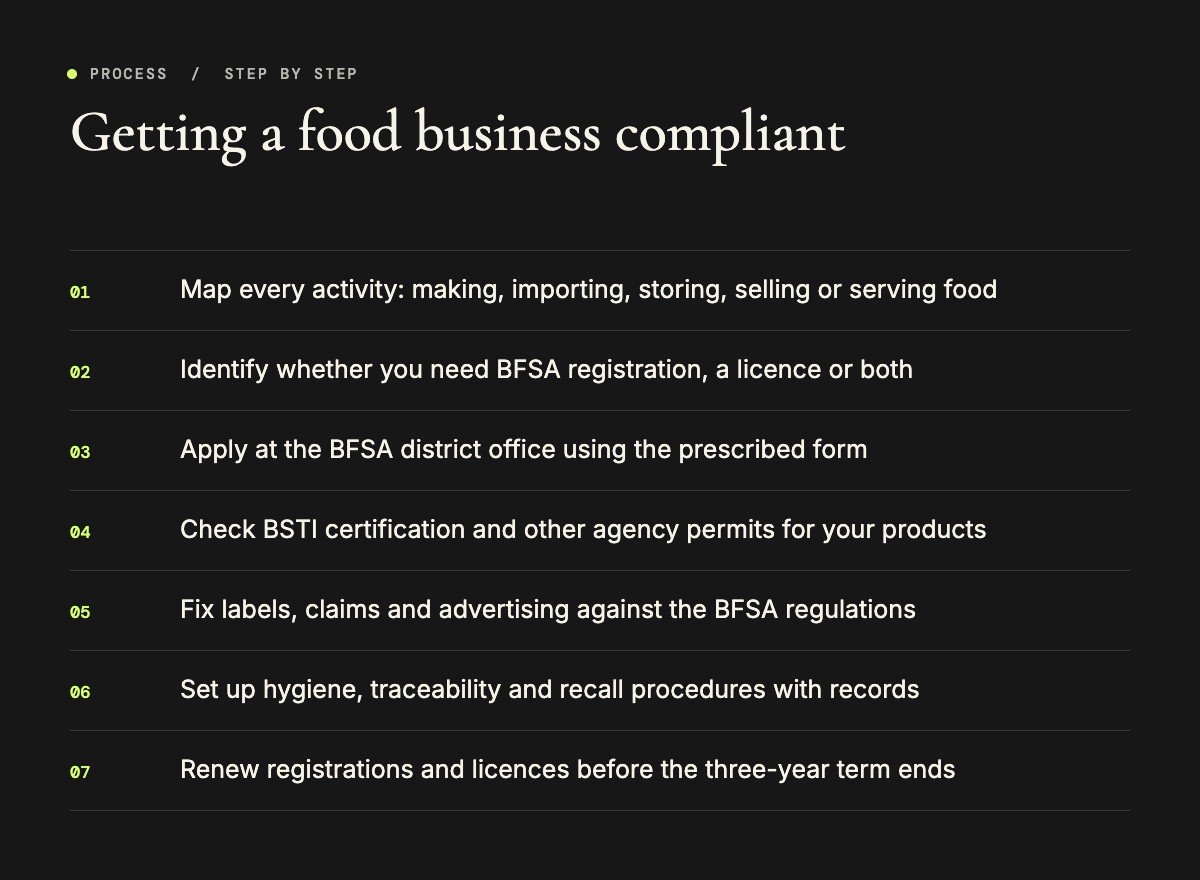
Compliance with the food safety law in Bangladesh is easier to manage as a system than as a series of reactions to inspections. The steps below are the ones we take with manufacturers, importers and restaurant groups.
- Map your activities. List every activity in the chain: production, processing, import, storage, wholesale, retail, online sale and catering. Each can trigger different obligations.
- Classify under the 2026 regulations. Decide whether each site and product needs registration only or the full set of licences for special foods.
- Apply and record. File applications at the BFSA district office on the prescribed forms, pay any scheduled fee, and keep stamped receipts.
- Check parallel approvals. Confirm BSTI certification, trade licence, fire and environmental clearances, and any sector certificates are current.
- Audit labels and claims. Review every label, menu claim, website and social media advertisement against the labelling and advertisement regulations.
- Document hygiene and traceability. Keep supplier approvals, batch records, cleaning logs, staff health records and temperature logs so you can trace and recall quickly.
- Plan for inspections and incidents. Train a responsible person to handle inspections, sampling and media, and agree in advance who calls your lawyer.
Diarise renewal dates three months ahead of expiry. A three-year term passes quickly, and an expired registration is treated the same as none.
Importers and online sellers
Importers carry particular risk under the food safety law in Bangladesh because they answer for food they did not make. Under the 2026 regulations, most importers need BFSA registration, and importers of special and health-oriented foods need licences and product registration before the goods are marketed.
Before shipping, an importer should confirm the product meets Bangladeshi labelling rules, that any required BSTI certification or testing will be obtained, and that the exporter's certificates of analysis cover the contaminants and residues limits that apply in Bangladesh. Relabelling at port is expensive and sometimes impossible.
Selling food online
The food safety law in Bangladesh applies equally to home kitchens selling on social media, cloud kitchens and e-commerce platforms. BFSA's registration requirements do not depend on having a shopfront. Platforms that list food sellers increasingly ask for BFSA registration numbers, and an online seller making health claims is squarely within the advertisement and claims regulations.
Contracts and the supply chain
Commercial contracts are where many food businesses can manage their exposure under the food safety law in Bangladesh. Supply agreements should require suppliers to hold all registrations and certifications, to meet stated specifications and limits, to permit audits, and to notify promptly of any problem.
Include rights to reject non-conforming goods, an obligation to cooperate in recalls, and an indemnity for losses caused by unsafe supplies, supported by insurance where possible. For new ventures, our overview of legal requirements for a new business sets out the wider licensing picture.
When something goes wrong
If you learn that a product may be unsafe, act fast: isolate stock, stop distribution, notify BFSA as the regulations require, and preserve samples and records. Early, documented action is the best evidence that you used due diligence, and it often shapes how the regulator responds.
Frequently asked questions about food safety law in Bangladesh
Does a small restaurant or street stall need BFSA registration?
Yes. Under the Safe Food (Registration and Licensing) Regulations 2026, restaurants and street or temporary stalls are among the sixteen categories that need registration. BFSA has said first registration for existing businesses in these categories is free.
From when must businesses apply?
The regulations were gazetted on 16 July 2026, and BFSA announced that food businesses must apply from 1 November 2026. Applications are being taken at BFSA district offices first, with online filing to follow.
Is BSTI certification still needed if I register with BFSA?
Usually, yes. BFSA registration does not replace BSTI's mandatory certification for products on BSTI's list. Many processed foods need both, along with a trade licence and other local permits.
How long does a BFSA registration or licence last?
Three years. It must be renewed before it expires, and operating on an expired registration or licence carries the same risk as having none.
Can a director be personally liable for a food safety offence?
Yes. Where a company commits an offence, its directors and officers may also be liable unless they show they did not know of it or used due diligence to prevent it. Documented procedures are the main defence.
Can a consumer claim compensation for harm from unsafe food?
Yes. Apart from a criminal complaint, a person harmed by unsafe food may bring a civil claim for compensation, and may also complain to the Department of National Consumer Rights Protection.
How we can help
We advise manufacturers, importers, restaurant groups and retailers on the food safety law in Bangladesh, including BFSA registration and licensing, labelling and claims reviews, supply contracts and recalls, and we defend clients in inspections, food court cases and related writ proceedings. Learn more about our agriculture and food practice.
Preparing for BFSA registration?
We classify your business under the 2026 regulations, prepare the filings and review labels and contracts so you are ready before inspectors arrive.
Book a consultationAgriculture and food practicePrimary sources: the Food Safety Act 2013 and the Consumer Rights Protection Act 2009 on the Laws of Bangladesh portal; regulations and notices of the Bangladesh Food Safety Authority; mandatory certification list of BSTI; consumer complaints at the Department of National Consumer Rights Protection.
This article is general information about Bangladeshi law as of October 2026 and is not legal advice. Regulations, fees and procedures change; confirm current requirements with BFSA or a qualified lawyer before acting.



0 Comments