
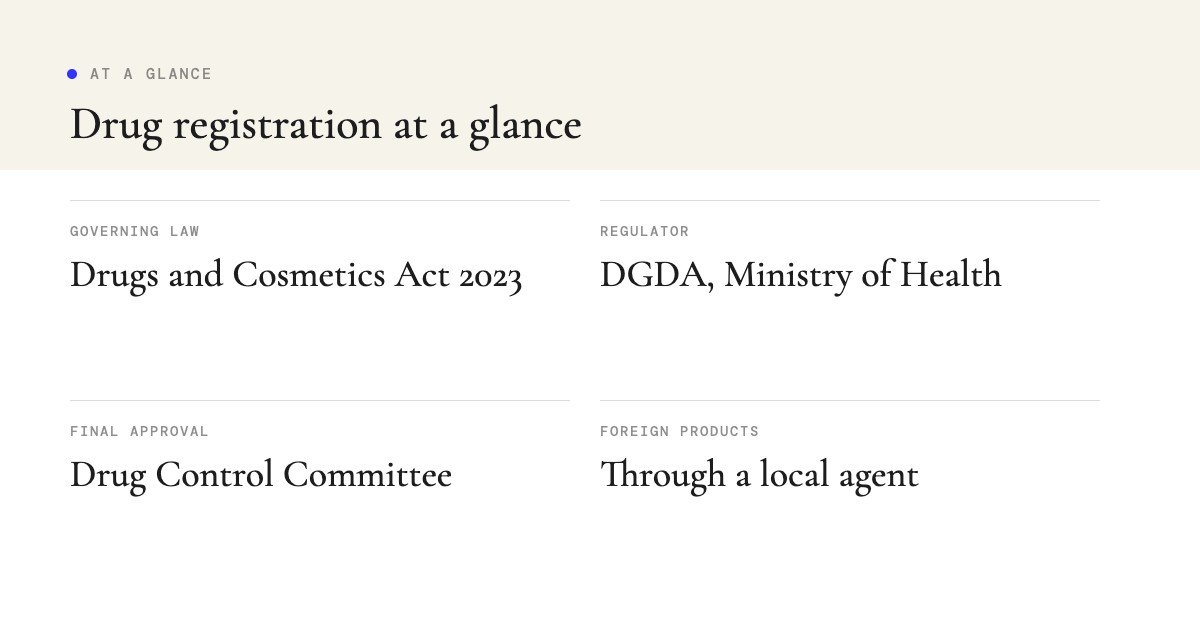
Drug registration in Bangladesh is the approval that allows a specific medicine, in a specific strength and dosage form, to be made, imported or sold. It is granted by the Directorate General of Drug Administration (DGDA) under the Drugs and Cosmetics Act 2023, and no amount of commercial readiness substitutes for it.
- The Drugs and Cosmetics Act 2023 (Act 29 of 2023) replaced the Drugs Act 1940 and the Drugs (Control) Ordinance 1982 and is now the single framework for medicines and cosmetics.
- Every product needs its own registration. DGDA registers a drug only with the approval of the Drug Control Committee, after technical review.
- Foreign manufacturers cannot apply directly; they register through a local agent, with a Certificate of Pharmaceutical Product or free sale certificate from the home regulator.
- Registration is time-limited and must be renewed; changes to formula, site, pack or label usually need prior approval.
- Committee backlogs, pricing rules and LDC graduation are the three issues most likely to affect a 2026 to 2027 launch plan.
What drug registration in Bangladesh involves
Bangladesh regulates medicines product by product. A company may hold a manufacturing licence for a modern plant, but it still cannot sell a tablet until that tablet has its own registration and its own registration number printed on the pack. The same rule applies to an importer: the import licence is not enough without a registered product behind it.
Since September 2023 the governing statute has been the Drugs and Cosmetics Act 2023. Parliament passed it as Act 29 of 2023, and it repealed the Drugs Act 1940 and the Drugs (Control) Ordinance 1982, which had governed the sector for four decades. The Act keeps DGDA as the licensing authority and puts registration, manufacturing licences, import, sale, pricing, clinical trials and pharmacovigilance into one law.
Which products are covered
The Act covers allopathic medicines, biological products and vaccines, as well as Unani, Ayurvedic, herbal and homeopathic medicines. It also brought cosmetics under DGDA control for the first time, with a separate cosmetic registration certificate. Medical devices are handled by DGDA under its own registration guidelines, and we deal with them only briefly here.
The practical point for anyone planning drug registration in Bangladesh is to classify the product correctly at the start. A product marketed abroad as a food supplement may be treated here as a drug, or as a food under the Bangladesh Food Safety Authority, depending on its claims and ingredients. Choosing the wrong route can waste months.
Who decides: DGDA and the approval committees
DGDA, which sits under the Ministry of Health and Family Welfare, receives applications, inspects plants, issues licences and maintains the register. But DGDA does not decide alone on product approvals. Under the 2023 Act, it registers a drug only with the approval of the Drug Control Committee, a multi-member body that includes clinicians, pharmacologists and officials.
New molecules and new combinations are first examined by a technical sub-committee, which looks at safety, efficacy and whether the product is rational and needed in Bangladesh. Its recommendation then goes to the Drug Control Committee for a final decision. Products that are already registered in Bangladesh by other companies, often called existing generics, generally follow a lighter technical review.
The National Drug Advisory Council
The Act also provides for a National Drug Advisory Council, a policy-level body that must be consulted on matters such as the essential drugs list. The council was constituted on 29 June 2026, and in August 2026 the Cabinet added the Director General of Health Services to it. Its revival matters because, as discussed below, the absence of that consultation led the government to withdraw two 2026 pricing instruments.
Committee schedules drive real-world timelines. In July 2025 The Daily Star reported that the technical sub-committee had not met for over a year and the Drug Control Committee for two years, leaving applications for 617 new medicines pending. Ask about the current meeting cycle before you promise a launch date to a board or a partner.
Registration routes compared
There is no single procedure for drug registration in Bangladesh. The route depends on who makes the product, where, and whether the molecule is already known in Bangladesh. The table summarises the main pathways we see.
| Route | Typical applicant | Key review points |
|---|---|---|
| Local manufacture, existing generic | Licensed Bangladeshi manufacturer | Plant capability, formula, stability data, labelling, price |
| Local manufacture, new molecule or combination | Licensed manufacturer, often under licence from an originator | Technical sub-committee review of need, safety and efficacy, then committee approval |
| Imported finished product | Foreign manufacturer through a local agent | CPP or free sale certificate, site status, samples, dossier, import price |
| Biologicals and vaccines | Manufacturer or importer with cold-chain capability | Lot release, cold chain, clinical data, often stricter scrutiny |
| Unani, Ayurvedic, herbal, homeopathic | Licensed traditional-medicine manufacturer | Pharmacopoeial basis, ingredients, claims |
| Cosmetics | Manufacturer or importer | Cosmetic registration certificate and licence under the 2023 Act |
For each route, the outcome is the same: a registration in the applicant's name for one product, one strength and one dosage form. A 500 mg tablet and a 250 mg suspension of the same molecule are two separate registrations.
Licences you need before filing
An application for drug registration in Bangladesh is only as strong as the licences behind it. DGDA will not register a product for a company that has no lawful way to make or import it.
For local manufacturers
A new pharmaceutical plant needs a company or other legal entity, a trade licence, DGDA approval of the factory layout and the manufacturing licence itself. It will also need an environmental clearance certificate from the Department of Environment under the Environment Conservation Rules 2023, fire safety clearance and, depending on location, approvals from the local development authority or an economic zone authority. Our guide to legal requirements for a new business covers the corporate side.
The Act requires manufacturers to follow World Health Organization good manufacturing practice, and DGDA inspects against those standards. The manufacturing licence lists the dosage forms the plant may produce, such as tablets, capsules, liquids or sterile products. Adding a new dosage form means amending the licence before any product in that form can be registered.
For importers
Before any drug registration in Bangladesh for an imported product, importers need their own DGDA licence to import and store medicines, a warehouse that meets storage requirements, and an Import Registration Certificate from the Chief Controller of Imports and Exports. Retail sale is separately licensed; if you plan to run pharmacies, see our guide on the pharmacy business licence.
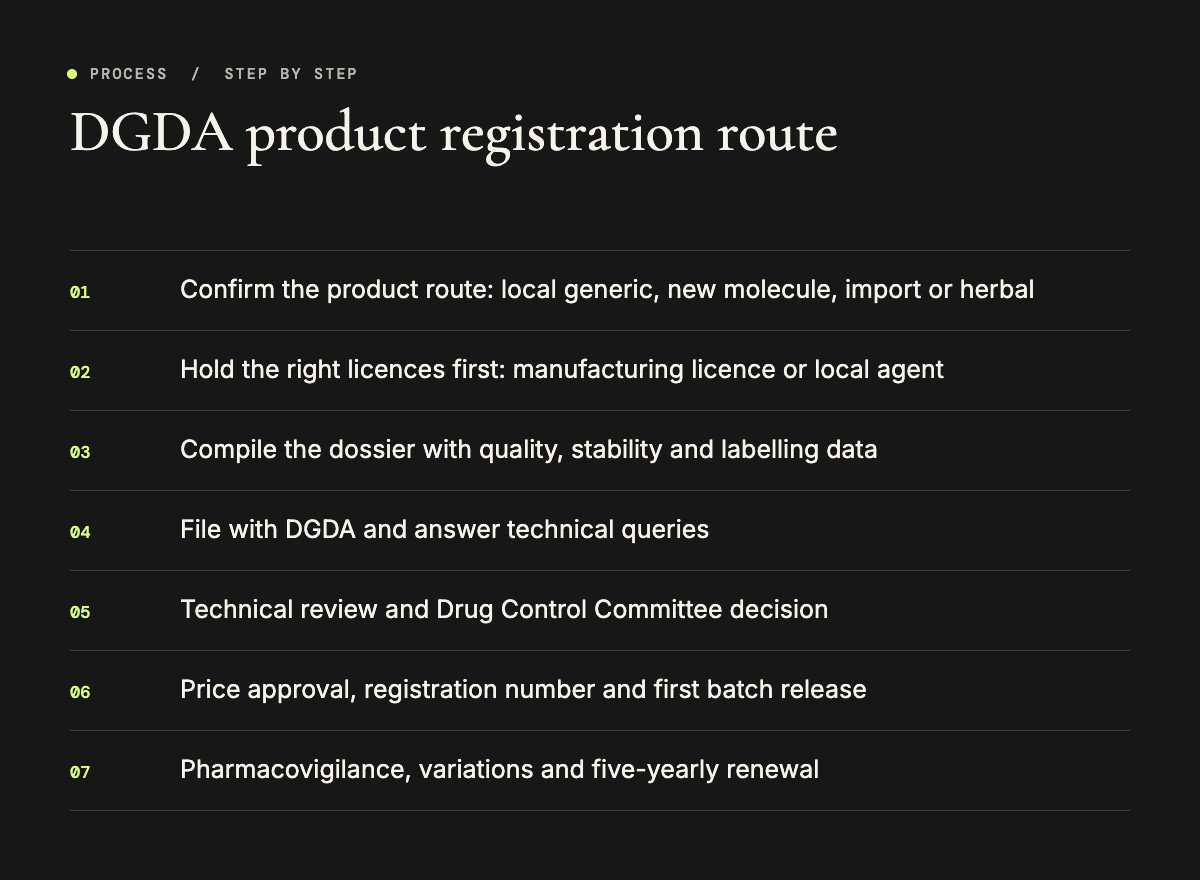
Step-by-step drug registration in Bangladesh for local manufacturers
The following sequence reflects the usual DGDA practice for a locally manufactured product. Details such as forms, fees and the number of samples change from time to time, so confirm the current checklist with DGDA before filing.
- Confirm the classification. Decide whether the product is an existing generic, a new molecule, a new combination or a new dosage form, and check whether any similar product has been banned or restricted in Bangladesh.
- Prepare the product dossier. Assemble the formula, specifications of active and inactive ingredients, manufacturing process, analytical methods, stability data and proposed labelling.
- File the application. Submit the application with the prescribed fee to DGDA. New molecules also need the supporting scientific literature and evidence of approval in reference countries where available.
- Answer technical queries. DGDA officers review the file and may ask for further data. Prompt, complete answers keep the file in the next committee agenda.
- Committee review. New products go to the technical sub-committee and then the Drug Control Committee; existing generics follow the review route DGDA applies to them.
- Price and registration. After approval, the price is fixed or approved, the product is entered on the register and a registration number is issued for printing on every pack.
- Release the first batches. Manufacture under the licence, keep batch records and retained samples, and make the first commercial release only once labels match what was approved.
Two points often surprise newcomers to drug registration in Bangladesh. First, approval of a new molecule is a policy decision as much as a technical one: the committee considers whether the product adds therapeutic value in Bangladesh. Second, until the registration number is issued, the product cannot be promoted, sampled or shipped to distributors.
Registering imported medicines
For foreign companies, drug registration in Bangladesh runs through a local agent or importer, who files and holds the application on the manufacturer's behalf. The agent becomes DGDA's point of contact for queries, inspections, adverse event reports and recalls, so choose the agent with the same care you would choose a distributor in a regulated market.
Documents that foreign manufacturers usually provide
- A Certificate of Pharmaceutical Product in the WHO format, or a free sale certificate, issued by the regulator in the country of manufacture and legalised as DGDA requires, usually through the Bangladesh mission abroad.
- Evidence of good manufacturing practice at the production site, and in some cases an inspection or site registration by DGDA.
- A product dossier, commonly in Common Technical Document format, with stability data suitable for hot and humid conditions.
- Product samples, commercial packs and labelling in English or Bangla.
- A letter of authorisation appointing the local agent.
Bangladesh has long applied a policy, reflected in the National Drug Policy, of not registering imported products that local manufacturers already make in sufficient quantity and quality. Imported registrations are therefore most realistic for specialised products such as biologics, oncology drugs, hormones and products with no local equivalent. Check this point before investing in a dossier for drug registration in Bangladesh.
Agency agreements
Because the registration usually stands in the agent's name, the agency agreement should say who owns the registration, what happens to it on termination, and that the agent must cooperate in transferring it to a new agent. Without that clause, a manufacturer can find its own product held hostage after a commercial dispute.
The dossier: what DGDA looks for
For drug registration in Bangladesh, a strong dossier is complete, consistent and written for a reviewer who has many other files. The quality section must match exactly what will be manufactured: the same formula, the same site, the same pack. Inconsistencies between the specification and the certificate of analysis are a common reason for queries.
Stability data deserves particular attention in any drug registration in Bangladesh. Bangladesh has a hot and humid climate, and reviewers expect data generated at conditions that reflect it, together with a shelf life justified by that data. Packaging must protect the product in those conditions.
Labelling requirements
Labels must carry the generic name prominently, the strength, the registration number, the batch number, the manufacturing and expiry dates, the maximum retail price and the manufacturer's name and address, along with any warnings DGDA requires. Bangla labelling obligations apply to many products. Brand names are approved by DGDA as part of registration, but that approval is not trademark protection; register the brand separately with the Department of Patents, Designs and Trademarks, as explained in our trademark registration guide.
Pricing and the essential drugs list
Price control is part of drug registration in Bangladesh, not a separate afterthought, and it is where many commercial plans change. Prices of medicines on the essential drugs list are fixed by the government. For other products, manufacturers have for many years declared an indicative price that DGDA approves, and importers' prices are reviewed by reference to import costs.
2026 brought sharp changes. In January 2026 the interim government issued an Essential Drugs List 2026 and a Drug Price Determination Policy 2026. On 3 August 2026 the Cabinet decided to scrap both, because the 2023 Act requires consultation with the National Drug Advisory Council before an essential drugs list is formulated, and that had not happened. A writ petition challenging the two instruments was also pending in the High Court Division.
As a result, the essential drugs list under the Ministry of Health's 1994 order and its pricing mechanism remain in force for now, and the government has said it will prepare an updated list. Anyone pricing a launch for 2027 should expect further change and build flexibility into supply and distribution contracts.
A product's price approval is tied to the registered pack. Changing the pack size or count can trigger a fresh price review, so settle the commercial pack before filing rather than after approval.
Validity, renewal and changes after approval
Drug registration in Bangladesh is not permanent. Under the 2023 Act, as summarised in published commentary, drug registration and marketing authorisation run for five years and manufacturing licences for two years, and both are renewable. Diarise renewals well ahead of expiry; a lapsed registration means the product cannot lawfully be made or sold, whatever stock is in the warehouse.
Variations
Once drug registration in Bangladesh is granted, most changes need DGDA's prior permission. These include changes to the formula, the manufacturing site, the source of the active ingredient, the shelf life, the pack, the label and the brand name. Minor administrative changes may be handled by notification, but treat every change as needing approval until DGDA confirms otherwise.
Pharmacovigilance and recalls
The Act includes pharmacovigilance obligations, and DGDA runs an adverse drug reaction monitoring system. Registration holders should have a written procedure for collecting and reporting adverse events, handling complaints and running recalls. For importers, the foreign manufacturer and the local agent should agree in writing who does what.
Suspension and appeal
DGDA can suspend or cancel a manufacturing licence or a drug registration in Bangladesh for breach of the Act or its notifications. Commentary on the 2023 Act notes a right of appeal within 30 days of cancellation. Because that window is short, prepare the record of compliance early rather than after a notice arrives.
Offences and enforcement
The 2023 Act prohibits making, importing, selling or distributing unregistered, substandard, counterfeit, adulterated and misbranded drugs, and it gives DGDA inspectors powers of entry, sampling and seizure. Offences can lead to imprisonment, fines and the loss of licences. Mobile courts regularly run operations against pharmacies and distributors that stock unregistered or expired products.
Liability does not stop with the company. Directors and managers can face proceedings where an offence is committed with their knowledge or through their neglect. Because the penalty provisions that back up drug registration in Bangladesh were restructured in 2023, read the current text of the Act on the Laws of Bangladesh portal rather than relying on summaries of the old Ordinance.
Patents, LDC graduation and new products
Bangladesh's generic industry grew under the World Trade Organization flexibility that lets least developed countries defer pharmaceutical patent protection. That flexibility applies only while a country is a least developed country. Bangladesh is scheduled to graduate on 24 November 2026. In February 2026 the newly elected government formally asked the UN Committee for Development Policy for a three-year deferral, to November 2029. Check the current status before relying on either date.
Graduation does not invalidate existing registrations, but it changes the patent landscape for new products. Patents are now governed by the Patent Act 2023. Originators planning drug registration in Bangladesh should review their patent position here, and generic manufacturers should run freedom-to-operate checks before investing in new molecules. Our patent registration guide explains the filing route.
Common mistakes in drug registration in Bangladesh
These are the issues that most often slow or derail an application for drug registration in Bangladesh, in our experience:
- Wrong classification. Filing a supplement-type product as a food, or a medicine as a cosmetic, and starting again months later.
- Licence gaps. Filing for a sterile product when the manufacturing licence covers only oral solids.
- Weak stability data. Shelf life claims that the data does not support for local conditions.
- Unlegalised documents. Certificates from abroad that lack the attestation DGDA requires.
- No agency safeguards. Registrations held by an agent with no obligation to transfer them.
- Launch plans ignoring committee dates. Board timelines that assume approval regardless of when the committees actually meet.
Frequently asked questions about drug registration in Bangladesh
Can a foreign company apply directly to DGDA?
In practice, no. Foreign manufacturers apply through a local agent or importer who files the application and acts as DGDA's contact. A foreign company with its own Bangladeshi subsidiary can use that subsidiary as the applicant if it holds the necessary licences.
How long does registration take?
There is no fixed statutory period. Existing generics can move relatively quickly, while new molecules depend on technical sub-committee and Drug Control Committee meetings. Industry estimates of twelve to eighteen months for a full dossier are common, and backlogs can extend that.
Do I need a separate registration for each strength?
Yes. Each combination of molecule, strength and dosage form is a separate product with its own registration number.
How long is a registration valid?
Commentary on the Drugs and Cosmetics Act 2023 states that drug registration lasts five years and is renewable. Apply for renewal well before expiry and confirm the current renewal requirements with DGDA.
Does DGDA brand approval protect my trademark?
No. DGDA approves the brand name for regulatory purposes only. To stop others using the name, register it as a trademark with the Department of Patents, Designs and Trademarks.
Can I sell while my application is pending?
No. Making, importing, promoting or selling a medicine before registration is an offence under the 2023 Act.
How we can help
We advise pharmaceutical manufacturers, importers and foreign originators on drug registration in Bangladesh: choosing the route, structuring agency and licensing agreements, checking dossiers for legal gaps, handling DGDA correspondence and protecting brands and patents. See our healthcare and pharmaceuticals practice for more.
Planning a product launch in Bangladesh?
We review your registration route, agency terms and licences against the Drugs and Cosmetics Act 2023 and help you engage with DGDA.
Book a consultationHealthcare practicePrimary sources: the Drugs and Cosmetics Act 2023 on the Laws of Bangladesh portal; registration guidance and notices from the Directorate General of Drug Administration; health policy from the Directorate General of Health Services.
This article is general information about Bangladeshi law as of 2026 and is not legal advice. Fees, forms, committee practice and pricing rules change; confirm current requirements with DGDA or a qualified lawyer before acting.


0 Comments