
Factory setup in Bangladesh is less about one permit than about a sequence of them: company and tax registrations, investment registration, land and building approvals, environmental clearance, fire safety and finally the factory licence from DIFE. Get the order right and each approval feeds the next; get it wrong and the project stalls.

- A manufacturing unit outside a zone usually needs a company, trade licence, TIN, BIN, IRC, investment registration, building approval, environmental clearance, fire clearance and a DIFE factory licence.
- Since 23 August 2026, BIDA, BEZA and the PPP Authority have been merged into Invest Bangladesh under the Invest Bangladesh Act 2026.
- The Environment Conservation Rules 2023 sort industries into green, yellow, orange and red categories; the higher the category, the longer the clearance route.
- The DIFE factory licence comes near the end, because it needs the layout approval, fire licence and environmental clearance first.
- Locating in an economic zone or EPZ replaces several of these steps with the zone authority's one-stop service.
What factory setup in Bangladesh requires
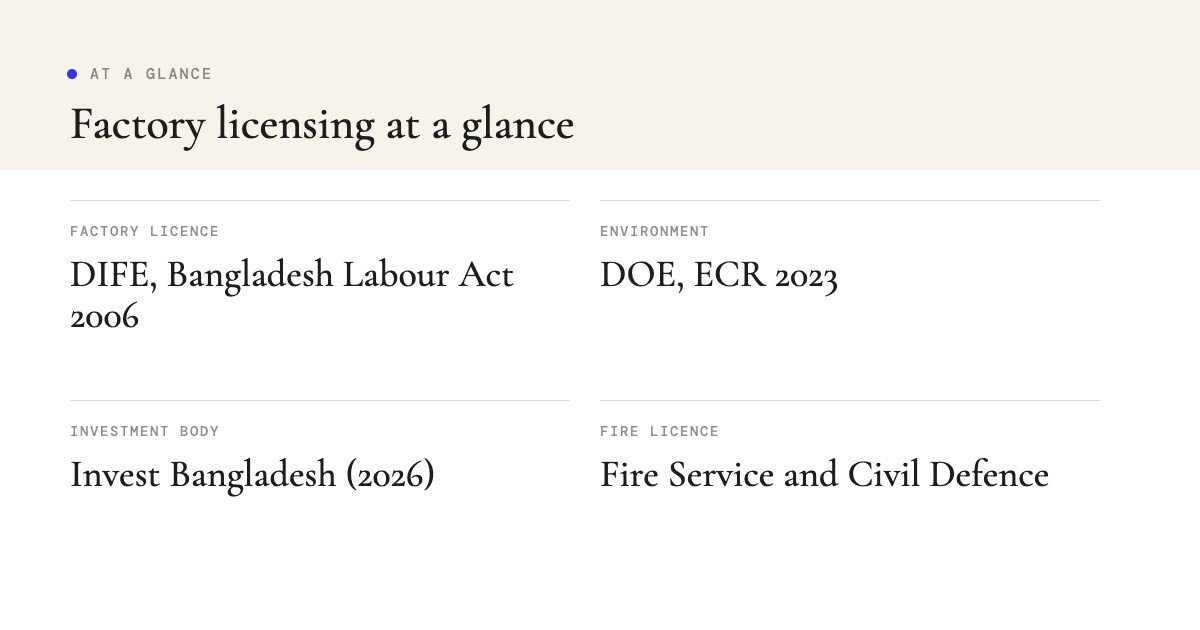
Bangladesh does not have a single industrial licence. Instead, a manufacturer collects approvals from several regulators, each looking at a different risk: the corporate registry at the legal entity, tax authorities at revenue, the investment agency at the project, the local authority at the building, the Department of Environment at pollution, the fire service at fire risk and the Department of Inspection for Factories and Establishments (DIFE) at worker safety.
The approvals are linked. DIFE will not issue a factory licence without an environmental clearance and a fire licence. The Department of Environment will want land documents and a local authority no-objection. Banks will not open letters of credit for machinery without an Import Registration Certificate. That is why factory setup in Bangladesh is best planned as a critical path rather than a checklist.
Who this guide is for
This guide is written for local entrepreneurs and foreign investors setting up a new manufacturing unit, whether a garment or textile factory, a light engineering plant, a food processing unit or a chemicals facility. Sector rules add further permits; we flag the main ones below.
Choosing the location: general area, economic zone or EPZ
The first decision in factory setup in Bangladesh shapes everything else. A factory on privately acquired land in a general industrial area deals with each regulator separately. A factory inside an economic zone or an export processing zone deals mainly with the zone authority, which provides serviced land, utilities and a one-stop service for most permits.
| Location | Main authority | Practical effect |
|---|---|---|
| General area, private land | Separate regulators: local authority, DOE, fire service, DIFE | Maximum flexibility on site, but more approvals and land-title risk |
| Economic zone | Invest Bangladesh (former BEZA functions) and the zone developer | Serviced plots, one-stop service, zone-specific incentives |
| Export processing zone | BEPZA | Export-oriented regime, separate labour law for EPZs, BEPZA permits |
| BSCIC industrial estate | Bangladesh Small and Cottage Industries Corporation | Allotted plots for small and medium industry |
EPZ enterprises are governed by the Bangladesh EPZ Labour Act 2019 for employment matters rather than the general labour law, and BEPZA issues most of their permits. If export is the core business, compare the EPZ regime carefully before committing to private land.
For private land, the biggest single risk is title, not licensing. A factory built on land with a defective chain of title or the wrong land class can lose its bank finance and its building approval. Complete a full title search before signing, as described in our land registration guide.

Company formation and the basic registrations
For factory setup in Bangladesh, most manufacturers operate through a private limited company incorporated with the Registrar of Joint Stock Companies and Firms (RJSC) under the Companies Act 1994. Foreign investors can hold up to 100 percent of a manufacturing company in most sectors, subject to sector restrictions and the rules on bringing in capital through banking channels. Our guide on private limited company registration sets out the incorporation steps.
Once incorporated, the company needs:
- Trade licence from the city corporation, municipality or union parishad where the factory sits.
- Taxpayer Identification Number (TIN) from the National Board of Revenue under the Income Tax Act 2023.
- Business Identification Number (BIN) for VAT under the VAT and Supplementary Duty Act 2012.
- Import Registration Certificate (IRC) from the Office of the Chief Controller of Imports and Exports, needed to import machinery and raw materials; an Export Registration Certificate (ERC) if you will export.
- Bank account and, for foreign capital, the encashment certificate that proves the inward remittance.
Membership of the relevant chamber or trade association is often a precondition for the IRC and ERC, and for sector services such as utilisation declarations in the garment industry.
Investment registration with Invest Bangladesh
Industrial projects that involve factory setup in Bangladesh outside the zones have for years registered with the Bangladesh Investment Development Authority (BIDA). In August 2026 the structure changed. Under the Invest Bangladesh Act 2026, BIDA, the Bangladesh Economic Zones Authority (BEZA) and the Public-Private Partnership Authority were merged into a single apex agency, Invest Bangladesh, which began operating on 23 August 2026 under the Prime Minister's Office.
Invest Bangladesh continues to run BanglaBiz, the digital platform for investment services that grew out of BIDA's one-stop service. Registration of the project gives the factory an official record of its investment, machinery and production plan, and it supports later approvals such as work permits for foreign staff, remittance of royalties and fees, and some customs facilities.
Because the agency is new, forms, fees and service timelines may change during the transition. Check the current procedure on the BanglaBiz platform before filing. For the wider investment framework, see our foreign direct investment practice.
Land, land use and building approvals
Every factory setup in Bangladesh starts with land the company can lawfully use for industry. If the land is classed as agricultural, conversion to industrial use generally needs permission from the Deputy Commissioner, and some areas restrict conversion of fertile farmland altogether. Leased land should be held under a registered lease long enough to support bank finance.
Building plan approval
The factory building needs plan approval from the relevant development authority, such as RAJUK in Dhaka, or the local authority elsewhere. Industrial buildings must comply with the Bangladesh National Building Code 2020, which sets structural, electrical and fire safety standards. After the Rana Plaza collapse in 2013, buyers and regulators expect structural design by qualified engineers and, for many export factories, independent structural and fire assessments.
A common rule in factory setup in Bangladesh: do not start construction before the plan is approved. Retrospective approval is difficult, and an unapproved building will block the fire licence, the DIFE licence and often bank finance.
Environmental clearance under the 2023 Rules
Every industrial unit, and so every factory setup in Bangladesh, needs an environmental clearance certificate (ECC) from the Department of Environment under the Environment Conservation Act 1995. The Environment Conservation Rules 2023, issued as SRO 53 of 5 March 2023, replaced the 1997 Rules and sort industries into four categories: green, yellow, orange and red.
- Green industries, the lowest risk, apply for the ECC directly.
- Yellow, orange and red industries usually need site or location clearance first, then the ECC once the plant is built and pollution controls are installed.
- Orange projects generally submit an initial environmental examination, and red projects a full environmental impact assessment, with an environmental management plan.
- Industries producing liquid waste, such as dyeing, washing, tanning and chemicals, must design and run an effluent treatment plant.
Applications are made online through the DOE system. Certificates must be renewed periodically, with shorter validity for higher-risk categories, and renewal should be filed before expiry. Our guide on how to get an environment licence explains the documents in detail.
Category is decided by the activity, not the size of the factory. A small dyeing unit can be red while a large assembly plant is yellow. Check the schedule to the 2023 Rules before you budget time and cost for environmental work.
Fire safety approvals
Fire risk is regulated by the Fire Service and Civil Defence Department. For factory setup in Bangladesh, two approvals matter. First, a fire safety clearance on the building design, which checks escape routes, fire separation, detection and suppression systems against the building code. Second, a fire licence under the Fire Prevention and Extinguishing Act 2003, which is needed to operate premises such as factories and warehouses that store or use combustible material.
Inspectors look at practical matters: unobstructed exits, fire doors, hydrants and sprinklers where required, trained fire fighters among the staff, regular drills and safe storage of chemicals. The fire licence must be renewed, and DIFE asks for a valid copy at licensing and renewal.
The DIFE factory licence
The last major step in factory setup in Bangladesh is DIFE licensing. The Bangladesh Labour Act 2006 and the Bangladesh Labour Rules 2015 require factories to obtain layout plan approval and a licence from DIFE, under the Ministry of Labour and Employment. The layout approval comes first: DIFE reviews the floor plans, machine layout, exits, ventilation, lighting, toilets and welfare facilities before the factory starts operating.
The licence application is filed online through DIFE's Labour Inspection Management Application (LIMA). It is supported by the trade licence, TIN, incorporation documents, land or lease documents, the approved layout plan, the fire licence and the environmental clearance certificate. An inspector then visits the premises, and the licence is issued if the factory meets the standards. Fees are set by the number of workers.
Validity and the 2025 to 2026 reforms
Under the Labour Rules 2015, factory licences have been renewable every year. In November 2025 the government approved extending the renewal period for factory, shop and establishment licences to five years, keeping one year for contractor organisations, to be implemented by amending the labour law. The late-2025 labour amendments were later re-enacted as the Labour (Amendment) Act 2026, but we have not confirmed that the five-year period appears in the final text. Check the amended Act and rules before relying on a longer term.
Step-by-step factory setup in Bangladesh
For a factory on private land outside a zone, the approvals usually run in this order. Some can overlap, but each later step tends to require a document from an earlier one.
- Select and verify the site. Complete title checks, confirm the land class and any conversion requirement, and agree a registered purchase or lease.
- Form the company. Incorporate with RJSC, open a bank account and bring in capital through banking channels.
- Get the basic registrations. Trade licence, TIN, BIN and IRC, plus ERC for exporters.
- Register the project. Register the industrial project with Invest Bangladesh through BanglaBiz, or with the zone authority if you are inside a zone.
- Obtain building and site approvals. Get building plan approval, fire safety clearance on the design and, for yellow, orange or red industries, environmental site clearance.
- Build and install. Construct to the approved plans, import machinery under the IRC, install pollution control and fire systems, and apply for utility connections.
- Get operating approvals. DIFE layout approval, the fire licence, the ECC and sector permits such as boiler registration and BSTI certification.
- Apply for the factory licence. File on LIMA with the supporting approvals, pass the DIFE inspection and start production lawfully.
In our experience, the realistic timeline for factory setup in Bangladesh on private land is measured in months rather than weeks, with environmental and building approvals usually on the critical path. Zone projects can move faster because the zone authority handles several steps.
Sector-specific licences
Beyond the general approvals for factory setup in Bangladesh, many factories need permits tied to their equipment or products. The most common are:
- Boilers. Boilers must be registered and certified for use under the Boiler Act 2022 and the Boiler Rules 2025, which replaced the 1961 Rules. Certificates are renewed periodically and after repairs, relocation or an accident.
- Mandatory standards. Products on the Bangladesh Standards and Testing Institution (BSTI) mandatory list, such as many food items, cement and electrical goods, need a BSTI certification marks licence before sale.
- Medicines and cosmetics. Pharmaceutical and cosmetics plants need DGDA manufacturing licences and product registrations; covered in detail by our healthcare and pharmaceuticals team.
- Food. Food manufacturers deal with the Bangladesh Food Safety Authority and BSTI.
- Hazardous materials. Storage of petroleum, gases, explosives and certain chemicals needs licences from the Department of Explosives.
- Generators. Captive power above set thresholds may need approval from the energy regulator or the relevant power authority.
Utilities, staffing and ongoing compliance
Licences are only part of factory setup in Bangladesh. Electricity, gas and water connections are applied for separately to the local utility. Industrial gas supply has been constrained for several years, and new connections and tariffs for industry have been subject to government and regulator decisions; confirm availability before relying on gas in your energy plan.
Labour compliance from day one
Once workers are hired, the Bangladesh Labour Act 2006, as amended in 2026, governs appointment letters, working hours, wages, leave, safety and welfare. Factories with 50 or more workers must form a safety committee. Factories must keep service books and registers, and larger companies must operate the workers' participation and welfare funds required by law. Our guide on termination of employment covers the exit side.
Renewals calendar
After factory setup in Bangladesh is complete, the trade licence, fire licence, ECC, DIFE licence, boiler certificates and BSTI licences all expire on different dates. A single compliance calendar, owned by one person, prevents the lapse that leads to fines or a stoppage order.
Common mistakes in factory setup in Bangladesh
These are the errors we see most often when reviewing factory setup in Bangladesh for clients:
- Building before approval. Starting construction without plan approval, then finding the fire and DIFE approvals blocked.
- Wrong environmental category. Assuming green or yellow status for a process that the 2023 Rules classify as orange or red.
- Weak land title. Buying land without checking the record of rights, mutation and land-use class.
- No effluent plan. Designing a wet-process factory without space or budget for an effluent treatment plant.
- Ignoring utilities. Planning on gas or high-capacity power before confirming that a connection will be granted.
- Lapsed renewals. Operating with an expired licence because no one tracked the dates.
Frequently asked questions about factory setup in Bangladesh
Can a foreigner own a factory in Bangladesh?
Yes. Foreign investors can own manufacturing companies, often up to 100 percent, through a Bangladeshi company registered with RJSC and an investment registration. A few sectors are restricted or reserved, so check the sector first.
Which licence comes last?
The DIFE factory licence usually comes last, because it requires the approved layout plan, the fire licence and the environmental clearance certificate.
Does BIDA still exist?
Since 23 August 2026 BIDA's functions have passed to Invest Bangladesh under the Invest Bangladesh Act 2026, together with those of BEZA and the PPP Authority. Existing registrations should carry over, but confirm any transition steps with the new authority.
Is an environmental clearance needed for a small factory?
Yes. Every industrial unit needs an ECC. Small, low-risk green category units follow a shorter route, but they still need the certificate.
How long is a DIFE factory licence valid?
Traditionally one year. A five-year renewal period for most factories was approved in late 2025 as part of the labour law amendments; confirm the period in the current Act and rules.
Is it easier to set up in an economic zone?
Often, yes. Zones offer serviced land and one-stop services, which removes much of the separate licensing, but plots, rents and zone rules vary.
How we can help
We advise local and foreign manufacturers on factory setup in Bangladesh, from site due diligence and company formation to investment registration, environmental and fire approvals, DIFE licensing and labour compliance. We coordinate with engineers and consultants so the legal steps stay on the critical path. Learn more about our manufacturing and industrials practice.
Planning a new factory?
We map the licences your project needs, in the right order, and handle the legal filings and title checks for you.
Book a consultationManufacturing practicePrimary sources: the Bangladesh Labour Act 2006, Environment Conservation Act 1995 and Fire Prevention and Extinguishing Act 2003 on the Laws of Bangladesh portal; factory licensing at the Department of Inspection for Factories and Establishments; environmental clearance at the Department of Environment; fire licensing at the Fire Service and Civil Defence.
This article is general information about Bangladeshi law as of 2026 and is not legal advice. Fees, forms, licence periods and agency structures change; confirm current requirements with the relevant authority or a qualified lawyer before acting.


0 Comments