
The consumer rights protection act in Bangladesh, the Consumers' Right Protection Act 2009, lets any buyer who is overcharged, sold adulterated or fake goods, or misled by an advertisement complain to the Directorate of National Consumer Rights Protection (DNCRP). Complaints are cheap and fast, but the 30-day deadline is strict.
- The Consumers' Right Protection Act 2009 created the Directorate of National Consumer Rights Protection (DNCRP) and lists anti-consumer practices that can be fined or prosecuted.
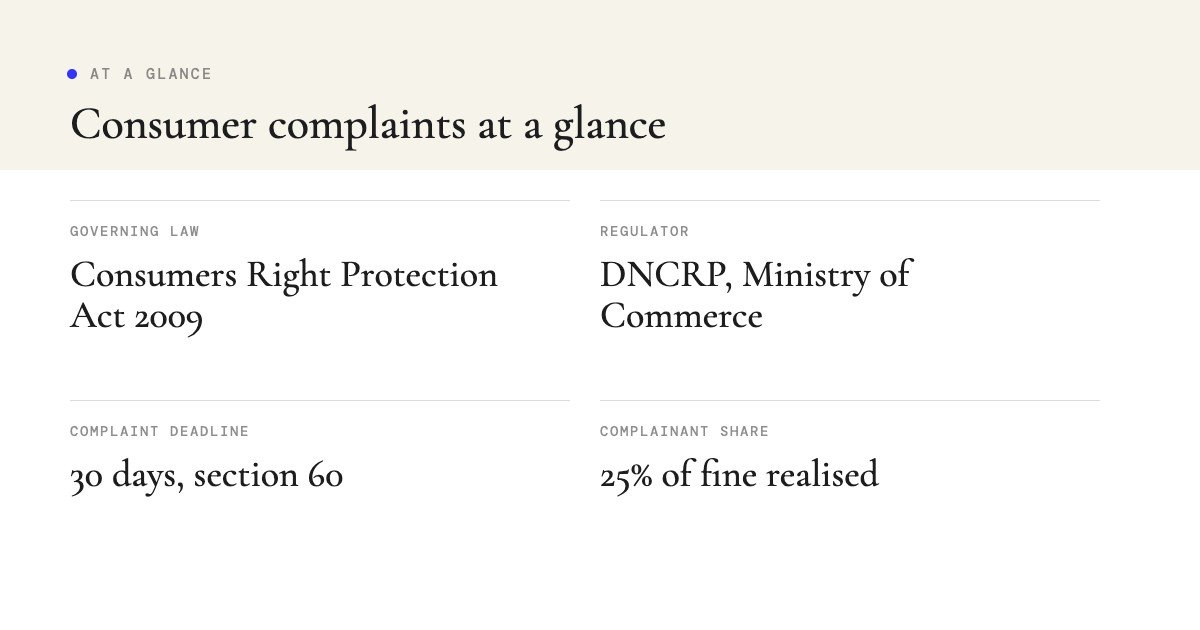
- A complaint must reach the Director General or an authorised officer within 30 days of the cause of action, under section 60.
- If a fine is imposed and realised after a proven complaint, 25 percent goes to the complainant.
- Consumers can also sue in the Joint District Judge's court for compensation of up to five times the assessed damage, alongside any criminal proceedings.
- A draft amendment published for comment in September 2026 would raise many fines and add digital commerce offences, but it is not yet law.
What the consumer rights protection act in Bangladesh does
Bangladesh passed the Consumers' Right Protection Act in 2009 to give ordinary buyers a quick remedy against unfair trade practices without going to court. The Act does three things. It defines anti-consumer practices, such as selling above the fixed price, selling adulterated food or medicine, using false weights and making deceptive advertisements. It creates a Directorate with power to hear complaints and impose fines. And it sets out criminal offences and a civil route to compensation.
The Directorate of National Consumer Rights Protection (DNCRP) sits under the Ministry of Commerce and is headed by a Director General. A National Consumers' Right Protection Council, chaired by the Commerce Minister, sets policy, with district committees under the Deputy Commissioners. For most people, though, the consumer rights protection act in Bangladesh means one thing: a written complaint to DNCRP that can lead to a fine on the seller and a share of that fine for the consumer.
How it fits with other laws
The consumer rights protection act in Bangladesh is not the only consumer-facing law. Some areas have their own regulators. Food safety is overseen by the Bangladesh Food Safety Authority under the Food Safety Act 2013, standards by BSTI, medicines by DGDA, and competition issues by the Competition Commission under the Competition Act 2012. The 2009 Act sits alongside these laws, and the same conduct can breach more than one of them.
Who is a consumer and who can complain
Under the consumer rights protection act in Bangladesh, a consumer is broadly a person who buys goods or hires services for consideration, other than for resale or commercial purposes, along with users of those goods or services with the buyer's permission. Commercial buyers who purchase to resell are generally outside the definition, which critics have argued is too narrow.
Under section 2(3), a complaint can be made by:
- any consumer, or one or more consumers with the same interest;
- any consumer association registered under any law;
- the National Consumers' Right Protection Council or an officer it authorises;
- the government or an authorised government officer; and
- the wholesaler or retailer concerned.
This means a group of buyers affected by the same practice, such as residents overcharged by a local supplier, can complain together, and registered consumer associations such as the Consumers Association of Bangladesh can complain on behalf of the public.
Anti-consumer practices under the consumer rights protection act in Bangladesh
The consumer rights protection act in Bangladesh lists specific practices and attaches a maximum punishment to each. The most common complaints we see involve the following:
- Selling goods, medicines or services above the price fixed by law or displayed by the seller.
- Selling adulterated goods or medicines, or mixing prohibited substances into food.
- False or misleading advertisements to deceive buyers.
- Failing to deliver goods or services as promised in return for payment.
- Short weight, short measure or tampered weighing and measuring devices.
- Selling counterfeit goods or expired products.
- Failing to display price lists or to show required information on packaging.
- Endangering life or safety through negligent service, including in hospitals and other service providers.
Penalties are imprisonment, fines or both, set offence by offence. The table shows a few current maximums as reported in coverage of the 2026 draft amendment; always check the specific section of the Act for the conduct involved.
| Practice | Current maximum (as reported) | 2026 draft proposal |
|---|---|---|
| Charging above the fixed price | 1 year or Tk 50,000 | Higher fine proposed |
| Adulterated goods | 3 years or Tk 2 lakh | 2 years or Tk 3 lakh |
| Missing packaging information | Fine up to Tk 50,000 | 1 year or Tk 2 lakh |
| False or harassing complaint | 3 years or Tk 50,000 | Lower jail term, higher fine |
| Hoarding to create shortage | No specific offence | 2 years or Tk 5 lakh |
False complaints are themselves an offence under the Act. Complain only about what you can prove, keep your tone factual, and attach evidence. A well-documented complaint is both stronger and safer.
DNCRP and the complaint machinery
DNCRP has its head office at the TCB Bhaban in Karwan Bazar, Dhaka, divisional offices in each division and offices at district level. Complaints can be made in person, by post, by email, through the Directorate's website or by other electronic means. DNCRP also runs a consumer hotline, 16121, and a National Consumer Complaint Centre in Dhaka.
Section 76(1) of the consumer rights protection act in Bangladesh requires the complaint to be in writing, with the receipt for the product or service attached where available. The complaint must give the complainant's full name, parents' names, address, contact details and profession. Anonymous complaints cannot lead to a hearing, although DNCRP may still act on information it receives through its own market drives.
DNCRP market drives
Apart from complaints, DNCRP officers regularly run market monitoring drives, especially before Ramadan and the Eid holidays, checking prices, price lists, expiry dates and adulteration. Fines imposed in these drives are separate from complaint-based proceedings, and businesses should treat a visit from DNCRP officers as a compliance inspection.
The 30-day rule and other deadlines
Deadlines under the consumer rights protection act in Bangladesh are short. Missing them usually ends the case.
- Complaint to DNCRP: within 30 days of the cause of action arising, under section 60.
- Charge sheet in a criminal case: under section 61, a Magistrate cannot take cognizance if no charge sheet is submitted within 90 days of the complaint.
- Appeal against a Magistrate's judgment: to the Sessions Judge within 60 days, under section 65.
- Appeal against a civil court decree under the Act: to the High Court Division within 90 days, under section 68.
The cause of action usually arises when you buy the product, receive the service or discover the defect. Where the problem appears later, such as a hidden defect, note the date you discovered it and complain promptly.
Step-by-step: filing a complaint under the consumer rights protection act in Bangladesh
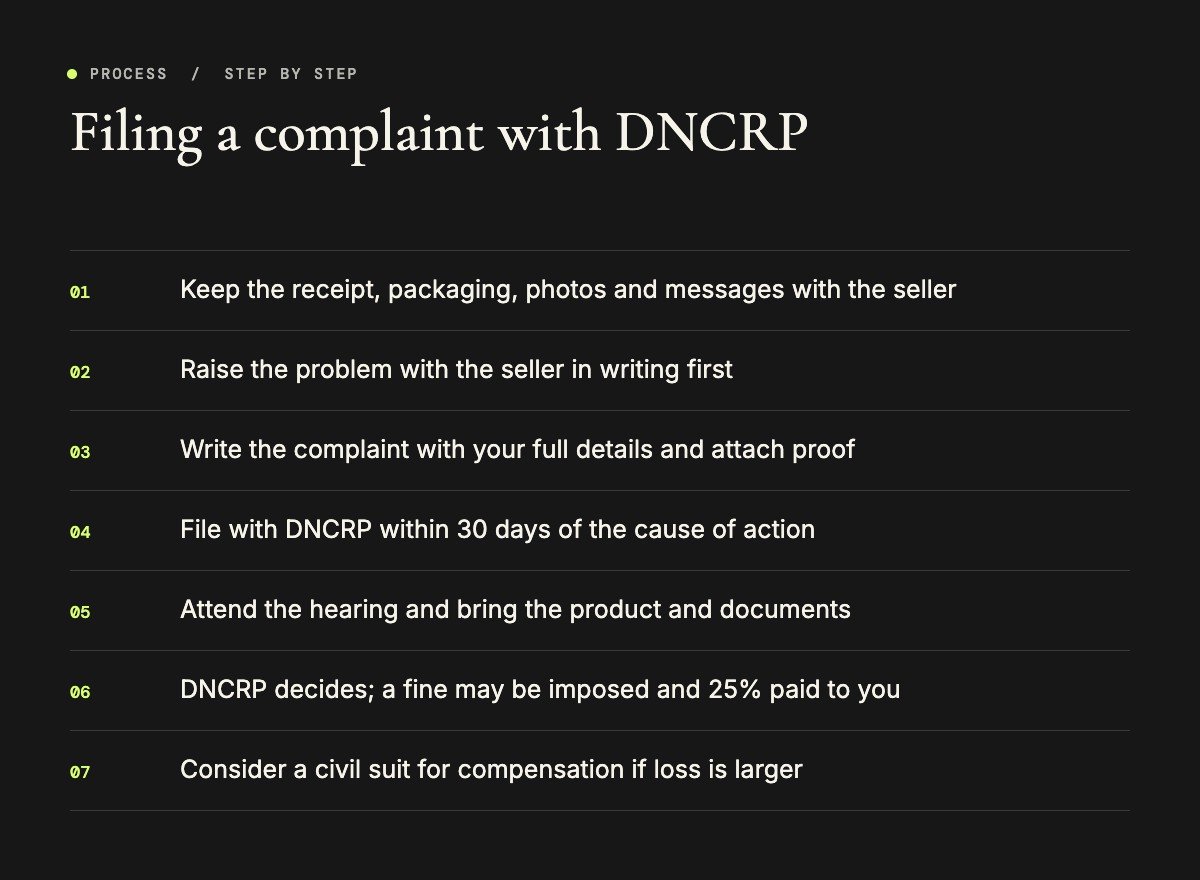
A DNCRP complaint does not need a lawyer, but preparation decides the outcome. The consumer rights protection act in Bangladesh rewards consumers who document their case well. Follow these steps.
- Preserve the evidence. Keep the receipt or invoice, the packaging, the product itself if possible, screenshots of the advertisement or listing, and messages with the seller. Photograph defects with the date visible.
- Raise it with the seller. Ask for a refund, replacement or correction in writing. A refusal or no reply strengthens your complaint.
- Write the complaint. Address it to the Director General, DNCRP. State your full details, the seller's name and address, what you bought, when, what went wrong and what you want.
- Attach proof. Add copies of the receipt and evidence. Keep the originals for the hearing.
- File within 30 days. Submit by email, online, by post or in person at the head office or the relevant divisional or district office, and keep proof of filing.
- Attend the hearing. DNCRP usually notifies both sides of a hearing date. Bring the originals and, where relevant, the product.
- Follow up on the decision. If the complaint is proved and a fine is imposed and realised, claim your 25 percent share through the procedure DNCRP sets.
Mistakes that weaken complaints
- Filing after the 30-day window.
- No receipt or proof of purchase.
- Vague complaints that do not say what was promised and what was delivered.
- Missing the hearing or failing to bring originals.
- Exaggerated claims that the evidence does not support.
What happens after you file
Once a complaint is filed under the consumer rights protection act in Bangladesh, DNCRP officers review it, notify the seller and usually hold a hearing at which both sides present their evidence. Where needed, officers may inspect the premises or collect samples. Many complaints are resolved at this stage when the seller agrees to refund or replace the product.
If the Director General or an authorised officer finds the complaint proved, the Directorate can take administrative action, including imposing a fine within the limits the Act sets for the relevant offence. Under section 76(4), when a fine is imposed and realised after a complaint is proved true, 25 percent of the amount realised is paid to the complainant. Officers and employees of the Directorate who file complaints are not entitled to that share.
The 25 percent share is a share of the fine, not compensation for your loss. If your loss is larger, for example a defective appliance that caused damage, you need a civil suit to recover full compensation.
Criminal prosecution and mobile courts
Offences under the consumer rights protection act in Bangladesh are tried by a Magistrate of the first class or a Metropolitan Magistrate under section 32, using summary procedure under the Code of Criminal Procedure 1898 as section 33 provides. Under section 34, all offences under the Act are bailable, cognizable and compoundable, which means many cases end in settlement.
Where a complaint about a defective product needs laboratory testing, section 62 allows the Magistrate to collect and seal a sample and send it to a laboratory, with the complainant depositing the testing fee first. Mobile courts also enforce the Act on the spot, especially in markets and restaurants. A person convicted or acquitted under the Act cannot be tried again for the same offence under another law.
Civil suit for compensation
Under the consumer rights protection act in Bangladesh, the administrative complaint and the criminal case punish the seller; the civil suit compensates the consumer. Section 66 lets a consumer file a civil suit in the court of the Joint District Judge with local jurisdiction, whether or not criminal proceedings are pending. Where the damage can be valued in money, compensation of up to five times the assessed damage may be claimed.
Under section 67, the civil court may order the seller to replace the defective goods, take them back and refund the price, pay compensation up to five times the proven damage, or pay costs. Appeals go to the High Court Division within 90 days. For a wider overview of civil proceedings, see our guide to types of civil cases in Bangladesh.
Choosing between the routes
The three routes under the consumer rights protection act in Bangladesh can run side by side. A DNCRP complaint is quick and cheap and suits most low-value disputes, such as overcharging or a defective household item. A criminal case suits deliberate wrongdoing, such as adulteration or counterfeiting, where punishment matters. A civil suit suits larger losses, such as damage caused by a faulty product or a failed service, where the consumer needs real compensation.
Many consumers start with DNCRP and move to a civil claim only if the loss justifies the time and cost of litigation.
Online shopping and e-commerce complaints
Many complaints now concern online purchases: goods not delivered, refunds not paid, items different from the listing or fake products. The consumer rights protection act in Bangladesh already covers failing to deliver goods as promised, deceptive advertising and counterfeit goods, and DNCRP accepts complaints against online sellers and platforms. The Ministry of Commerce's Digital Commerce Operational Guidelines 2021 add rules on delivery times, refunds and payment through escrow-style arrangements for e-commerce businesses.
To use the consumer rights protection act in Bangladesh effectively for online purchases, keep the order confirmation, payment record, the product listing and chat history. If you paid by card or mobile financial service, also contact the payment provider promptly, because chargeback and dispute windows are short.
The 2026 draft amendment and what businesses should do
On 30 September 2026 the Ministry of Commerce published a draft amendment to the 2009 Act for 30 days of stakeholder comment.
As reported, it would raise many maximum fines on the ground that current levels no longer deter large companies, make hoarding to create shortages a specific offence, require sales receipts, penalise obstruction of DNCRP officers, introduce appeals against enforcement decisions, and add digital commerce offences such as trading without registration or a digital business identity, failing to give online product details and failing to refund advance payments for undelivered goods.
The draft is not yet law and may change before it reaches Parliament, so the consumer rights protection act in Bangladesh still applies in its current form. Businesses selling to consumers should nevertheless prepare now: display prices clearly, issue receipts, keep packaging information complete, train staff on refunds and replacements, and keep records that answer a DNCRP complaint quickly. Our regulatory compliance practice helps retailers and online sellers build these controls.
Responding to a DNCRP complaint as a business
Businesses that receive notice of a complaint under the consumer rights protection act in Bangladesh should respond promptly and in writing. Collect the sale record, the product batch details, any warranty terms and the customer correspondence before the hearing.
If the complaint is justified, an early refund or replacement often resolves it and may reduce any fine. If it is not, present clear evidence: price lists, invoices, test reports or delivery records. Send a person with authority to the hearing, and treat any adverse finding as a signal to fix the underlying process, because repeat complaints attract closer scrutiny from DNCRP and the mobile courts.
Frequently asked questions about the consumer rights protection act in Bangladesh
How long do I have to complain?
Thirty days from the date the cause of action arises, under section 60. Complaints filed later are generally not accepted, so act quickly.
Do I need a lawyer to complain to DNCRP?
No. The complaint can be made in writing by the consumer, by email, online or in person. A lawyer becomes useful if you plan a civil suit for compensation or if the seller contests the case seriously.
Will I get my money back?
DNCRP proceedings lead to fines, and you receive 25 percent of a fine that is realised after your complaint is proved. Many sellers also refund during the hearing. Full compensation for your loss requires a civil suit.
Can I complain without a receipt?
The Act expects the receipt to be attached. Without it, use other proof such as payment records, order confirmations or messages, but the complaint will be weaker.
Does the Act cover services such as hospitals or couriers?
Yes, services hired for consideration are covered, including negligent services that endanger life or safety, subject to any specialised regulator for that sector.
Has the 2009 Act been amended in 2026?
A draft amendment was published for comment in September 2026, but it had not been enacted at the time of writing. Check the current text before relying on the proposed fines.
How we can help
We advise consumers on complaints and compensation claims, and we advise manufacturers, retailers and online platforms on compliance with the consumer rights protection act in Bangladesh, DNCRP hearings, mobile court proceedings and product recalls. Learn more about our consumer and retail practice.
Facing a consumer dispute?
Whether you are a buyer seeking redress or a business answering a DNCRP complaint, we help you prepare the evidence and present your case.
Book a consultationConsumer practicePrimary sources: the Consumers' Right Protection Act 2009 on the Laws of Bangladesh portal; complaint procedures from the Directorate of National Consumer Rights Protection; product standards from BSTI.
This article is general information about Bangladeshi law as of 2026 and is not legal advice. Penalties, procedures and the status of proposed amendments change; confirm current requirements with DNCRP or a qualified lawyer before acting.


0 Comments